How to make hard business decisions: a board-style process for small companies
A practical decision process for owners without a board: frame the question, get independent views, run a pre-mortem, record your assumptions and review the decision later.
- Published:
Key takeaways
- Hard decisions are the irreversible, high-stakes ones made under uncertainty — they deserve a process, while reversible ones deserve speed.
- Managers in McKinsey's survey spent 37% of their time on decisions, and 61% said most of that time was used ineffectively.
- Collect independent views before any discussion, or the first opinion — usually the owner's — anchors everyone else.
- A pre-mortem (imagining the decision has already failed) improves the identification of risks; Gary Klein cites research showing a 30% improvement.
- Write down your assumptions and a review date. Reviewing decisions against what actually happened is the only way to get better at deciding.
Contents
To make a hard business decision well, separate it into steps: write down the exact question, collect independent views from different perspectives before discussing them, imagine how it could fail, decide with your assumptions written down, and set a date to check whether those assumptions held. The process matters more than brilliance. Most bad decisions in small companies are not made by foolish owners — they are made alone, in a hurry, with the first idea anchoring everything that follows.
This guide shows how to run a board-style decision process in a company that has no board: which decisions deserve it, how to write a decision record you can learn from, how to run a pre-mortem, how to review a decision after the fact, and how AI Boardroom and Decision Room in Boardeon support each step.
Why do owners of small companies struggle with big decisions?
Because they usually decide alone, under time pressure, with no one whose job is to disagree. A large company has a board, a CFO and a finance team that challenge a proposal before it is approved. A twelve-person company has the owner, a phone and a Sunday evening.
Even in large organisations, decision-making is a weak spot. In McKinsey's survey of 1,259 managers, respondents spent 37% of their time making decisions, and 61% said most of that time was used ineffectively (McKinsey, Decision making in the age of urgency). Owner-led companies have fewer people, so each decision weighs more.
The typical failure modes are predictable:
- Anchoring. The first number or opinion on the table — often the owner's — becomes the reference point for everyone else.
- Confirmation. We look for information that supports what we already want to do.
- One perspective. A decision about pricing is also a decision about sales, marketing and delivery capacity, but it is usually judged only through one of them.
- No record. Three months later nobody remembers what was assumed, so nobody learns whether the reasoning was sound.
Which decisions deserve a full process?
Decisions that are hard to reverse, expensive to get wrong and made under real uncertainty deserve a process; everything else deserves speed. Spending a week on a reversible choice is its own kind of mistake.
| Type of decision | Examples | How to handle it |
|---|---|---|
| Reversible, low stakes | A new tool on a monthly plan, a test campaign | Decide quickly, adjust later |
| Reversible, high stakes | A price change for new clients, a new sales channel | Short process; set a review date |
| Irreversible, low stakes | A small long-term contract | Check the terms; decide |
| Irreversible, high stakes | Hiring a senior person, opening a location, entering a market, a large investment | Full process: independent views, pre-mortem, written record |
A useful test: if this turns out wrong, how long will it take and how much will it cost to undo? If the answer is "a month and a small amount", decide. If it is "a year, or never", slow down.
How does a board-style decision process work?
A board-style process forces a decision through several independent perspectives before anyone argues for a conclusion. You do not need a formal board to use it; you need a sequence of steps.
- Frame the question. Write it as one sentence that can be answered: "Should we raise the price of the Standard package by 8% from next quarter?" — not "What should we do about pricing?".
- Gather the facts. Margins, cash, capacity, the clients affected. Numbers should be calculated, not estimated in the meeting.
- Collect independent views. Look at the question separately from five angles — strategy, finance, marketing, sales and operations — and write each view down before comparing them.
- Surface the disagreements. The places where perspectives conflict are where the decision actually lies. Averaging them away hides the risk.
- Decide and record. State the decision, the reasoning, the assumptions it depends on, the main risks and a confidence level.
- Review on a date. Put a review date in the calendar — 60 or 90 days for most operational decisions.
How do you write a decision record you can learn from?
A good decision record captures what you knew, what you assumed and what you expected — in a form you can check later. It is a page, not a report. Keep it in one place, with the same fields every time:
| Field | What to write | Example |
|---|---|---|
| Question | The decision in one sentence | Raise the Standard package price by 8%? |
| Context | Why now, what triggered it | Price unchanged for 26 months; six-week queue |
| Decision | What you decided | Staged rise: new clients from January, existing after three months |
| Rationale | Why this option | Margin improves at once; risk limited to new contracts |
| Assumptions | What must be true for it to work | Cancellations stay below 5%; competitors' prices stay stable |
| Upside / downside | What you gain and what you risk | More margin per month / a few cancellations |
| Confidence | How sure you are, in % | 72% |
| Review date | When you will check | In 60 days |
The assumptions field is the most important one. Outcomes are partly luck; assumptions are where your judgement shows. A decision that worked for reasons you did not anticipate was not a good decision — it was a fortunate one.
What is a pre-mortem, and how do you run one?
A pre-mortem is an exercise in which you imagine that the decision has already been implemented and has failed, and then list the reasons why. It was popularised by the psychologist Gary Klein, who describes it as a way to surface risks people are reluctant to voice in normal discussion.
Klein cites research showing that prospective hindsight — imagining that an event has already occurred — "increases the ability to correctly identify reasons for future outcomes by 30%" (Harvard Business Review, Performing a Project Premortem). Whatever the exact size of the effect, the mechanism is easy to see: asking "why did this fail?" gives people permission to be pessimistic.
To run one in 20 minutes:
- State the decision as if it had been made and implemented.
- Say: "It is six months later. It has failed badly. Why?"
- Everyone writes reasons independently for five minutes.
- Go round the table and collect one reason per person until the list is exhausted.
- For the top three risks, decide on a mitigation or an early-warning signal — and add them to the decision record.
How do you review a decision after the fact?
On the review date, compare what you assumed with what actually happened, and judge the quality of the reasoning separately from the outcome. This step is the only reason recording decisions is worth anything — and it is the step most people skip.
Ask four questions:
- What actually happened? Facts first: numbers, events, client reactions.
- Did the assumptions hold? Go through them one by one.
- Was the outcome driven by our reasoning or by luck?
- What would we do differently with the information we had at the time?
Over a year, the share of decisions whose assumptions held becomes your most honest management metric. If it is low, the problem is not courage or speed — it is the quality of the information or the optimism of the assumptions.
How to run a decision through Boardeon, step by step
Boardeon turns the process into two connected tools: AI Boardroom, where five AI directors analyse a question independently using your company data, and Decision Room, where decisions are recorded with their assumptions and reviewed later. The screenshots show a fictional demo company and an example meeting.
Step 1: Ask the question in AI Boardroom
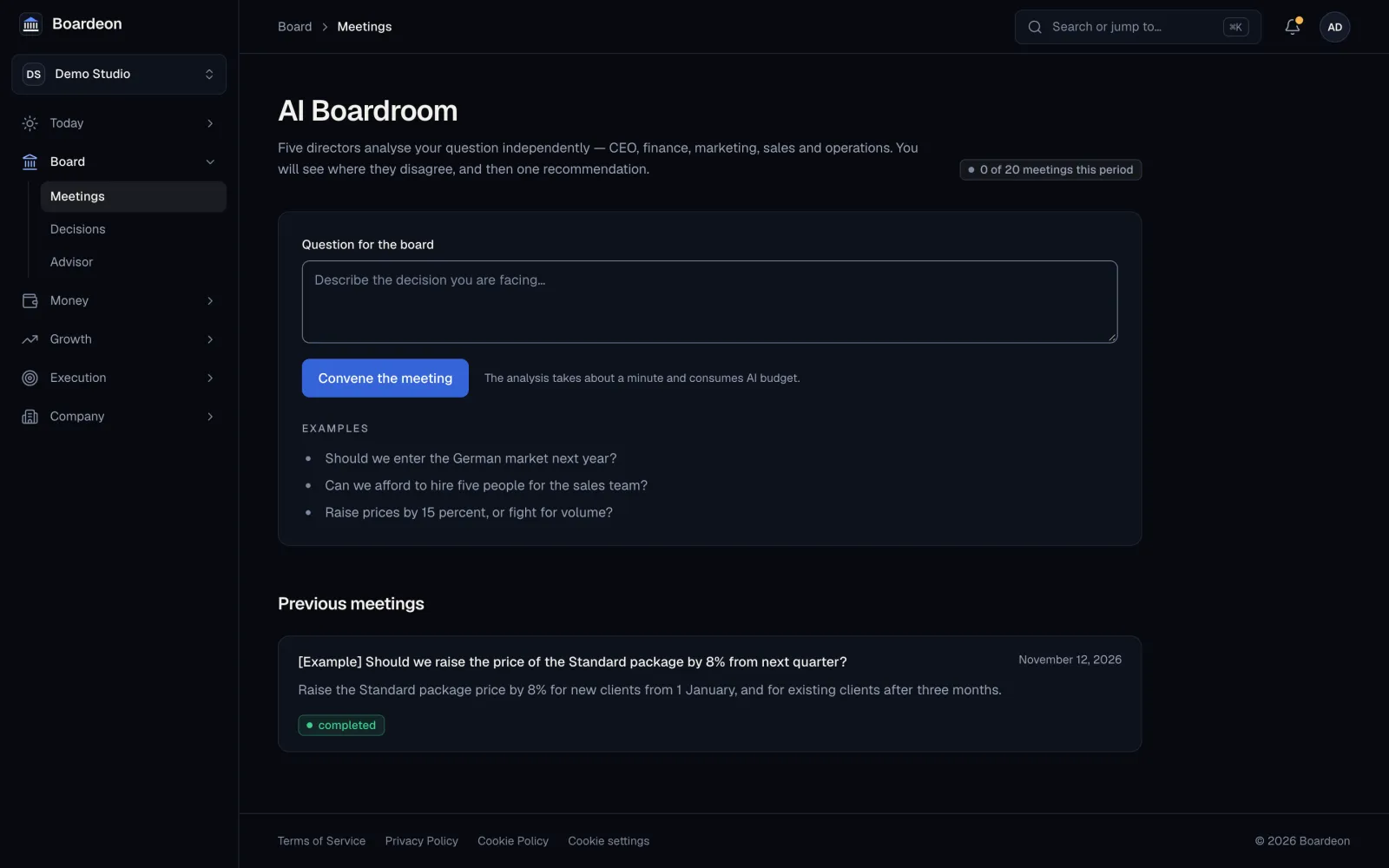
Open AI Boardroom (Board → Meetings) and describe the decision you are facing in a sentence or two. Boardeon suggests examples such as "Should we enter the German market next year?" or "Raise prices by 15 percent, or fight for volume?". The board works from Company Brain, so it analyses your company, not companies in general. A meeting takes about a minute and uses AI budget.
Step 2: Read the directors' independent positions
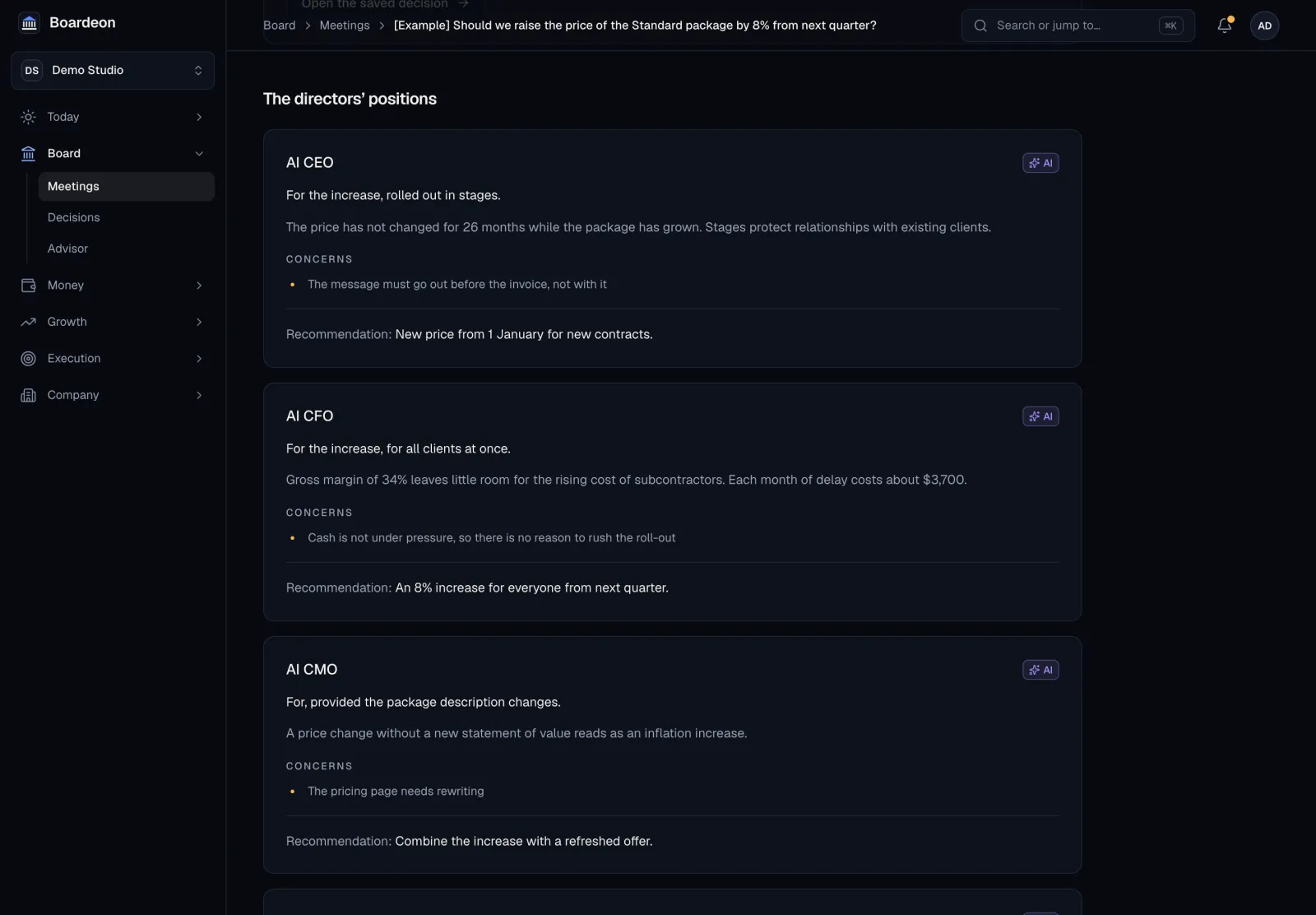
Five directors — CEO, CFO, CMO, CRO and COO — each analyse the question from their own discipline: strategy and priorities; cash, margin and risk; demand and positioning; pipeline and pricing; capacity and delivery. Each gives a position, the reasoning, concerns and a recommendation. Read them before the summary: the disagreements are where the decision really lies.
Step 3: Read the board's recommendation
Boardeon consolidates the views into one recommendation with the assumptions it rests on, the risks, the opportunities, the next steps and a confidence level. Where directors disagree, the synthesis says so and explains how the disagreement was resolved, instead of averaging it away.
Step 4: Save it as a decision to review
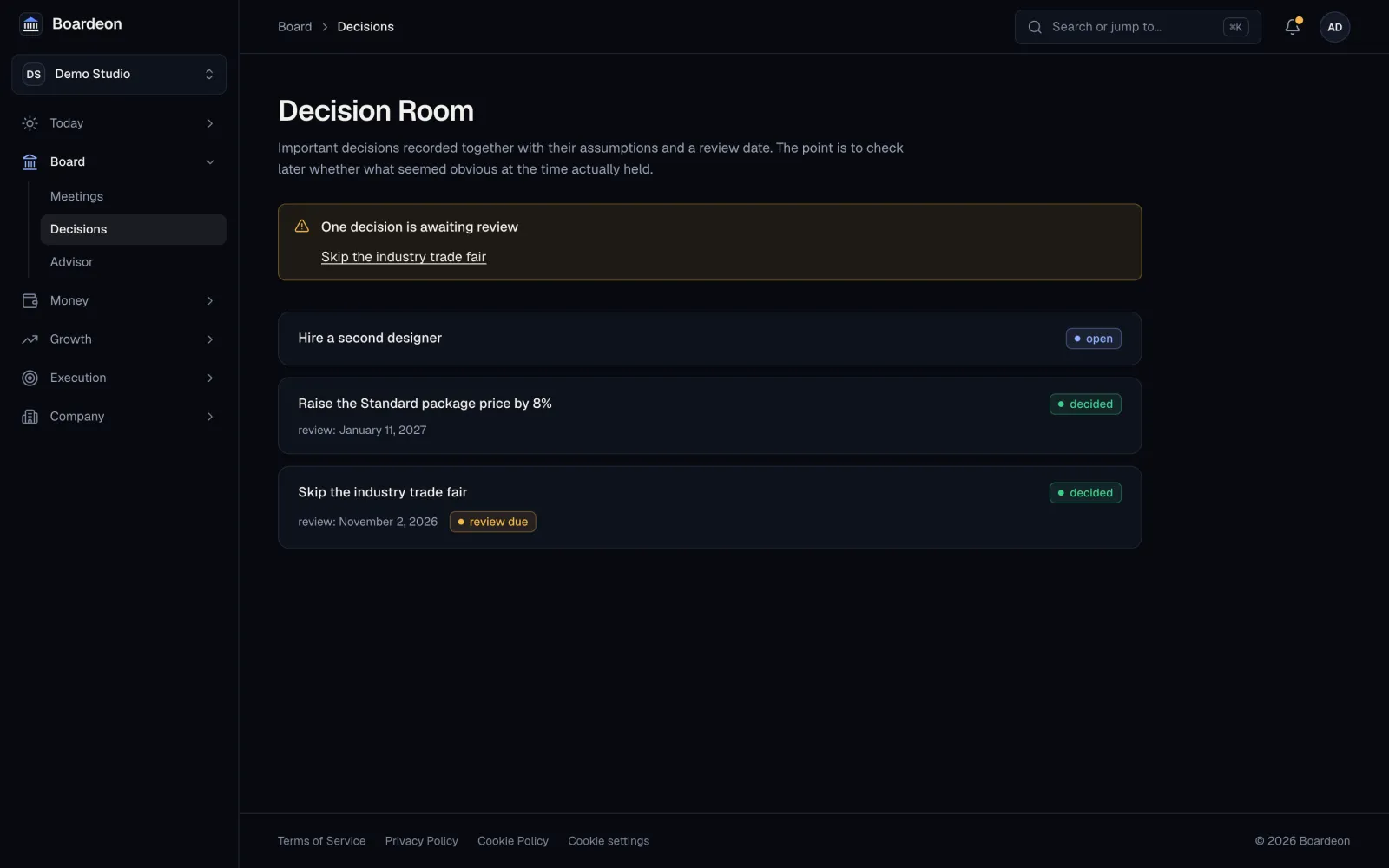
Click Save as a decision to review. In Decision Room, write what you actually decided — it can differ from the board's recommendation — and keep the question, the risks and the review date. Decisions have statuses (open, decided, deferred, reversed, reviewed), and the list shows which ones are waiting for review.
Step 5: Review the decision on its review date
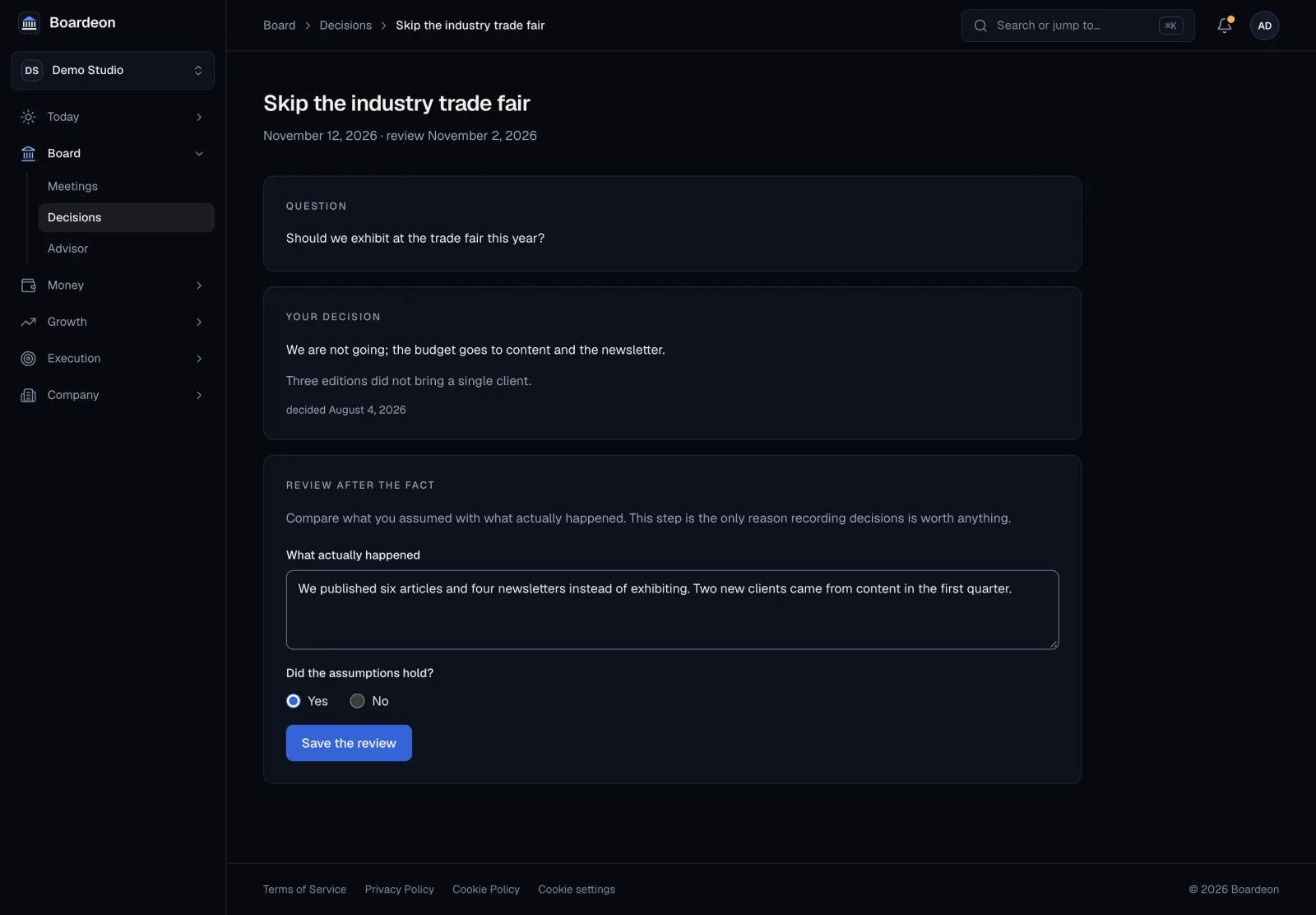
When the review date passes, Boardeon raises an alert, and the decision appears in the daily brief as the one thing for today. Open it, describe what actually happened and answer did the assumptions hold?
Step 6: Watch how accurate your assumptions are
Over time, Decision Room shows the share of reviewed decisions whose assumptions held. It is a blunt but honest measure of how well you and your team judge the future — and it gets better only if you keep reviewing.
AI Boardroom is available in both plans (2 meetings a month in Entrepreneur, 20 in Executive); Decision Room is part of the Executive plan. See pricing for details.
When is Boardeon not the right tool for a decision?
Do not use AI Boardroom — or any AI — as the sole basis for decisions about specific people. Boardeon's AI policy explicitly forbids taking decisions about hiring, dismissal, pay or the evaluation of individuals based solely on AI responses. Use it to think through a hiring plan; do not use it to choose between two candidates.
It is also not a substitute for professional advice in legal, tax and regulatory matters, or for a real board where one is required by law or by investors. The AI directors are roles played by a language model, clearly labelled as such; they work from your data and can still be wrong. Check any material information before you act on it.
Frequently asked questions
How do I make a difficult business decision on my own?
Write the question as one sentence, look at it separately from the perspectives of strategy, finance, marketing, sales and operations, imagine how it could fail, and decide with your assumptions written down. Set a review date. The structure compensates for not having a board to challenge you.
What is a decision journal?
A decision journal is a record of important decisions with the question, the context, what you decided, why, the assumptions it depends on, the expected upside and downside, a confidence level and a review date. Its purpose is to let you compare later what you assumed with what actually happened.
What is a pre-mortem?
A pre-mortem is a short exercise in which a team imagines that a decision has already failed and lists the reasons why. It surfaces risks that people hesitate to raise in a normal discussion. Gary Klein, who popularised it, cites research showing that this kind of prospective hindsight improves the identification of reasons for future outcomes by 30%.
How often should I review business decisions?
Set a review date when you make the decision: 60 to 90 days for most operational decisions, longer for strategic ones. Review on that date even if the outcome looks obvious; the point is to check the assumptions, not only the result.
Can AI make business decisions for me?
No — and it should not. AI can analyse a question from several perspectives quickly, surface risks and summarise the arguments, but the decision and the responsibility stay with you. In Boardeon, recommendations are proposals; the AI does not act on your behalf outside the app.
How is AI Boardroom different from asking ChatGPT?
A general chatbot does not know your company, and gives one voice. AI Boardroom works from your Company Brain data, runs five independent analyses from different disciplines, shows where they disagree, and produces a recommendation you can save as a decision with a review date in Decision Room.
Sources
- Iskandar Aminov, Aaron De Smet, Gregor Jost, David Mendelsohn, Decision making in the age of urgency, McKinsey, April 2019: mckinsey.com
- Gary Klein, Performing a Project Premortem, Harvard Business Review, September 2007: hbr.org
- Boardeon's rules for AI, including the ban on decisions about individuals based solely on AI: AI policy. Related guides: how to price products and services and the 90-day plan.
Hire an AI board for your company
Your AI board applies this to your company’s data and prepares decisions for you to approve. Every plan starts with a 3-day trial for your first company; the diagnosis takes about a quarter of an hour.
Keep reading
All guides →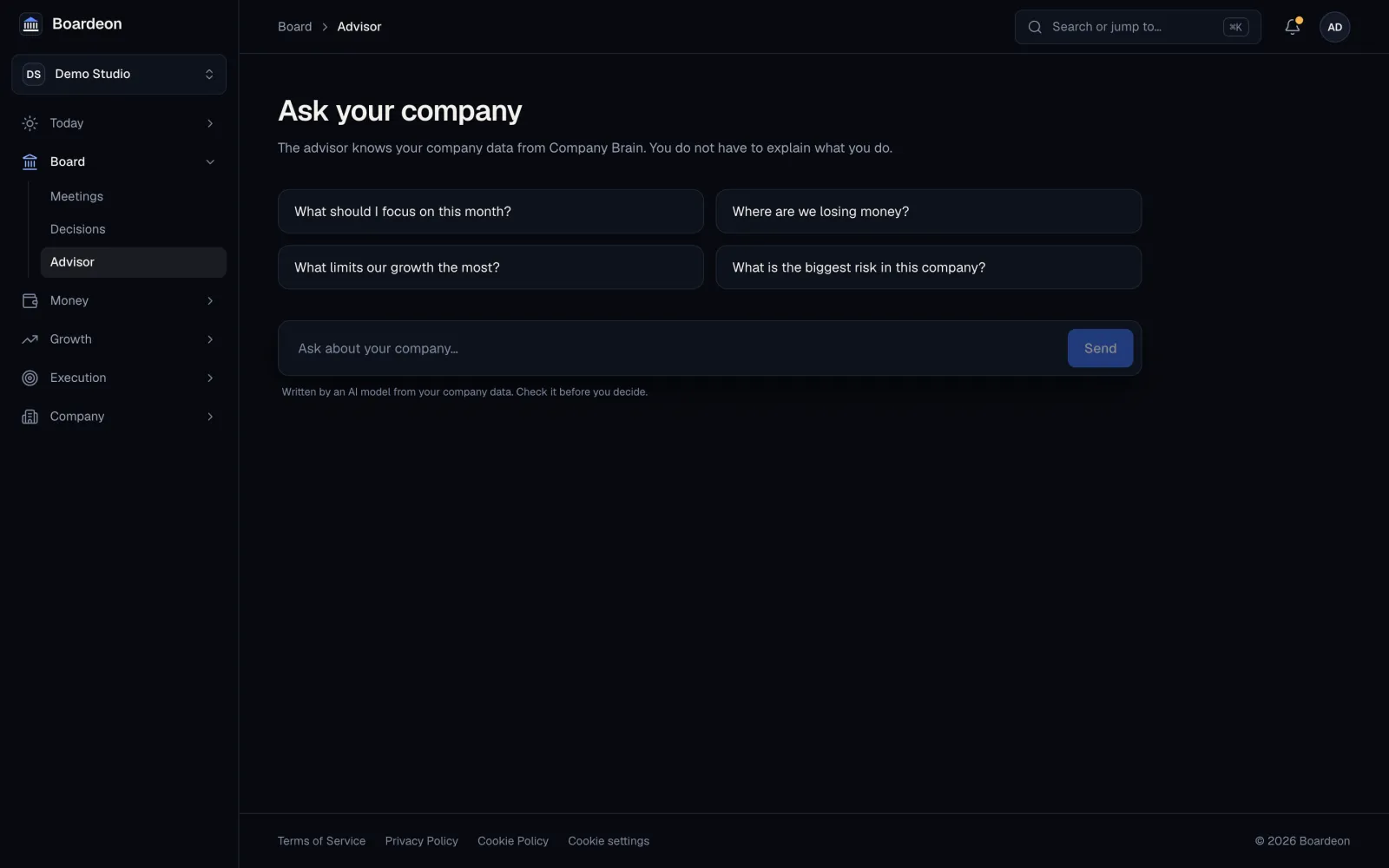
AI
Boardeon vs ChatGPT for running a company: when a general AI assistant is enough
ChatGPT is a general AI assistant; Boardeon is an AI board built on a model of your company. When each one is enough, where the numbers come from, and prices.
11 min read
Read the guideAI
Boardeon vs MyExecs.ai: two AI boards for small and mid-sized companies, compared
Boardeon and MyExecs.ai both give a company a board of AI executives. How they differ on finance, approvals, integrations, languages, data location and price.
12 min read
Read the guide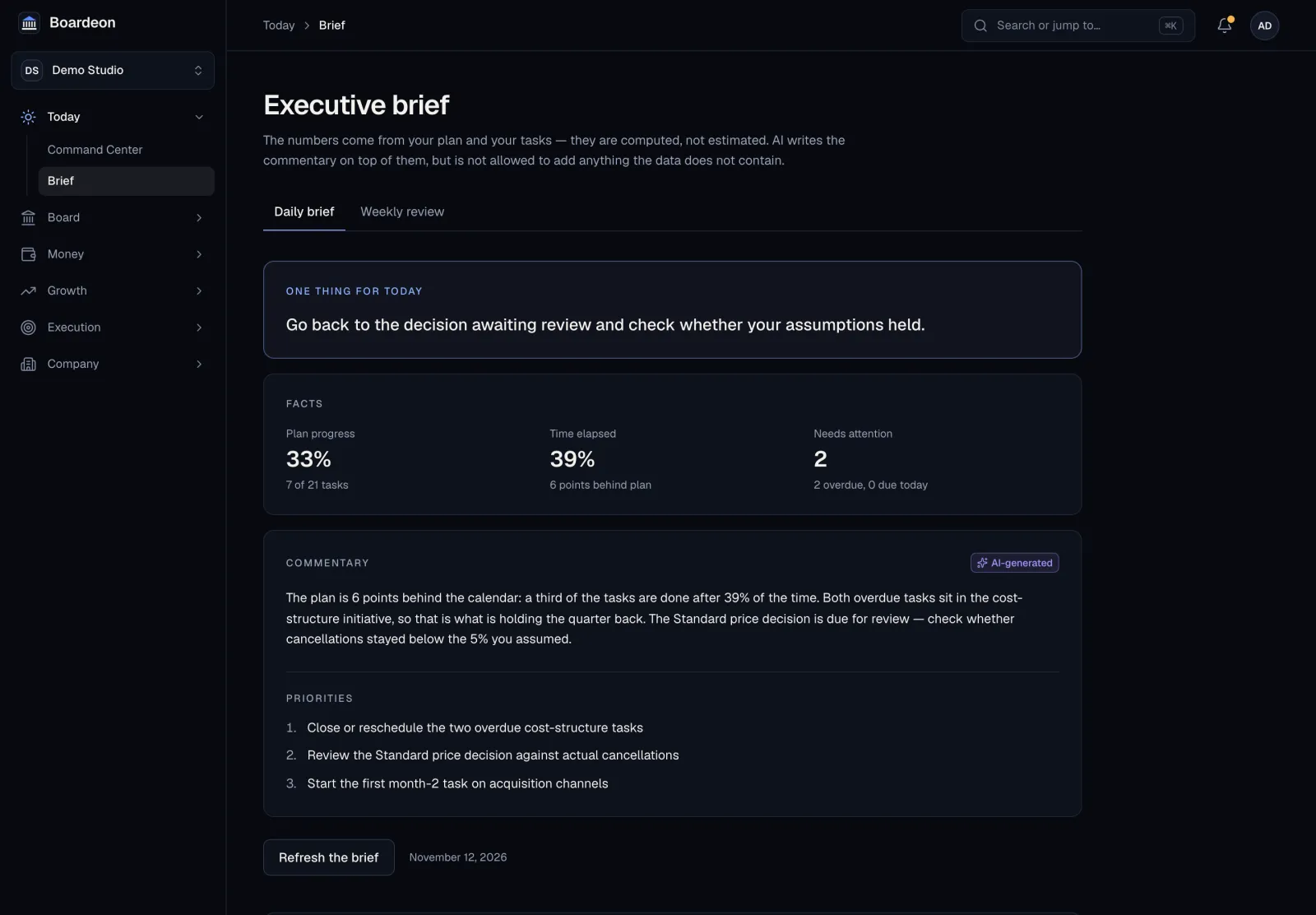
AI
Boardeon vs Hello Alice: a paid AI board with a model of your company, or a free AI advisory board?
Boardeon vs Hello Alice, compared honestly: advisors, health score, daily routine, financial calculations, approvals, integrations, data location and price.
13 min read
Read the guide