Boardeon vs ChatGPT for running a company: when a general AI assistant is enough
ChatGPT is a general AI assistant; Boardeon is an AI board built on a model of your company. When each one is enough, where the numbers come from, and prices.
- Published:
Key takeaways
- ChatGPT is a general-purpose AI assistant: it knows your company only from what you type, upload, keep in memory or projects, or connect to it.
- Boardeon is an AI board for one job — running your company: it builds a structured model of the company (Company Brain) and every analysis starts from it.
- In Boardeon, financial figures and the Business Score are calculated by tested, deterministic code; the language model explains them but never produces them.
- ChatGPT is enough for writing, research, brainstorming and one-off questions; a dedicated AI board pays off when you want a daily rhythm of numbers, a 90-day plan and decisions you approve.
- The two are not exclusive: through its MCP server, Boardeon can be used from ChatGPT and Claude, with every proposed change waiting for your approval.
Contents
ChatGPT is a general-purpose AI assistant that knows your company only from what you tell it; Boardeon is an AI board built for one job — running your company — that works from a structured model of your business, calculates its numbers with tested code and asks you to approve every action. If you need help writing, researching or thinking through a one-off question, ChatGPT is often enough. If you want a daily rhythm — a Business Score, a 90-day plan, a morning brief and five AI directors who prepare decisions — a dedicated AI board like Boardeon is the better fit.
This comparison explains how the two differ, where each one's numbers come from, who approves what, when ChatGPT is genuinely enough, what each costs and how to use them together. Facts about ChatGPT were checked on 15 November 2026 on OpenAI's pricing page; features and plans change, so check the current page before you decide.
What is the difference between Boardeon and ChatGPT?
The difference is scope and starting point: ChatGPT is built to help with almost anything, starting from an empty conversation, while Boardeon is built to answer one question — "What should I do next to improve my company?" — starting from a model of your company. Both use large language models; what surrounds the model is different.
ChatGPT is a general assistant from OpenAI. According to its pricing page, plans include memory (limited on Free, expanded on Plus and Pro), projects, file uploads, data analysis and apps. It does not come with a structured model of your company out of the box: the context comes from what you type, upload, keep in memory or projects, or connect.
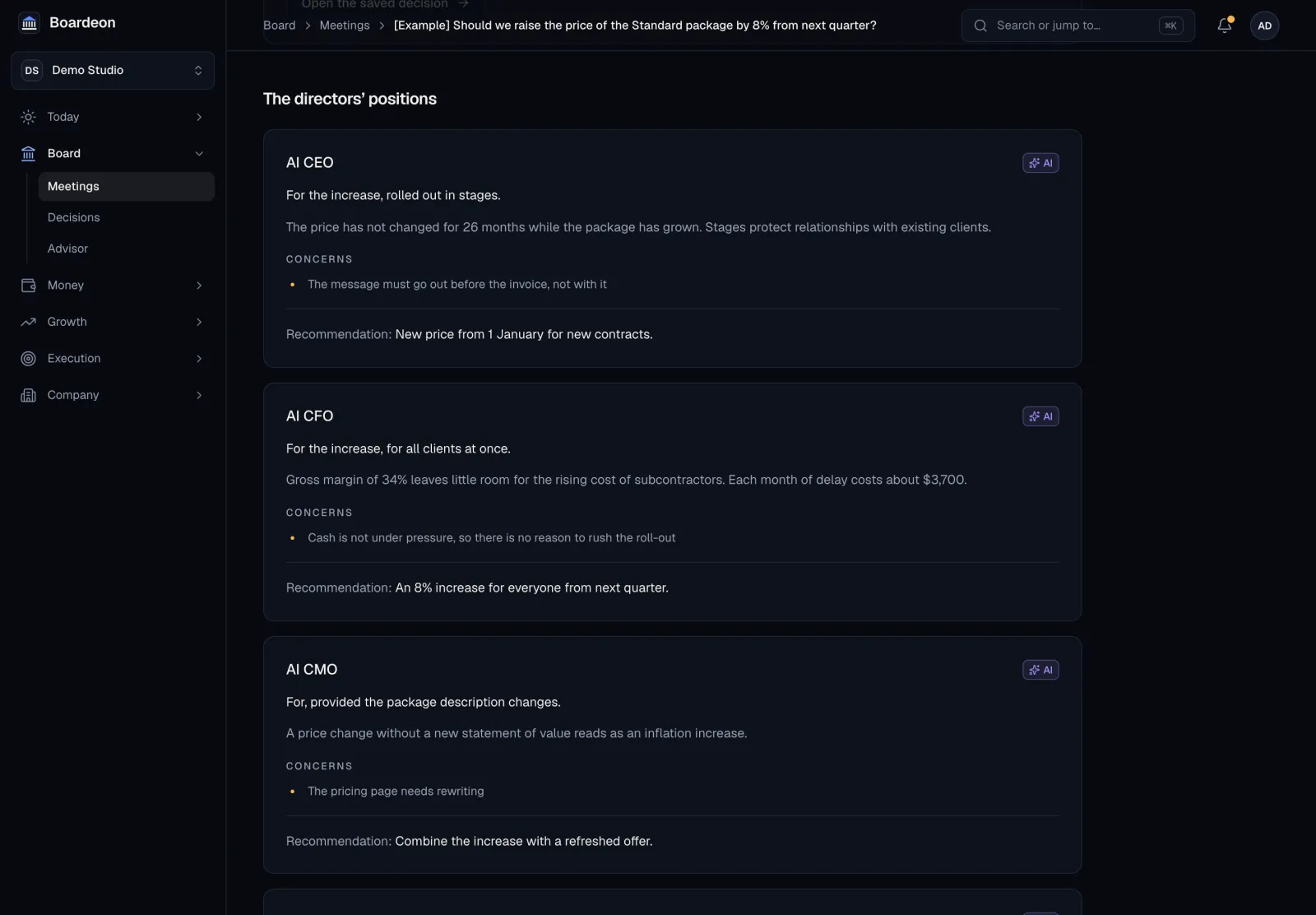
Boardeon starts with an eight-step diagnosis that builds Company Brain — revenue, costs, margins, customers, channels, team, goals and risks. Every module then works from that model: the Business Score rates eight areas, the 90-day plan turns the weakest areas into initiatives, the daily brief shows one priority each morning and AI Boardroom convenes five AI directors (CEO, CFO, CMO, CRO and COO) to analyse a decision. You never start by explaining what your company does.
How do Boardeon and ChatGPT compare, criterion by criterion?
On company context, the origin of the numbers, approvals and a built-in management rhythm, Boardeon is more specialised; on breadth of tasks, ChatGPT is far wider. The table summarises the differences that matter for running a company.
| Criterion | Boardeon | ChatGPT |
|---|---|---|
| Context about your company | Structured model of the company (Company Brain) built in an eight-step diagnosis; documents in Company Vault | What you type, upload, store in memory or projects, or connect |
| Where the numbers come from | Deterministic, tested code (Finance Center, Business Score, valuation); the model only explains | The model, or its data analysis tool when you ask for it |
| Who approves actions | You: every change proposed by the advisor or a connected agent waits in Approvals for an owner or admin | Depends on the features and apps you use — see OpenAI's documentation |
| Business Score, 90-day plan, daily brief | Built in, generated from your company data | Not built in; you can ask for a plan in a conversation |
| AI board of five directors | AI Boardroom: CEO, CFO, CMO, CRO and COO analyse independently, then one recommendation | Not built in; you can ask it to take different perspectives |
| Languages | Interface and analyses in English, Spanish and Polish | Many languages — see OpenAI's site |
| Data location | European Union (Ireland), isolation per organisation at the database level | Not covered in our check — see OpenAI's terms |
| Price | From $99 / PLN 399 a month (Entrepreneur), net; 3-day trial | See chatgpt.com/pricing |
ChatGPT facts checked on 15 November 2026 at chatgpt.com/pricing.
Where do the numbers come from in Boardeon and in ChatGPT?
In Boardeon, margins, runway, break-even, customer economics, the Business Score and valuation multiples are calculated by tested, deterministic code; in ChatGPT, numbers come from the model or, when you ask for it, from its data analysis tool working on the files you provide. That difference matters most when you base decisions on the figures.
A language model predicts likely text. It can explain what a 34% gross margin means for a nine-person agency very well, but it should not be the source of the 34%. ChatGPT's data analysis feature reduces that risk because it runs calculations on your file — but you still choose the file, the formula and the definition of each metric, every time, in every conversation.
Boardeon separates the two jobs by design. Finance Center, Business Simulator and Company Valuation calculate from your data with code that gives the same result for the same input. The advisor, the brief and AI Boardroom read those results and comment on them. When data is missing, Boardeon says so and lowers the confidence level instead of guessing. The guide on using AI safely in your company explains why this split matters for any AI tool you choose.
Who decides and who approves actions?
In Boardeon, you decide and you approve: the AI board analyses, recommends and prepares actions, but nothing changes until an owner or admin approves it. In ChatGPT, what happens after an answer depends on which features and connected apps you use, so check OpenAI's documentation for your plan.
Boardeon has a dedicated Approvals screen. Every change the advisor or a connected AI agent proposes — a task, an entry in company memory, an action in a connected tool such as HubSpot, Linear or Notion — waits there until an owner or admin approves or rejects it. Members and viewers cannot approve. Boardeon is not a corporate body of your company and does not take over the legal responsibility of its owners or directors; it helps you exercise that responsibility well.
Decision Room, on the Founder and Multi-Founder plans, adds a record of what you decided, on what assumptions and when you will review it. That is the habit described in the guide on making hard business decisions: independent views first, a written decision, then a review against what actually happened.
When is ChatGPT enough, and Boardeon not the right tool?
ChatGPT is enough when your needs are broad, occasional or creative rather than an ongoing management rhythm built on your company's numbers. Be honest with yourself about which one you are actually missing.
ChatGPT is usually the better or sufficient choice when:
- You mainly write. E-mails, offers, job ads, website copy, social posts and translations are general tasks, and a general assistant handles them well.
- You research and learn. Explaining a tax concept, summarising an article, comparing software categories or preparing for a meeting do not need a model of your company.
- You have one-off questions. If you think about strategy a few times a year, a conversation with a file attached may be all you need.
- You want images, code or other media. Boardeon is not a general writing, image or coding tool.
- Your company is at the idea stage. Without revenue, costs and customers, there is little for a Business Score or a cash runway to measure.
- You need decisions about specific people. Neither tool should be the sole basis for hiring, dismissal or pay decisions — and Boardeon's rules prohibit that use.
Boardeon is also not a replacement for an accountant, a lawyer or a tax adviser, and it is not a bookkeeping system. It works from the numbers you give it and from the tools you connect.
When is a dedicated AI board like Boardeon the better choice?
Boardeon is the better choice when you run an operating company and want the same context, the same numbers and the same priorities to carry over from one day to the next. The value comes from continuity, not from a single clever answer.
Signs that a dedicated AI board fits:
- You keep re-explaining your company. Boardeon's advisor already knows it from Company Brain.
- You need figures you can rely on. Calculations are done by code, and every Business Score area shows its reasoning and a confidence level.
- Plans do not survive the week. The 90-day plan is built from your weakest areas, and the daily brief and weekly review compare progress with time elapsed. The guide to the 90-day business plan explains the method.
- You have no board to challenge you. AI Boardroom gives five independent views and shows where the directors disagree before it consolidates one recommendation.
- Several people need the same picture. One organisation has several members with roles — owner, admin, member and viewer.
- You work in Spanish or Polish. Analyses are written directly in your language, with local number and currency formats.
Can you use Boardeon and ChatGPT together?
Yes: Boardeon runs a company MCP server, so ChatGPT, Claude and other AI agents can connect to your company in Boardeon, read its data and propose changes that wait for your approval. You do not have to choose one tool and abandon the other.
The connection uses the Model Context Protocol. A member of the company signs in to Boardeon and approves the connection (OAuth 2.1) or creates a personal access token, and chooses which companies and permissions the app gets. From then on, you can ask ChatGPT about your plan, your Business Score or last week's decisions without pasting anything — and any change it proposes lands in Boardeon's Approvals screen.
The number of connected apps depends on the plan: Entrepreneur includes 2 connected apps, while Founder and Multi-Founder have no limit on connected apps. Settings → AI agents shows which apps are connected and the last tool calls, and lets you disconnect any of them at any time.
How much do Boardeon and ChatGPT cost?
Boardeon costs $99 (PLN 399) a month on Entrepreneur, $199 (PLN 799) on Founder and $399 (PLN 1,599) on Multi-Founder; prices are net, and applicable taxes are added at checkout. For ChatGPT prices, see chatgpt.com/pricing — OpenAI lists Free, Go, Plus and Pro plans for individuals, and Business (from two users) and Enterprise for organisations.
| Boardeon plan | Monthly (net) | What it adds |
|---|---|---|
| Entrepreneur | $99 / PLN 399 | Company Brain, Business Score, 90-day plan, daily brief, AI Advisor, 2 AI Boardroom meetings a month, 2 connected apps |
| Founder | $199 / PLN 799 | 20 meetings a month, Decision Room and valuation, daily brief on Telegram, up to 10 users, no limit on connected apps |
| Multi-Founder | $399 / PLN 1,599 | 60 meetings a month, up to 25 users, every additional company at 50% off |
Yearly billing gives two months free. Every plan starts with a 3-day trial for your first company; a card is required and you can cancel any time before the trial ends. Full details are in pricing.
Comparing the two on price alone misses the point: they do different jobs. Many owners will keep a general assistant for writing and use Boardeon for the management rhythm — and connect the two.
How to test Boardeon next to ChatGPT, step by step
The fairest test is to ask both tools the same management question about your real company and compare where the answers come from. The screenshots show a fictional demo company.
Step 1: Write down three real questions
Pick three questions you actually face this quarter — for example "Where are we losing money?", "Should we raise prices?" and "What should I focus on this month?". Ask them in ChatGPT first, the way you usually would, and note how much context you had to provide.
Step 2: Run the diagnosis in Company Brain
Create an account and complete the eight-step diagnosis. It takes about a quarter of an hour and builds Company Brain; saving the last step calculates your Business Score. Leave a field empty when you do not know a value — empty means missing data, which lowers confidence rather than the score. The guide on assessing the health of your business explains how the score is built.
Step 3: Ask the advisor the same questions
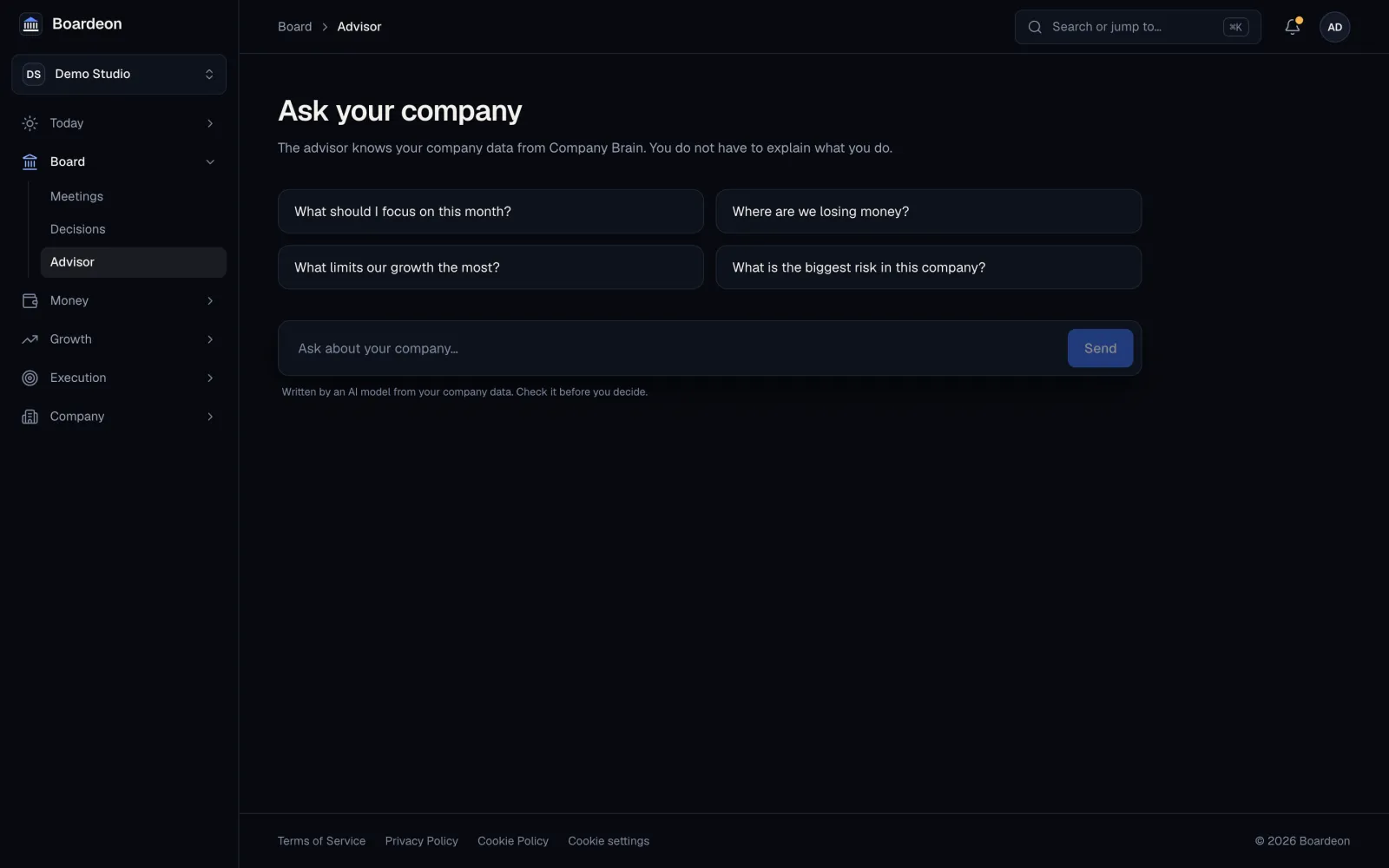
Open Board → Advisor and ask the same three questions without explaining your company. Compare the answers with ChatGPT's: which figures were calculated, which were assumed and which data each answer relied on.
Step 4: Put one decision to AI Boardroom
Open Board → Meetings, describe one real decision and convene the meeting. Read the five positions, the disagreements and the consolidated recommendation, then record what you decide — in Decision Room with a review date if your plan includes it.
Step 5: Read the daily brief for a few mornings
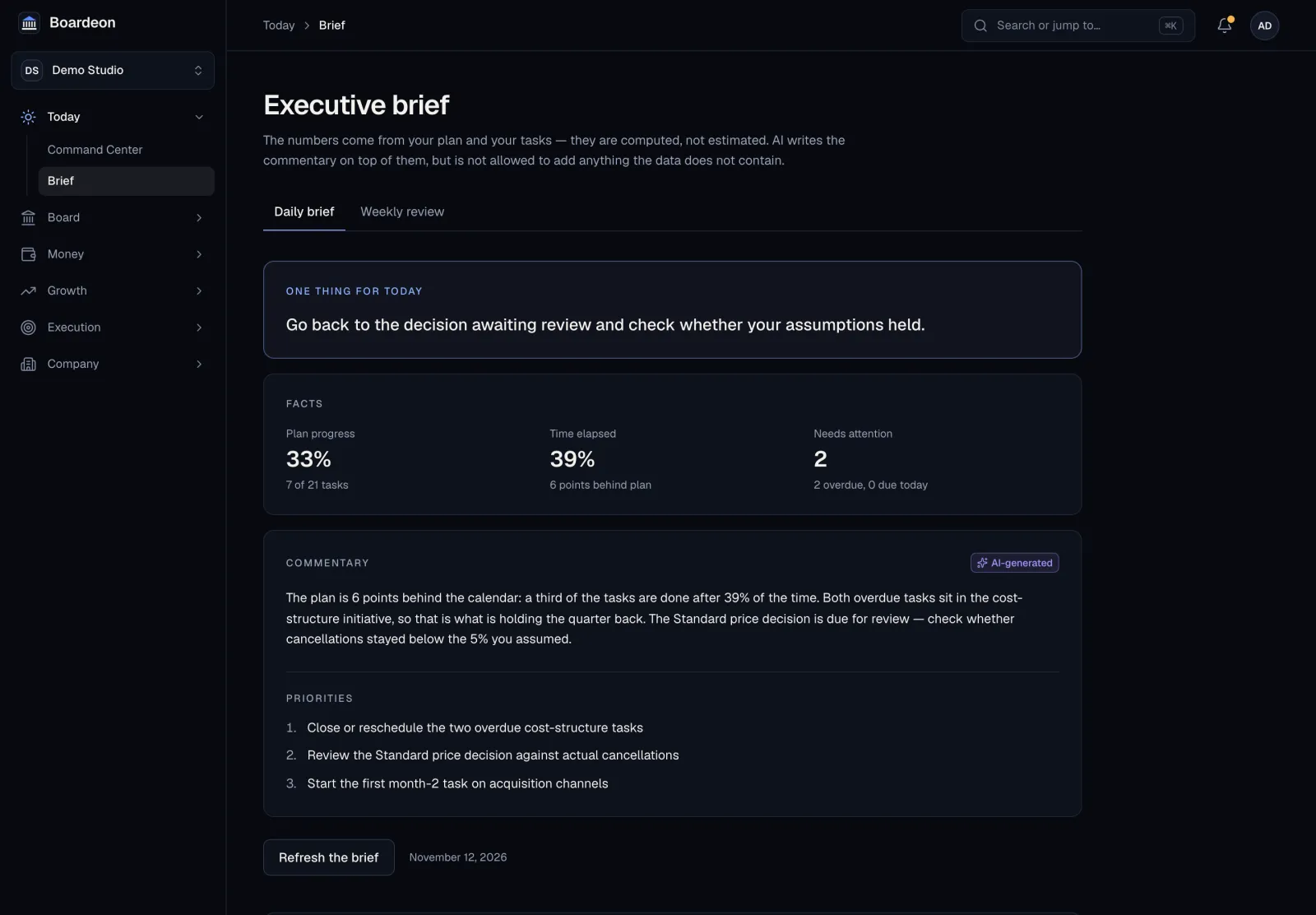
Build the 90-day plan and open Today → Brief for the next few mornings. The facts in the brief — plan progress, time elapsed and items needing attention — come from your plan and tasks; the AI-generated commentary may not add anything they do not contain.
Step 6: Connect ChatGPT to Boardeon
In Boardeon, open Settings → AI agents and copy the company MCP server address. In ChatGPT, open Settings → Apps → Advanced settings, turn on developer mode, create an app called Boardeon with that address and OAuth authentication, sign in and choose the company. Ask ChatGPT about your plan — and check that any change it suggests waits in Boardeon's Approvals screen.
Frequently asked questions
Is Boardeon built on ChatGPT?
Boardeon is a separate product with its own model of your company, its own calculations and its own approval workflow. It uses language models through model providers to write analyses and explanations, and the providers it uses do not train on data sent via the API. You can also connect your own OpenRouter key.
Can ChatGPT run my business?
No AI tool should run your business for you. ChatGPT can help you think, write and analyse files you give it. Boardeon prepares decisions from a model of your company, but you make the decisions and approve every action — the responsibility stays with the owners and directors.
Do I need both Boardeon and ChatGPT?
Not necessarily. If you mainly need writing and research, ChatGPT may be enough. If you want a management rhythm built on your company's numbers, Boardeon covers that on its own. Many owners use both and connect ChatGPT to Boardeon through the MCP server.
Is my company data safer in Boardeon than in ChatGPT?
We cannot assess OpenAI's data handling for you — check OpenAI's terms for your plan. Boardeon hosts data in the European Union (Ireland), isolates every organisation at the database level, does not train models on your data and sends a model only the fragments needed for a request.
Which languages does Boardeon support?
The whole Boardeon interface works in English, Spanish and Polish. AI analyses are written directly in your language, and numbers and currencies follow your local format.
Sources
- OpenAI, ChatGPT plans and features (Free, Go, Plus, Pro, Business, Enterprise), checked 15 November 2026: chatgpt.com/pricing
- Boardeon plans, modules and the AI agents (MCP) documentation: pricing, platform, for AI agents, security
- Related guides: using AI safely in your company, making hard business decisions
Hire an AI board for your company
Your AI board applies this to your company’s data and prepares decisions for you to approve. Every plan starts with a 3-day trial for your first company; the diagnosis takes about a quarter of an hour.
Keep reading
All guides →AI
Boardeon vs MyExecs.ai: two AI boards for small and mid-sized companies, compared
Boardeon and MyExecs.ai both give a company a board of AI executives. How they differ on finance, approvals, integrations, languages, data location and price.
12 min read
Read the guideAI
Boardeon vs Hello Alice: a paid AI board with a model of your company, or a free AI advisory board?
Boardeon vs Hello Alice, compared honestly: advisors, health score, daily routine, financial calculations, approvals, integrations, data location and price.
13 min read
Read the guide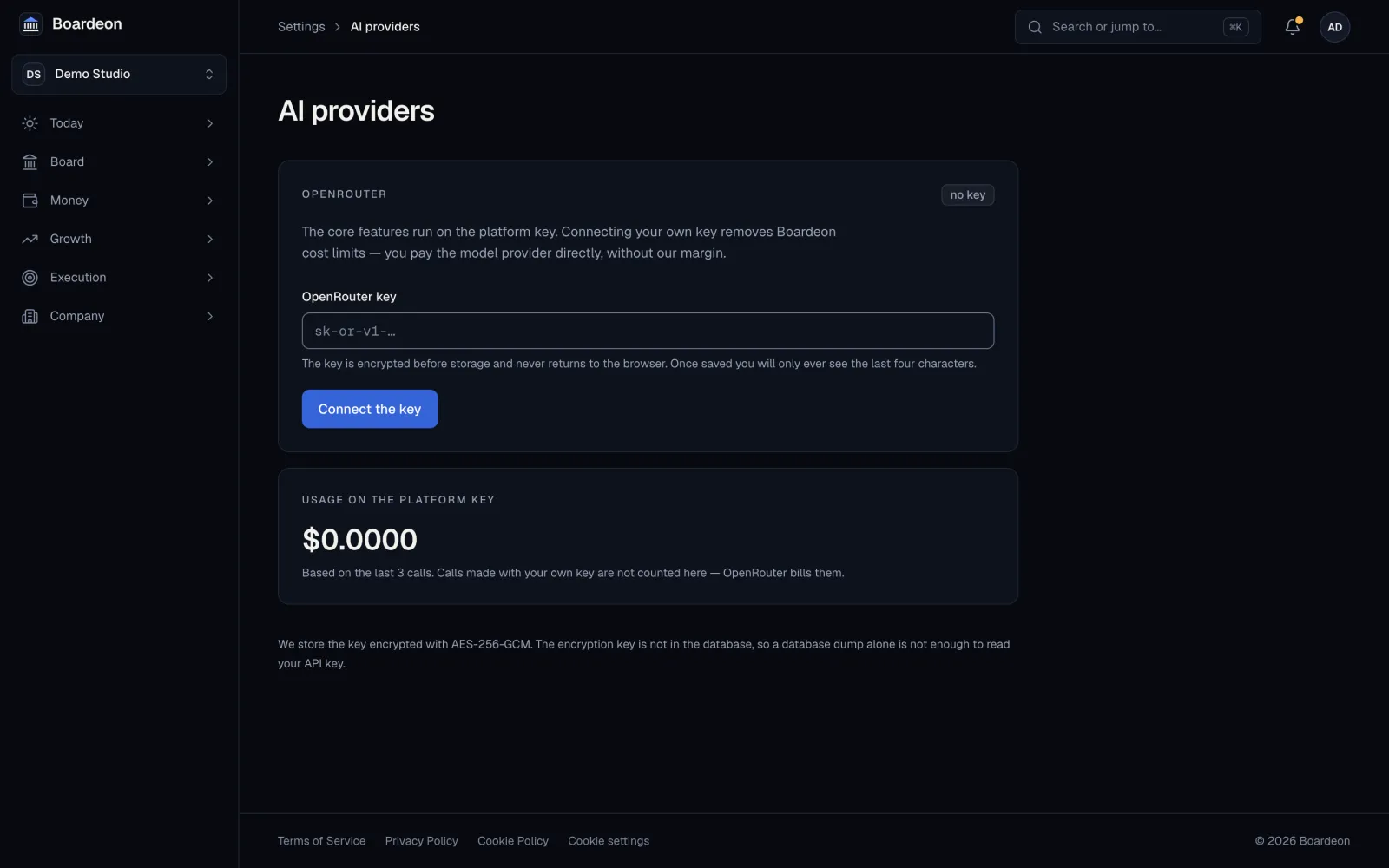
AI
How to use AI safely in your company: data, numbers and decisions
Which data never goes into a public chatbot, why AI must not calculate your numbers, what the EU AI Act requires and how to write a one-page AI policy.
10 min read
Read the guide