The 90-day business plan: why a quarter beats a year for small companies
How to build a 90-day plan from a business diagnosis: what it should contain, how many initiatives fit, how to track progress weekly and what to do when it falls behind.
- Published:
Key takeaways
- A 90-day plan turns a diagnosis into a few initiatives with owners, tasks, deadlines and a metric each — and it is rebuilt every quarter.
- A quarter is long enough to change something real and short enough that the plan still matches the company when you reach the end.
- Limit the plan to the weakest areas and to about three initiatives a month: a plan with fifteen items does not get done.
- Track two numbers every week — the share of tasks done and the share of time elapsed. When the first falls behind the second, drop work, do not stretch it.
- In Boardeon the 90-day plan is built from your Business Score, split into foundation, optimisation and scaling months, and followed up by a daily brief and a weekly review.
Contents
A 90-day business plan is a short list of initiatives — each with an owner, tasks, deadlines and one metric — that turns what you know about your company into what you will do this quarter. For small and mid-sized companies it works better than an annual plan for a simple reason: in twelve months your market, your team and your cash will change, while ninety days is long enough to change something real and short enough that the plan still describes the company you actually run.
This guide explains what a good 90-day plan contains, how to choose what goes into it, how to structure the three months, how to write initiatives that get done, how to track progress week by week, what to do when it falls behind, and how to build and run the whole cycle in Boardeon.
Why does a 90-day plan work better than an annual plan?
Because a quarter matches the speed at which a small company changes and the attention span of a small team. An annual plan written in December is usually out of date by March: a large client leaves, a key person resigns, a price change works better than expected. By then the plan is either ignored or followed blindly.
A 90-day horizon has three practical advantages:
- Accuracy. You can forecast your cash, capacity and pipeline for one quarter with reasonable confidence; for four quarters you are guessing.
- Urgency. A deadline 90 days away creates pressure from the first week. A deadline twelve months away creates pressure in November.
- Learning. Four plans a year mean four reviews: four chances to see what worked and adjust, instead of one post-mortem at year end.
None of this means abandoning a long-term direction. Keep a one-page view of where the company is going in three years — the market, the positioning, the size you want to be. The 90-day plan is the next step on that road, not a replacement for it.
What should a 90-day plan contain?
A good 90-day plan fits on one page: a handful of initiatives, each with a goal, a metric, an owner, a few tasks with dates, and a weekly rhythm to follow it up.
| Element | What it is | Example |
|---|---|---|
| Starting point | The diagnosis the plan is built from | Business Score 62/100; five of eight areas below 60 |
| Initiatives | 3 to 9 pieces of work, each solving one problem | Put the cost structure in order |
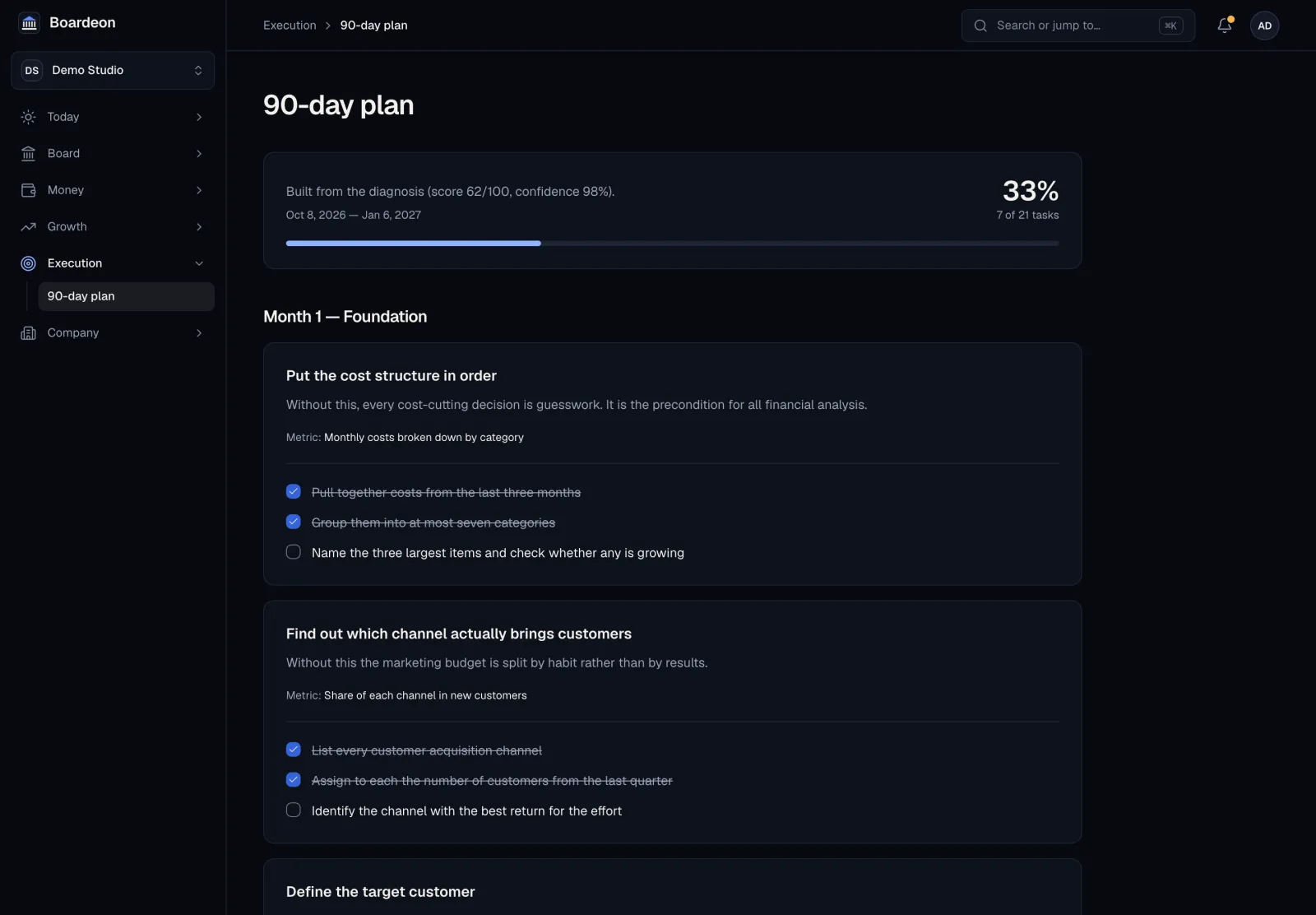
| Why | One sentence explaining what changes if it is done | Without this, every cost-cutting decision is guesswork |
| Metric | How you will know it worked | Monthly costs broken down by category |
| Tasks | Concrete steps of a few days each | Pull together costs from the last three months |
| Owner and date | One person and one deadline per task | Anna, 15 October |
| Rhythm | When progress is checked | Daily one-thing; weekly review on Monday |
What it should not contain is just as important: no long lists of "nice to have" projects, no goals without a metric, no tasks without an owner. If something is important but not urgent, write it on a separate list for the next quarter.
How do you choose what goes into the plan?
Start from the weakest areas of an honest business diagnosis, not from the projects you find most interesting. A plan built from enthusiasm tends to contain a new website, a rebrand and a product launch; a plan built from a diagnosis tends to contain pricing, cost structure and the sales process — less exciting, more profitable.
A practical selection method:
- Score the company area by area — strategy, growth, finance, marketing, sales, operations, digital maturity, AI readiness. The business health check guide explains how.
- Pick the areas below your threshold. Ignore areas that are already healthy, however tempting the improvements there.
- For each weak area, choose one or two initiatives that address the cause, not the symptom. Low margin is a symptom; pricing below value or uncontrolled delivery costs are causes.
- Order them by dependency. Foundations first: you cannot optimise a sales channel before you know which channel brings customers.
- Cap the total. About three initiatives a month is the most a small team can run alongside its normal work.
Research on goal setting supports the second half of this: in a review of decades of studies, Edwin Locke and Gary Latham found that specific, challenging goals lead to higher performance than vague instructions to "do your best" (Locke and Latham, American Psychologist, 2002). A metric for every initiative is what makes it specific.
How should the 90 days be structured?
Split the quarter into three months with a clear purpose each: foundation, optimisation and scaling. The order matters because each month builds on the previous one.
- Month 1 — Foundation. Put the facts in order: cost structure, the real sources of customers, a description of the target customer, a documented offer. These are the initiatives without which later decisions are guesswork.
- Month 2 — Optimisation. Use those facts: reprice the weakest offers, cut the costs that do not support delivery, focus the marketing budget on the channel that actually works.
- Month 3 — Scaling. Do more of what works: a second sales channel, a standardised process that frees the owner's time, an automation of repetitive work.
Not every quarter needs all three. If the diagnosis shows only one weak area, a plan with three initiatives spread over three months is a perfectly good plan.
How do you write initiatives and tasks that actually get done?
Write each initiative as an outcome with a metric, and break it into tasks small enough to finish in a few days by one named person. Big, vague tasks are where plans go to die.
Compare:
| Weak | Strong |
|---|---|
| Improve marketing | Find out which channel actually brings customers — metric: share of each channel in new customers |
| Work on costs | Put the cost structure in order — metric: monthly costs broken down into at most seven categories |
| Grow sales | Define the target customer — metric: a written description used by sales and marketing |
For tasks, three rules are enough: a verb at the start ("List every customer acquisition channel"), one owner, and a due date inside the month the initiative belongs to. If a task cannot be finished within two weeks, it is an initiative in disguise — split it.
How do you track progress week by week?
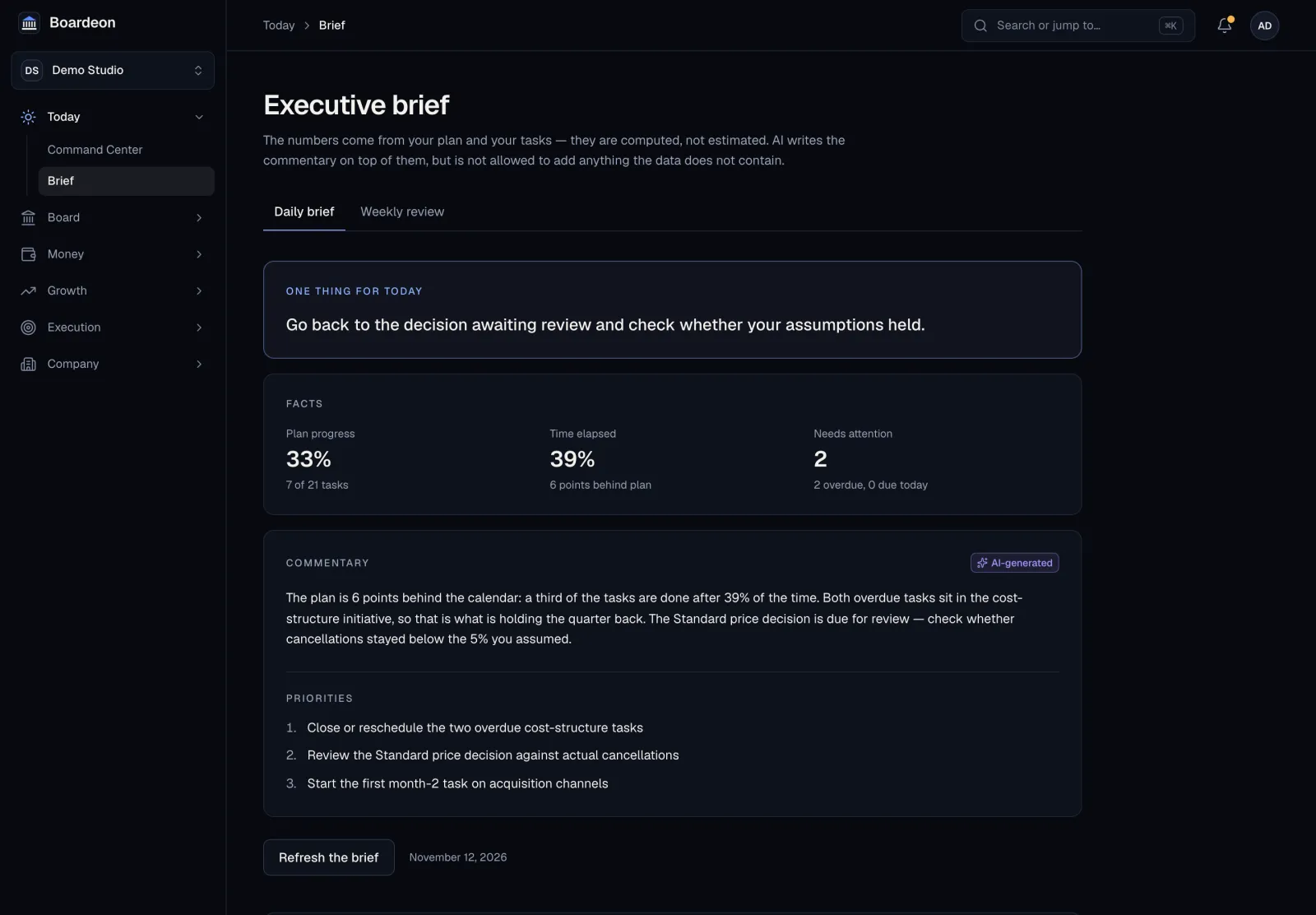
Compare two percentages every week: the share of tasks done and the share of the quarter that has passed. If 39% of the time has passed and 33% of the tasks are done, you are six points behind — early enough to fix it, late enough to take seriously.
Three rhythms keep a plan alive:
- Daily — one thing. Each morning, decide the single most important task for the day. Overdue tasks and decisions waiting for review come first.
- Weekly — the review. Every Monday, 30 minutes: what changed, what worked, what did not, three priorities for the week, decisions that need to be made.
- Monthly — the gate. At the end of each month, check whether the month's initiatives reached their metric before starting the next month's work.
What should you do when the plan falls behind?
Drop work, do not stretch the plan. When progress falls behind the calendar, the instinct is to keep every initiative and push the dates. The result is a plan that is late everywhere instead of done somewhere.
Do this instead:
- Sort out overdue tasks first. Close them, move them, or delete the ones that no longer make sense — before any new work starts.
- Cut the lowest-impact initiative of the quarter. Write it on the list for the next plan.
- Look for the blocker. A plan that falls behind across the board usually has one cause: a missing decision, an overloaded person, or a task nobody owns.
- Check whether the plan still matches the company. If something structural changed — a large client lost, a key hire — rebuilding the plan is better than following an outdated one.
How to build and run a 90-day plan in Boardeon, step by step
Boardeon builds the plan from your diagnosis with a deterministic playbook, so two companies with the same weaknesses get the same skeleton; AI can tailor the descriptions to your company's documents, but never decides what goes in. The screenshots show a fictional demo company.
Step 1: Finish the diagnosis in Company Brain
The plan is built from your Business Score, so it needs the eight-step diagnosis in Company Brain first. Without it, Boardeon tells you so instead of producing a plan of generalities.
Step 2: Build the 90-day plan
Open 90-day plan (Execution) and click Build the 90-day plan. Boardeon picks initiatives for the weakest-scoring areas and spreads them over three months — foundation, optimisation, scaling — with at most three initiatives a month. Each initiative comes with a reason, a metric and a checklist of tasks with due dates.
Step 3: Work through the tasks and mark them done
Tick tasks as you finish them. Progress on the plan screen, the Command Center and the brief updates at once. If you change Company Brain later and the plan no longer fits, use Rebuild the plan: the current plan is archived together with its progress, not deleted.
Step 4: Start each day with the brief
The daily brief is generated every morning from the plan and your tasks. It compares plan progress with time elapsed, lists overdue tasks and decisions to make, and gives you one thing for today — for example, closing the overdue tasks before anything else. AI writes the commentary on top of these numbers, but may not add anything the data does not contain.
Step 5: Review the week every Monday
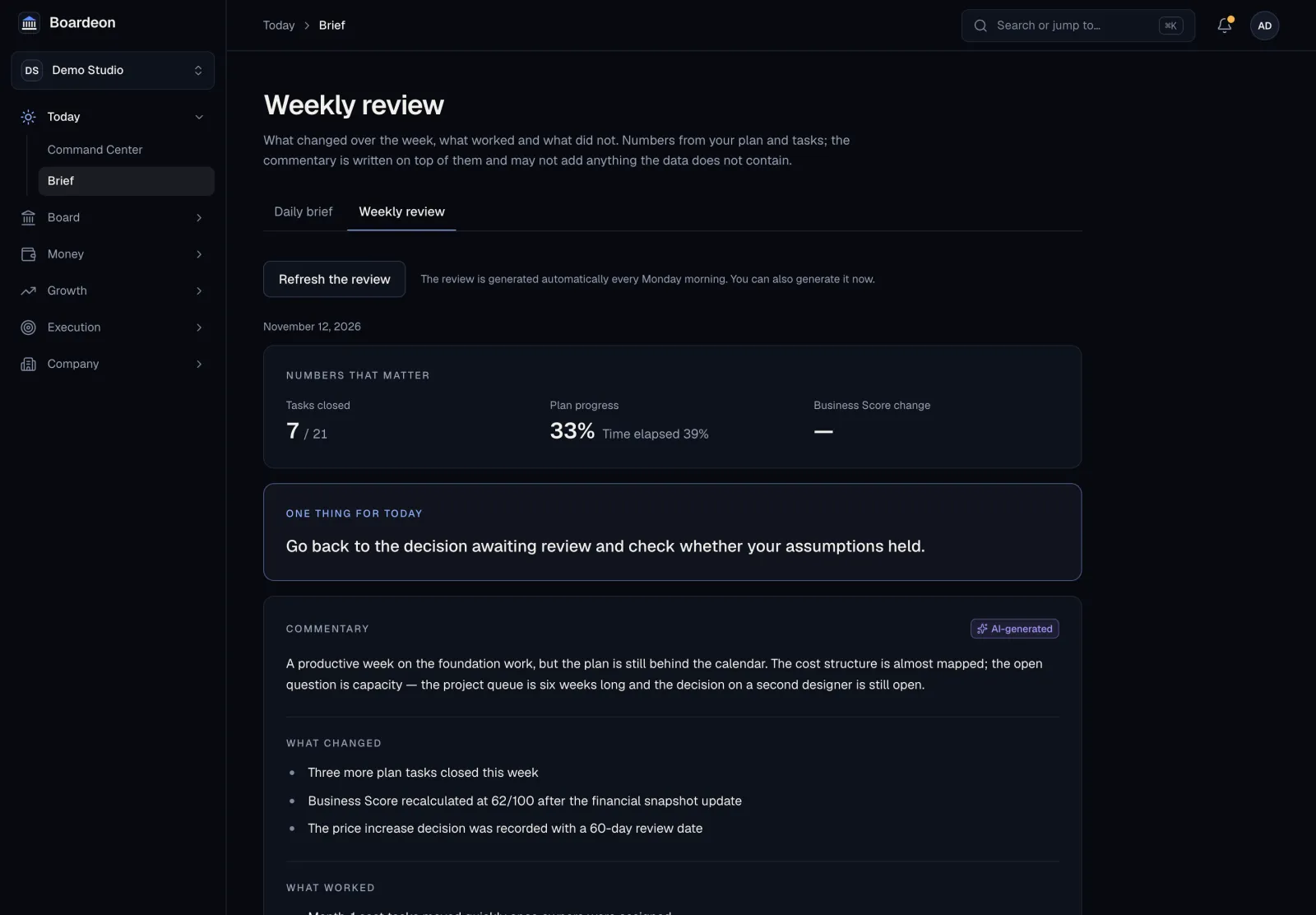
The weekly review is generated automatically every Monday morning, and you can generate it at any time. It shows tasks closed, plan progress, time elapsed and the change in Business Score, followed by what changed, what worked, what did not, risks, opportunities, three priorities for the coming week and the decisions required. You can receive the brief and the review by e-mail, or on Telegram in the Executive plan.
Step 6: Close the quarter and rebuild
At the end of the 90 days, update Company Brain with what changed — margins, team, channels — and rebuild the plan. Boardeon recalculates your Business Score and builds the next quarter from the new weakest areas. Alerts tell you along the way when the plan falls behind the calendar or tasks pass their deadline.
When is Boardeon not the right tool for planning?
If you need a project-management tool — dependencies between tasks, Gantt charts, time tracking, resource allocation across dozens of people — use one. Boardeon's 90-day plan is the management layer: what the company works on this quarter and why. It does not replace the tools your team uses to deliver client projects.
It is also not designed for detailed annual budgeting or for plans required by a bank or an investor in a specific format. For those, your accountant's templates and a spreadsheet will serve you better; the 90-day plan can still be how you execute them.
Frequently asked questions
What is a 90-day business plan?
A 90-day business plan is a short plan for one quarter that lists a few initiatives — each with a goal, a metric, an owner, tasks and deadlines — chosen from the company's weakest areas. It is reviewed every week and rebuilt at the end of each quarter.
Why is a 90-day plan better than an annual plan for a small business?
Small companies change too quickly for a twelve-month plan to stay accurate. Ninety days is long enough to finish meaningful work and short enough to forecast cash and capacity with confidence, and it gives you four chances a year to learn and adjust instead of one.
How many initiatives should a 90-day plan have?
As few as solve the most important problems — typically between three and nine for the whole quarter, and no more than about three active in any month. A small team runs the plan alongside its normal work; more initiatives mean slower progress on all of them.
How do I track progress on a 90-day plan?
Compare the share of tasks completed with the share of the quarter that has passed, every week. If tasks fall behind time, act immediately: close or move overdue tasks and cut the lowest-impact initiative rather than pushing all the dates.
What should a 90-day plan template include?
A starting point (the diagnosis), the initiatives, a one-line reason and a metric for each, tasks with owners and due dates, and the review rhythm: a daily one-thing, a weekly review and a monthly check that each month's initiatives reached their metric.
Does Boardeon write the plan with AI?
No. The structure of the plan is chosen by deterministic rules from your Business Score — the same weaknesses always produce the same skeleton. AI can tailor the descriptions and tasks to your company's documents, and those initiatives are labelled; it never decides which areas the plan covers.
Sources
- Edwin A. Locke, Gary P. Latham, Building a practically useful theory of goal setting and task motivation: A 35-year odyssey, American Psychologist, 2002: doi.org/10.1037/0003-066X.57.9.705
- How Boardeon builds and follows up the plan, as of the date of this guide: platform overview, how it works and pricing. Related guides: how to make hard decisions and cash control.
Hire an AI board for your company
Your AI board applies this to your company’s data and prepares decisions for you to approve. Every plan starts with a 3-day trial for your first company; the diagnosis takes about a quarter of an hour.
Keep reading
All guides →
AI
Boardeon vs ChatGPT for running a company: when a general AI assistant is enough
ChatGPT is a general AI assistant; Boardeon is an AI board built on a model of your company. When each one is enough, where the numbers come from, and prices.
11 min read
Read the guide
AI
Boardeon vs MyExecs.ai: two AI boards for small and mid-sized companies, compared
Boardeon and MyExecs.ai both give a company a board of AI executives. How they differ on finance, approvals, integrations, languages, data location and price.
12 min read
Read the guideAI
Boardeon vs Hello Alice: a paid AI board with a model of your company, or a free AI advisory board?
Boardeon vs Hello Alice, compared honestly: advisors, health score, daily routine, financial calculations, approvals, integrations, data location and price.
13 min read
Read the guide