How to price products and services: margin, markup and the price-increase test
How small companies should set prices: margin vs markup, contribution margin, the price floor, and how many customers you can lose before a price rise stops paying off.
- Published:
Key takeaways
- A 1% price increase with stable volume raised operating profit by about 8% for the average S&P 1500 company in McKinsey's analysis — price is the strongest profit lever most owners leave untouched.
- Margin is profit as a share of the price; markup is profit as a share of the cost. A 50% markup is only a 33% margin.
- Your price floor is the variable cost of delivering one unit; everything above it is contribution margin that pays fixed costs and profit.
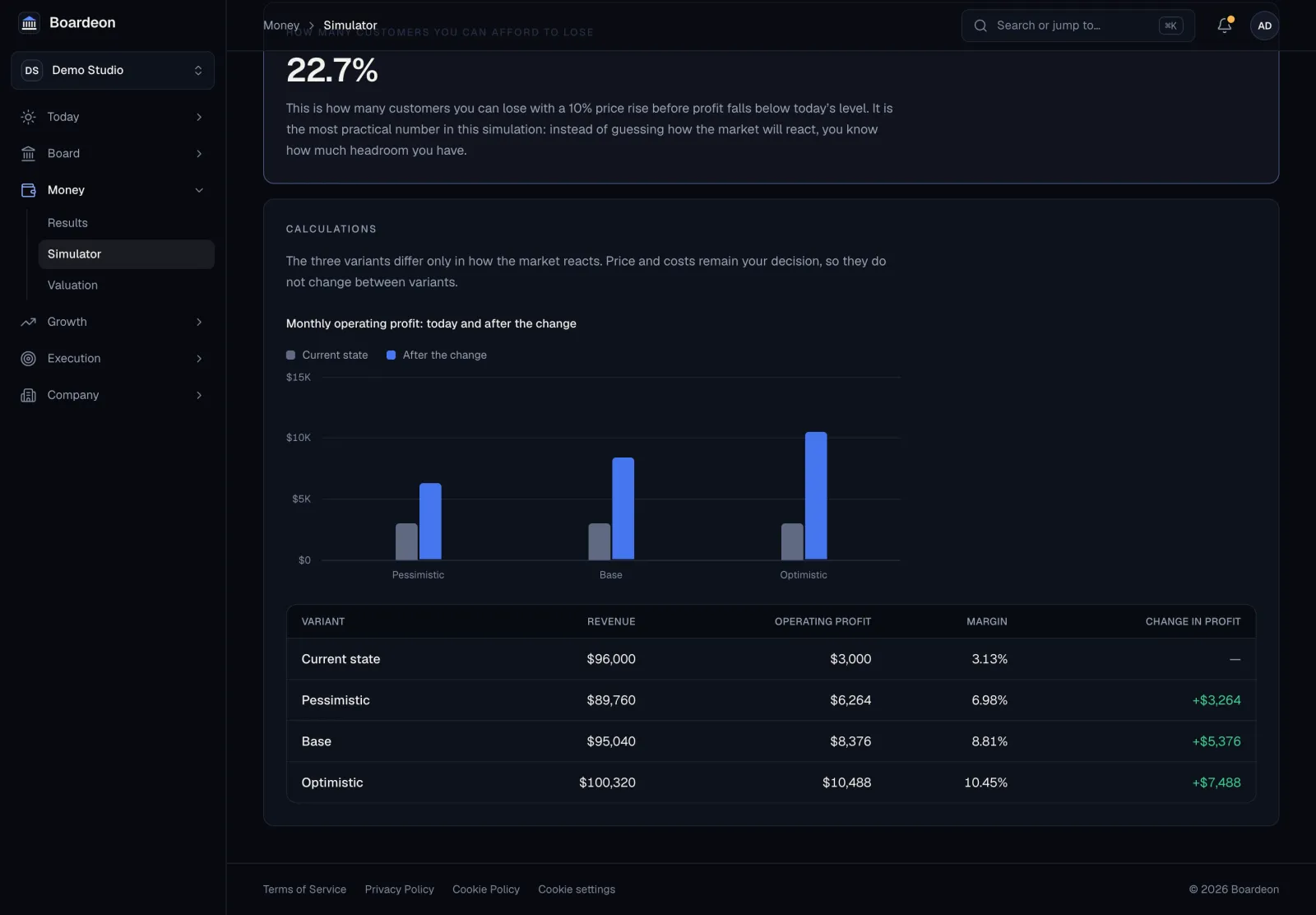
- Before a price rise, calculate how many customers you can afford to lose: with a 34% contribution margin, a 10% increase still pays off if you lose fewer than 22.7% of the volume.
- In Boardeon, Finance Center computes your margins, Business Simulator tests the change in three market scenarios, and AI Boardroom stress-tests the decision before you commit.
Contents
The right price is the highest price at which enough of your target customers still buy — and you find it by working up from your costs and down from the value you deliver, not by copying competitors. For most small companies the practical question is not "what is the perfect price?" but "can I afford to raise it, and by how much?". You can answer that with three numbers: your contribution margin, the size of the increase, and the share of customers you could lose before the rise stops paying off.
This guide explains margin and markup, the price floor, the price-increase test that tells you how much volume you can afford to lose, how to roll out a rise, and how to model the whole decision in Boardeon before you send a single new quote.
Why is pricing the most powerful profit lever?
Because a price change goes straight to profit, while a volume or cost change is diluted on the way. If you sell the same amount at a slightly higher price, every extra unit of currency is profit; nothing else in the business has to change.
McKinsey's often-quoted analysis of the average S&P 1500 company found that "a price rise of 1 percent, if volumes remained stable, would generate an 8 percent increase in operating profits" (McKinsey Quarterly, The power of pricing). The effect is even larger for companies with thin operating margins, which describes many owner-led businesses.
The arithmetic is easy to check on your own numbers. Take a company with monthly revenue of 100,000, variable costs of 66,000 and fixed costs of 31,000:
| Today | Price +5%, same volume | |
|---|---|---|
| Revenue | 100,000 | 105,000 |
| Variable costs | 66,000 | 66,000 |
| Fixed costs | 31,000 | 31,000 |
| Operating profit | 3,000 | 8,000 |
| Operating margin | 3.0% | 7.6% |
A 5% price change multiplies operating profit by 2.7. No cost-cutting programme or marketing campaign delivers that in a month. The catch is the assumption "same volume" — which is exactly what the price-increase test below is for.
What is the difference between margin and markup?
Margin is profit as a percentage of the selling price; markup is profit as a percentage of the cost. They describe the same profit from two different starting points, and confusing them is one of the most expensive mistakes in small-business pricing.
If something costs you 100 to deliver and you sell it for 150, your profit is 50. That is a 50% markup (50 / 100) but only a 33.3% margin (50 / 150). An owner who wants a 50% margin and adds 50% to the cost charges 150 instead of 200 — a quarter too little.
| Markup on cost | Resulting margin on price |
|---|---|
| 20% | 16.7% |
| 25% | 20.0% |
| 50% | 33.3% |
| 100% | 50.0% |
| 200% | 66.7% |
To set a price from a target margin, divide the cost by one minus the margin: price = cost ÷ (1 − target margin). For a cost of 100 and a target margin of 40%, the price is 100 ÷ 0.6 = 166.67.
How do you calculate the right price for a product or service?
Set a floor from your variable cost, a ceiling from the value to the customer, and pick a point between them that your positioning can defend. The three classic methods each answer one part of that question; none of them is enough alone.
- Cost-plus pricing — cost plus a markup. It guarantees you do not sell at a loss per unit, but it ignores what the customer would pay. Use it to find your floor, not your price.
- Competitor-based pricing — matching or undercutting the market. It tells you the range customers are used to, but you inherit your competitors' cost structure and mistakes.
- Value-based pricing — pricing from what the outcome is worth to the customer: hours saved, revenue gained, risk avoided. It produces the highest defensible prices, but it requires you to know your customer well and to explain the value clearly.
In practice, owners of small service companies get the best results by combining them: calculate the floor, check the market range, and position the price in that range according to the value and the proof they can show. The guide on SEO and marketing for small businesses covers positioning and how to explain value.
What is contribution margin, and why does it set your price floor?
Contribution margin is what is left from the price of one unit after its variable costs; it is the money that pays your fixed costs and, after that, your profit. If the price does not cover the variable cost, every additional sale deepens the loss — no volume will save it.
For a service business, variable costs are the ones that grow with each project: subcontractors, materials, licences bought per client, and the delivery hours of people paid per project. Salaries of permanent staff, rent and software subscriptions are usually fixed.
Contribution margin also gives you the break-even point: fixed costs divided by the contribution per unit. With fixed costs of 62,000 a month, a package price of 12,000 and a variable cost of 5,500 per package, the contribution is 6,500 and you need 9.5 packages a month to break even. The guide on cash and break-even walks through it in detail.
How many customers can you lose after a price increase?
With a contribution margin ratio c and a price increase p, you can lose up to p ÷ (c + p) of your volume before profit falls below today's level. This single formula turns a nervous guess into a decision you can reason about.
Take a company whose variable costs are 66% of revenue, so its contribution margin ratio is 34%. For a 10% price increase:
- maximum volume loss = 0.10 ÷ (0.34 + 0.10) = 22.7%.
In other words, the company can lose almost a quarter of its sales volume and still earn as much as before. If it loses fewer customers than that, the price rise increases profit; if it loses more, it does not. The lower your margin, the more room a price increase gives you — which is counter-intuitive, but true.
| Contribution margin | Price +5% | Price +10% | Price +15% |
|---|---|---|---|
| 20% | 20.0% | 33.3% | 42.9% |
| 34% | 12.8% | 22.7% | 30.6% |
| 50% | 9.1% | 16.7% | 23.1% |
| 70% | 6.7% | 12.5% | 17.6% |
Maximum share of volume you can lose before operating profit falls below today's level.
Demand elasticity is the name for that reaction: an elasticity of 1 means a 10% price rise costs 10% of volume. Nobody knows it precisely for their own business, which is why it should be an explicit assumption you can change, not a hidden constant in a spreadsheet.
When should you raise prices — and how do you do it without losing customers?
Raise prices when the value you deliver has grown faster than the price, when your margin is below what is typical for your model, or when demand exceeds your capacity. Three signals in particular are hard to argue with:
- The price has not changed for two years or more, while the scope of what you deliver has grown.
- Your gross margin is well below the typical level for your business model — a sign of pricing below value or of delivery costs that crept up.
- You have a queue. A six-week backlog is the market telling you the price is too low for the demand.
How you roll out the increase matters as much as its size:
- Stage it. Apply the new price to new clients first and to existing ones after a notice period. Margin improves from the first month while the risk is limited to new contracts.
- Talk to your largest clients in person. If two clients make up a third of your revenue, they deserve a conversation, not an e-mail.
- Explain the value, not the cost. "Our costs went up" invites negotiation; "the package now includes X and Y" invites comparison with alternatives.
- Send the message before the invoice. A price change discovered on an invoice feels like a trick.
- Measure what happens. Count cancellations and lost deals after 60 days and compare them with the headroom you calculated.
How to test a price change in Boardeon, step by step
Boardeon keeps the arithmetic in code and lets the AI do what it is good at: arguing about the assumptions. The screenshots show a fictional demo company, a nine-person branding studio with a gross margin of 34%.
Step 1: Check your margins in Finance Center
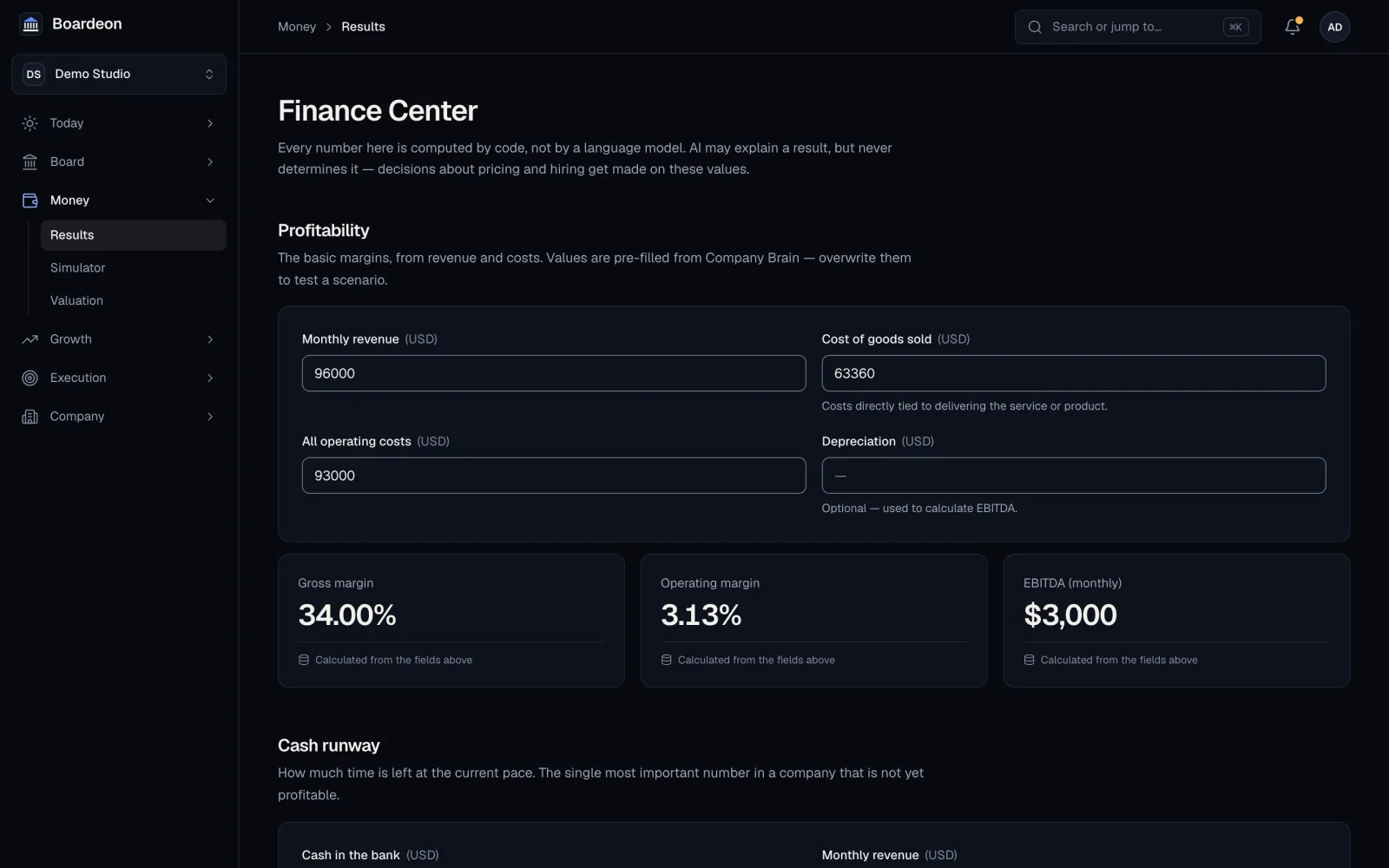
Open Finance Center (Money → Results). In the profitability group, monthly revenue and operating costs are pre-filled from Company Brain; enter the cost of goods sold — the costs directly tied to delivery — and Boardeon shows gross margin next to operating margin and monthly EBITDA. Every number here is computed by code, not by a language model; an empty field means missing data, not zero, so without the cost of goods sold you see which value is missing instead of an invented margin.
Step 2: Open Business Simulator and choose "Raise prices by 10%"
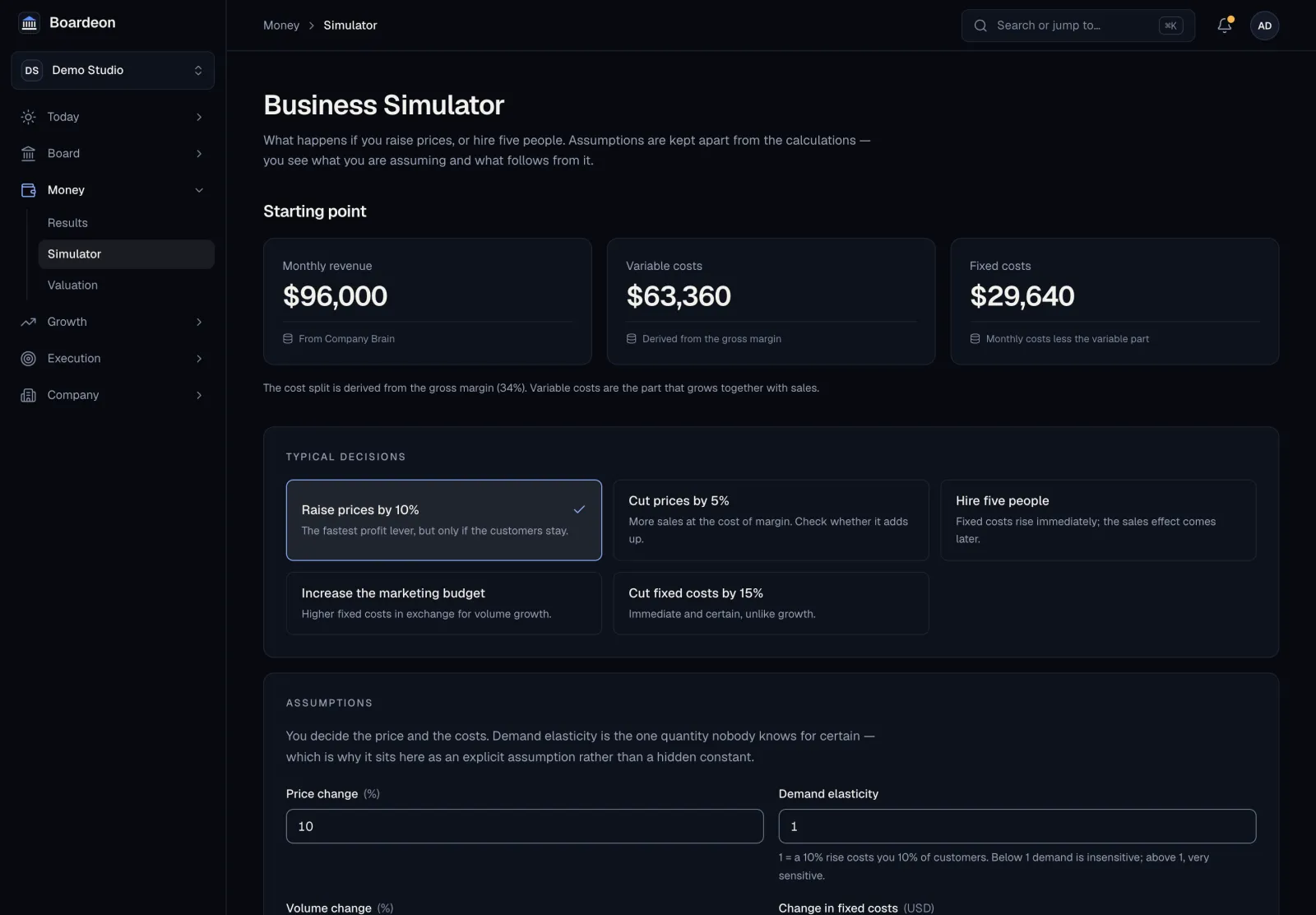
Go to Business Simulator and pick the preset Raise prices by 10%. The starting point — monthly revenue, variable and fixed costs — comes from Company Brain. If your gross margin is missing, the simulator says so and splits costs in half as an explicit assumption.
Step 3: Read the three variants and your headroom
The simulator shows the current state and three variants — pessimistic, base and optimistic — which differ only in how the market reacts. Price and costs are your decision, so they do not change between variants. Above the chart, Boardeon shows how many customers you can afford to lose: for the demo company, 22.7% with a 10% rise. In the base variant, operating margin rises from about 3% to almost 9% even though volume falls by 10%.
Step 4: Put the decision in front of AI Boardroom
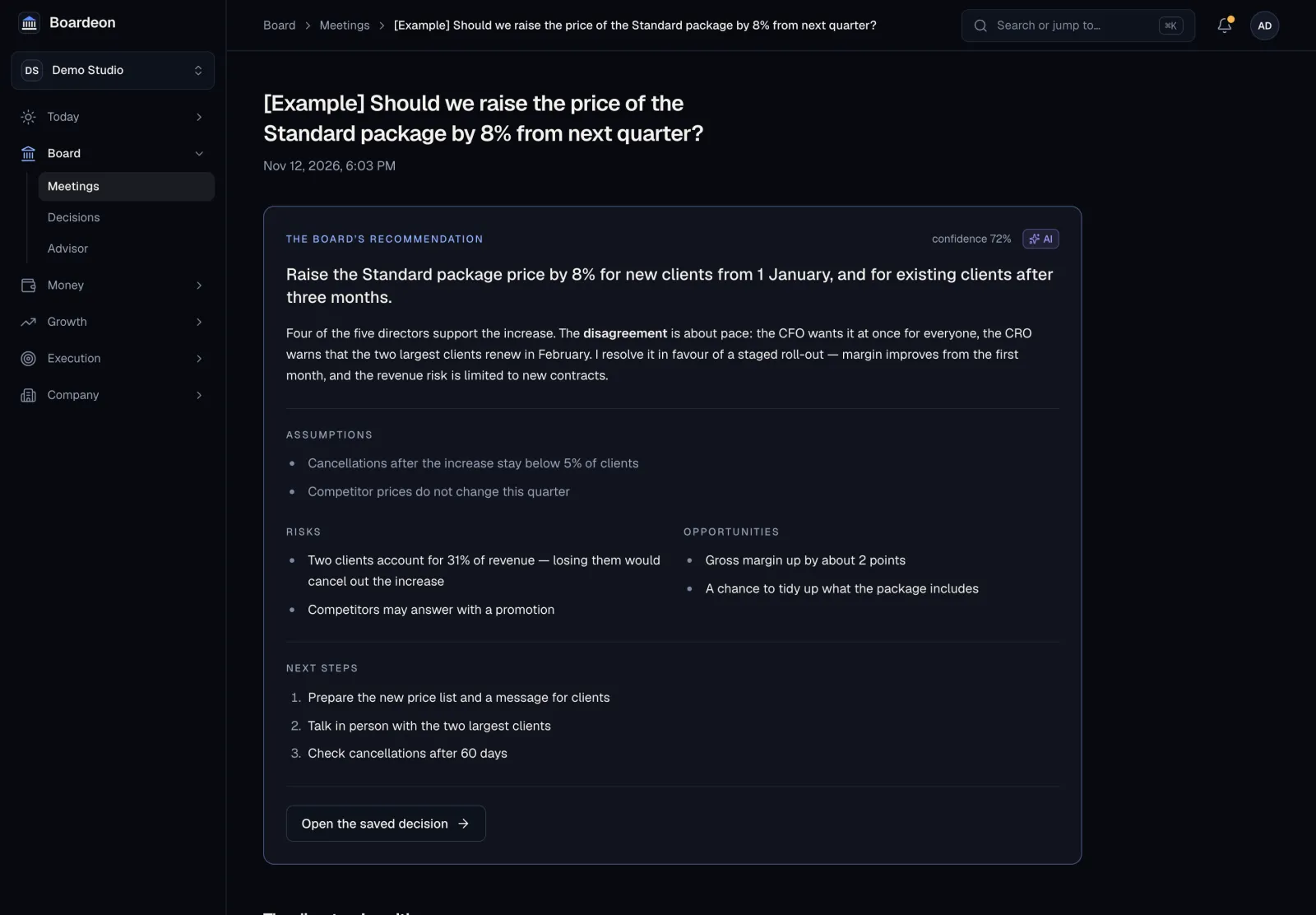
Open AI Boardroom and describe the decision — for example, "Should we raise the price of the Standard package by 8% from next quarter?". Five AI directors (CEO, CFO, CMO, CRO and COO) analyse it independently using your company data; Boardeon then consolidates one recommendation with assumptions, risks, opportunities and next steps, and shows where the directors disagree. A meeting takes about a minute.
Step 5: Save the decision with a review date
Click Save as a decision to review. The decision goes to Decision Room with its assumptions — for example, "cancellations stay below 5% of clients". On the review date, Boardeon reminds you to compare what you assumed with what happened. AI Boardroom is included in both plans (2 meetings a month in Entrepreneur, 20 in Executive); Decision Room is part of the Executive plan. The guide on making hard decisions explains why that step matters most.
When is Boardeon not the right tool for pricing?
If you sell thousands of products and need prices that change daily with stock and competitors, you need dedicated pricing or e-commerce software. Boardeon models pricing decisions at the level of the company and its main offers; it does not manage price lists per SKU, run A/B tests on a checkout or connect to marketplaces.
It is also no substitute for talking to customers. The simulator can tell you how much headroom you have; only your customers can tell you whether the new price matches the value they see.
Frequently asked questions
How do I calculate a selling price from cost and target margin?
Divide the cost by one minus the target margin. For a cost of 100 and a target gross margin of 40%, the price is 100 ÷ (1 − 0.40) = 166.67. Adding 40% to the cost would give 140, which is only a 28.6% margin.
What is the difference between margin and markup?
Margin is profit divided by the selling price; markup is profit divided by the cost. Selling for 150 something that costs 100 is a 50% markup but a 33.3% margin. Benchmarks and financial reports almost always use margin.
How much can I raise prices without losing money?
Use the formula p ÷ (c + p), where p is the price increase and c is your contribution margin ratio. With a 34% contribution margin, a 10% increase pays off as long as you lose less than 22.7% of your volume. Boardeon's Business Simulator calculates this headroom for you.
What is a good gross margin for a small business?
There is no universal number, because healthy margins depend on the business model: software and services typically run much higher gross margins than retail or manufacturing. Compare yourself with businesses that work like yours, and watch the trend — a margin falling year after year is a warning regardless of its level.
How often should a small business raise its prices?
Review prices at least once a year and whenever your costs, your scope or your demand change materially. Small, regular adjustments are easier for customers to accept than a large increase after several years without change.
Does Boardeon set prices for me?
No. Boardeon calculates margins and the effect of a price change with deterministic code and lets AI directors debate the decision, but the price is always your decision. The AI never invents the numbers and never sends anything to your customers.
Sources
- Michael V. Marn, Eric V. Roegner, Craig C. Zawada, The power of pricing, McKinsey Quarterly, February 2003: mckinsey.com
- The margin, markup and headroom formulas are standard management-accounting identities; the worked examples use round, illustrative numbers.
- Boardeon features as of the date of this guide: platform overview, pricing, and the 3-day trial.
Hire an AI board for your company
Your AI board applies this to your company’s data and prepares decisions for you to approve. Every plan starts with a 3-day trial for your first company; the diagnosis takes about a quarter of an hour.
Keep reading
All guides →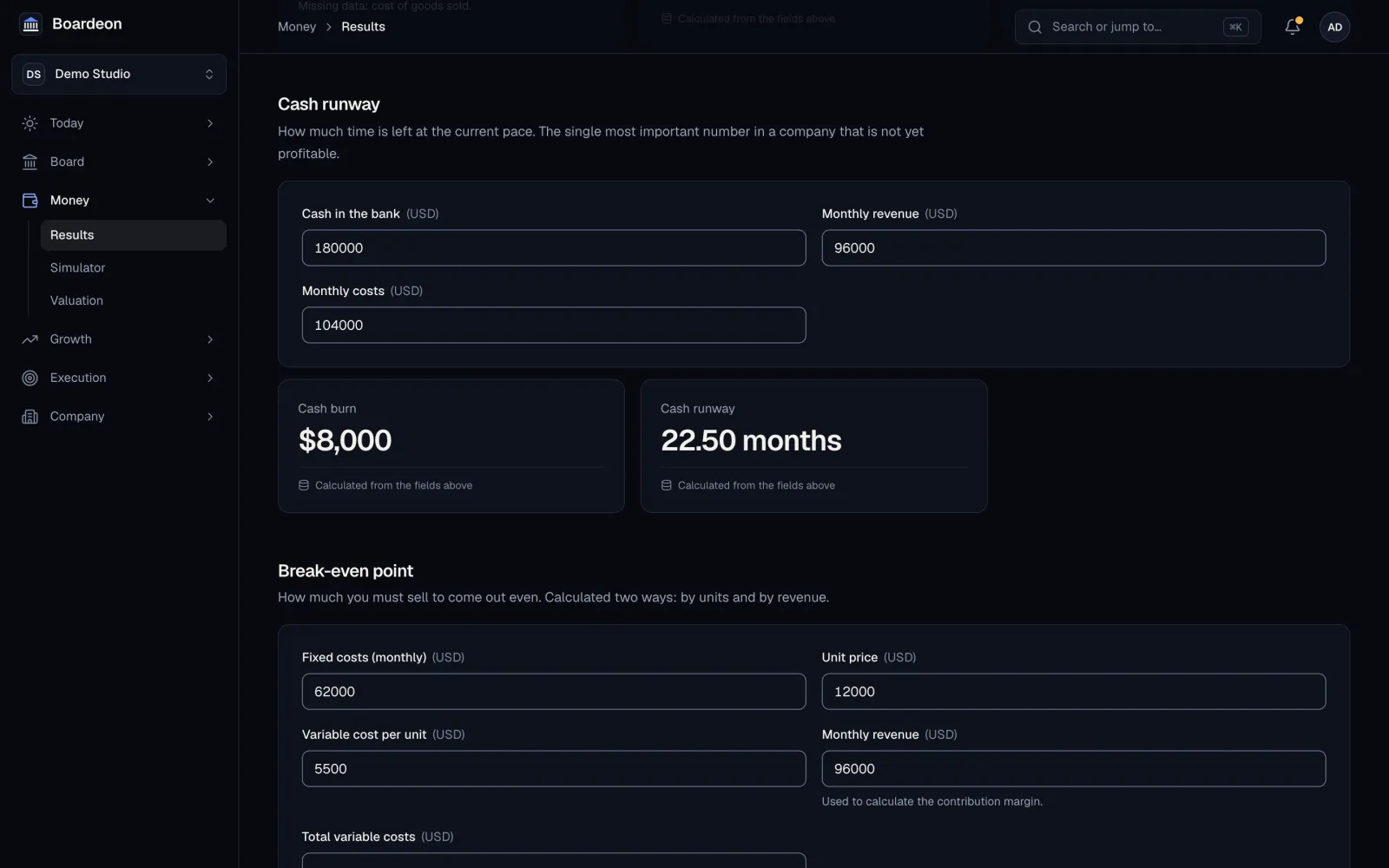
Finance
Cash flow control for small businesses: runway, burn rate and break-even explained
How owners keep control of cash: burn rate, cash runway, break-even, customer acquisition payback and a 13-week cash view — with formulas, examples and the warning thresholds.
10 min read
Read the guide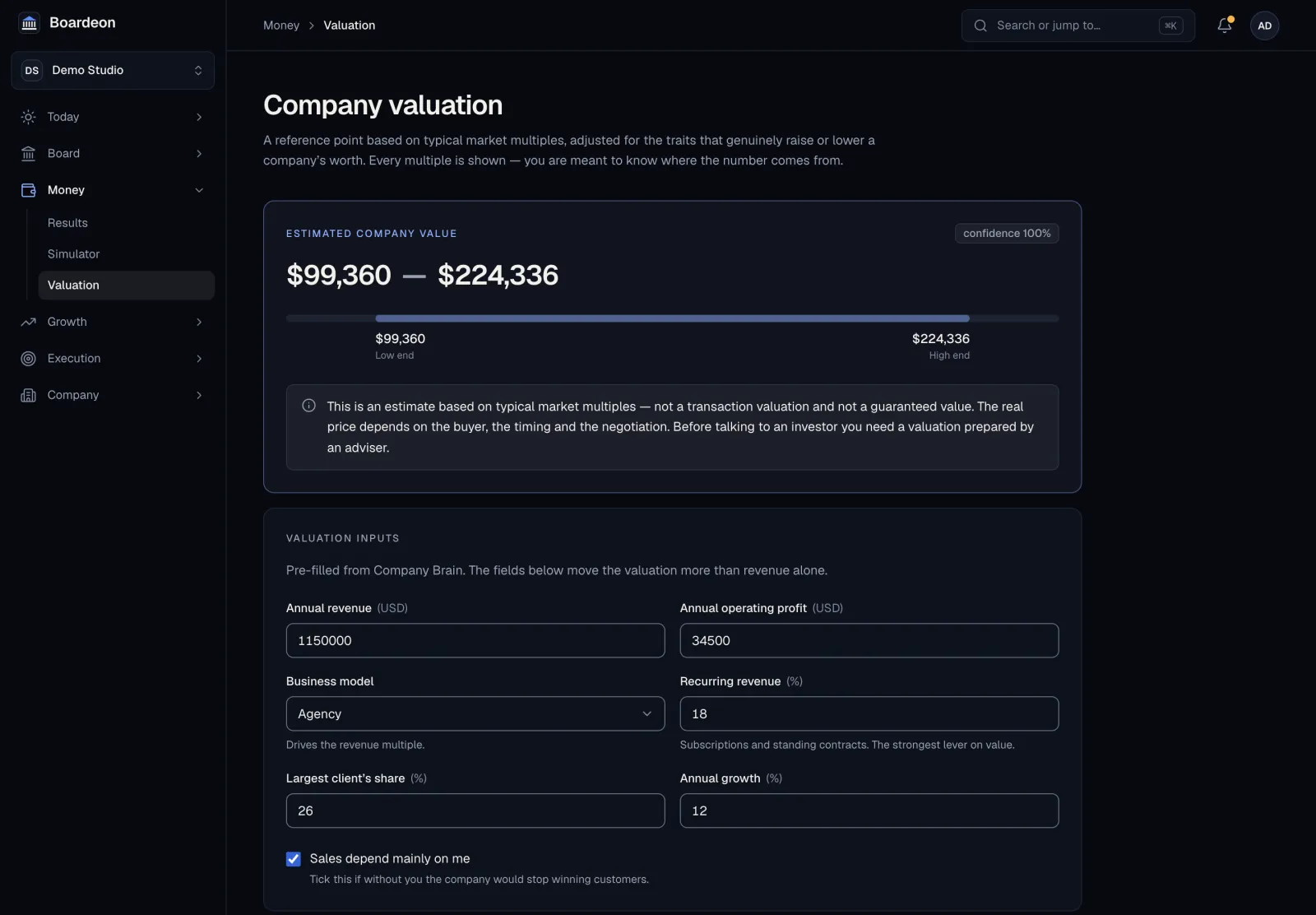
Finance
How to value a small business: revenue and profit multiples, and what moves the price
How small businesses are valued: revenue and profit multiples by model, the traits that raise or cut the price, a worked example and how to increase value.
10 min read
Read the guide
AI
Boardeon vs ChatGPT for running a company: when a general AI assistant is enough
ChatGPT is a general AI assistant; Boardeon is an AI board built on a model of your company. When each one is enough, where the numbers come from, and prices.
11 min read
Read the guide