How to use AI safely in your company: data, numbers and decisions
Which data never goes into a public chatbot, why AI must not calculate your numbers, what the EU AI Act requires and how to write a one-page AI policy.
- Published:
Key takeaways
- The biggest everyday AI risk in a small company is not a rogue robot but data leakage: 48% of professionals in Cisco's 2024 study admitted entering non-public company information into generative AI tools.
- Language models predict text; they should explain numbers, never produce them. Financial figures belong to tested, deterministic code.
- Decisions — and responsibility for them — stay with people, and decisions about specific individuals should never rest on AI output alone.
- Under the EU AI Act, AI literacy obligations have applied since 2 February 2025: companies using AI must make sure their staff understand it well enough.
- A one-page AI policy — approved tools, data classes, human review, labelling and prohibited uses — covers most of what a small company needs.
Contents
To use AI safely in a company, decide in advance which data may go into which tool, keep all calculations in deterministic software, keep people responsible for every decision, label what AI produced, and make sure your team understands what the tools can and cannot do. None of this requires a large compliance department. It requires a few clear rules, written down, and tools designed to respect them.
This guide covers the real risks of AI in a small company, the data that should never go into a public chatbot, why AI must not calculate your numbers, what the EU AI Act means for an ordinary business, how to write a one-page AI policy, how to choose an AI tool for managing a company — and how Boardeon is built around these rules.
What are the real risks of using AI in a small company?
The everyday risks are data leakage, confident mistakes, over-reliance and decisions about people — not science fiction. Each has a simple countermeasure once you name it.
- Data leakage. Employees paste contracts, client lists and financial statements into whichever chatbot is open in the browser. In Cisco's 2024 Data Privacy Benchmark Study, 48% of respondents admitted entering non-public information about their company into generative AI tools, and 27% said their organisation had banned generative AI applications altogether for the time being (Cisco, January 2024).
- Confident mistakes. Language models can state false information with complete confidence, misread data or rely on outdated knowledge. The more fluent the answer, the less likely it is to be checked.
- Over-reliance. When AI answers quickly, people stop thinking about the question. The decision quietly moves from the person responsible to the tool.
- Decisions about people. Using AI to rank candidates, evaluate employees or set pay creates legal and ethical risk that a small company cannot afford.
- Weak key and access management. API keys pasted into shared documents, personal accounts used for company data, no record of who used what.
Banning AI outright rarely works: people use it anyway, on personal accounts, where you have no control at all. Clear rules and a sanctioned tool work better.
Which company data should never go into a public AI chatbot?
Anything that identifies people, anything covered by a confidentiality obligation, and anything that would hurt the company if a competitor read it should stay out of consumer AI tools. Business tools with a data-processing agreement, data isolation and a no-training commitment change the picture — but the principle of entering only what the task needs still applies.
| Type of data | Why it is risky | Safer approach |
|---|---|---|
| Personal data of clients and employees | Data-protection law; trust | Leave it out or anonymise it; use tools with a data-processing agreement |
| Special categories (health, beliefs, etc.) | Strictest legal protection | Do not enter it at all |
| Contracts under NDA | Breach of confidentiality | Summarise the business question without the protected text |
| Detailed financial statements | Competitive and banking sensitivity | Use a business tool with isolation and no training on your data |
| Passwords, API keys, bank details | Direct financial risk | Never paste them into any chat |
| Strategy, pricing plans, M&A | Competitive damage if leaked | Business tools only, with access limited to the people who need it |
Why should AI never calculate your financial figures?
Because a language model predicts the most likely next words, not the correct result of a calculation — so it can produce a margin, a runway or a valuation that looks right and is wrong. For numbers you base decisions on, the calculation must be done by code that always gives the same answer for the same input and that can be checked.
The right division of labour is clear: software calculates, AI explains. A model is excellent at saying what a 3% operating margin means for a nine-person company, what the options are and what to ask next. It should never be the source of the 3%.
When you evaluate an AI tool for finance or management, ask one question: where do the numbers come from? If the answer is "the model writes them", treat every figure as unverified.
What does the EU AI Act mean for a small business that uses AI?
For most small companies that use AI tools rather than build them, the AI Act mainly means AI literacy for staff, transparency where AI interacts with people or produces content, and staying away from prohibited practices. It is a regulation of the European Union, but it applies to companies outside the EU too when their AI systems are used in the EU.
The key dates, according to the European Commission:
- 1 August 2024 — the AI Act (Regulation (EU) 2024/1689) entered into force.
- 2 February 2025 — prohibited AI practices and AI literacy obligations started to apply.
- 2 August 2026 — the regulation became generally applicable, with some exceptions.
(European Commission, AI Act; EUR-Lex, Regulation (EU) 2024/1689)
AI literacy means taking measures to ensure that the people who operate and use AI systems on your behalf understand them sufficiently — their capabilities, their limitations and their risks — in proportion to how the systems are used. For a small business, a short internal policy, a briefing for the team and tools that clearly label AI output go a long way.
How do you write a simple AI policy for your team?
Write one page that answers six questions: which tools are approved, what data may go into them, when a human must check the output, how AI output is labelled, what is prohibited, and whom to ask. A policy nobody reads is useless; a page people can remember is enough.
- Approved tools. List them, with the account type (company account, not personal).
- Data classes. Use the table above: what may go in, what may go in only in approved business tools, what never goes in.
- Human review. Anything sent to a client, published, or used for a decision is checked by a person who takes responsibility for it.
- Labelling. Say when a text, image or analysis was produced with AI — internally and, where relevant, to clients.
- Prohibited uses. Decisions about specific people based solely on AI output; manipulating people; presenting unchecked AI output as a human expert's opinion; trying to bypass a tool's safeguards.
- Questions and incidents. One named person to ask, and a rule to report mistakes or data entered by accident.
Review the page every six months; the tools change faster than the principles.
How do you choose an AI tool for managing your company?
Choose a tool that knows your company's context, keeps your data isolated and out of model training, calculates numbers with code, labels what AI wrote, and lets you control access and costs. Use this checklist when you compare options:
| Question | What a good answer looks like |
|---|---|
| Where is the data stored? | A stated region (for example, the EU) and a data-processing agreement |
| Is my data isolated from other customers? | Isolation at the database level, not only in the interface |
| Is my data used to train models? | No — neither by the vendor nor by its model providers via the API |
| Where do the numbers come from? | Deterministic, tested code; the model only explains |
| Is AI output labelled? | Yes, everywhere it appears |
| Who can see and do what? | Roles and permissions per person |
| How are API keys handled? | Encrypted, never shown again in full, removable at any time |
| What does it cost, and can it run away? | Visible limits and budgets, not open-ended usage |
| Can I leave? | Export and deletion of your data on request |
How to use AI safely in Boardeon, step by step
Boardeon was designed around the rules above: numbers are computed by code, AI output is labelled, every organisation is isolated at the database level, and the data is hosted in the European Union (Ireland). The screenshots show a fictional demo company.
Step 1: Decide which documents go into Company Vault
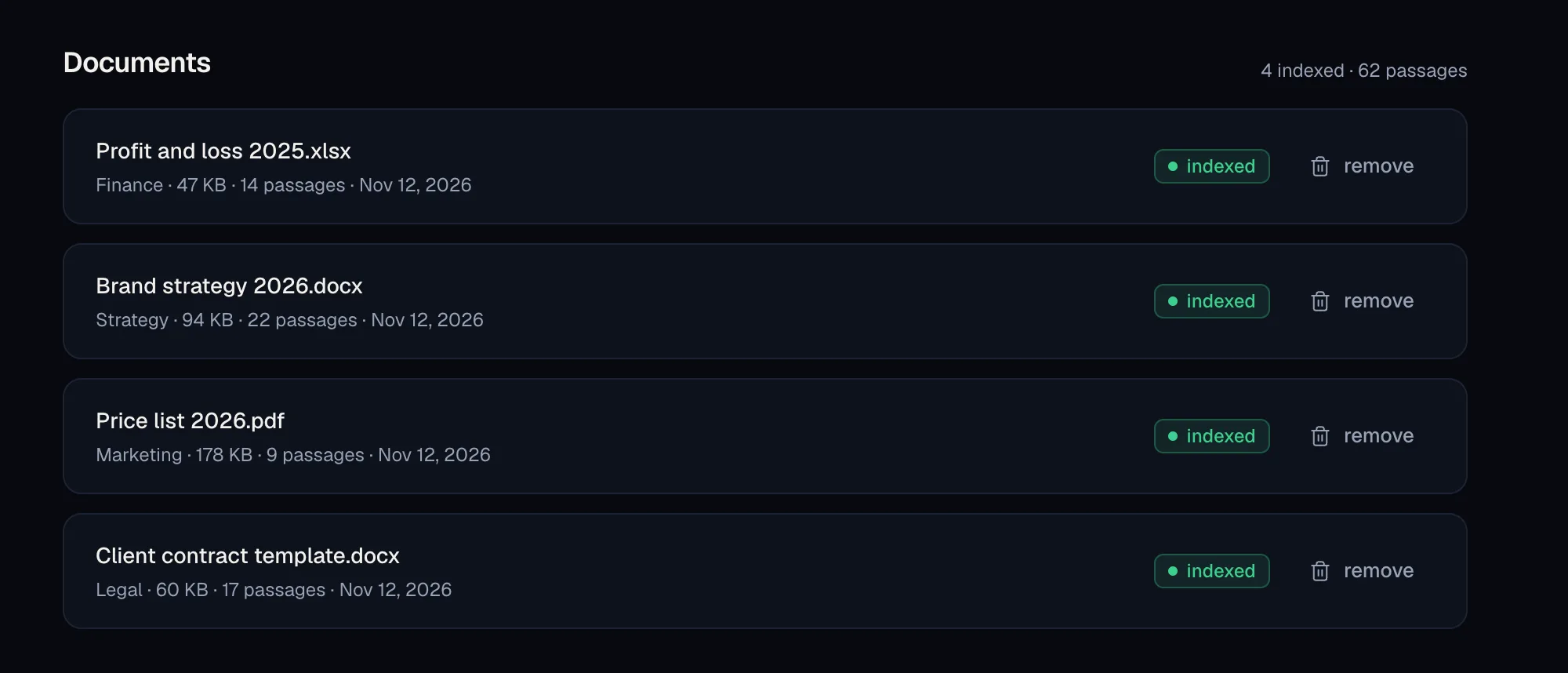
Open the document archive (Company → Archive). Upload only what genuinely describes the company and is needed for analysis — a profit and loss statement, your price list, the strategy. PDF, DOCX, XLSX, CSV and text files are indexed for search (up to 25 MB each); images are stored but not read. You can delete a document at any time, and the advisor stops using it.
Step 2: Ask the advisor about your company
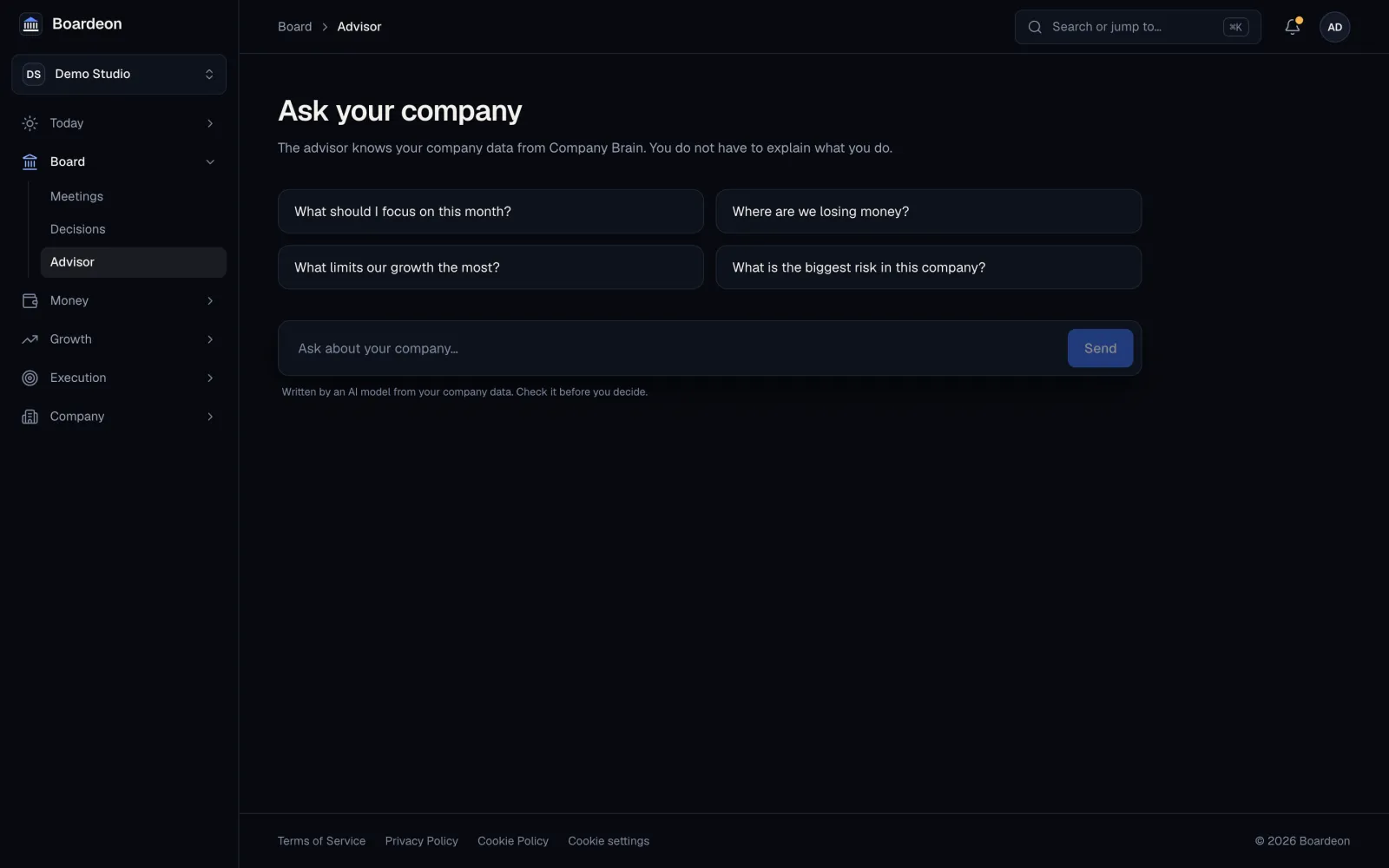
Open the Advisor and ask a question such as "Where are we losing money?". The advisor knows your company from Company Brain, so you do not explain what you do. Only the fragments of data needed for a specific request are sent to the model, and the model providers Boardeon uses do not train on data submitted via the API.
Step 3: Check the numbers where they are calculated
When the advisor or a board meeting refers to a margin, a runway or a valuation, open Finance Center, Business Simulator or Valuation: those figures are calculated by tested code from your data, and the model only comments on them. When data is missing, Boardeon says so instead of guessing.
Step 4: Control the AI provider and the costs
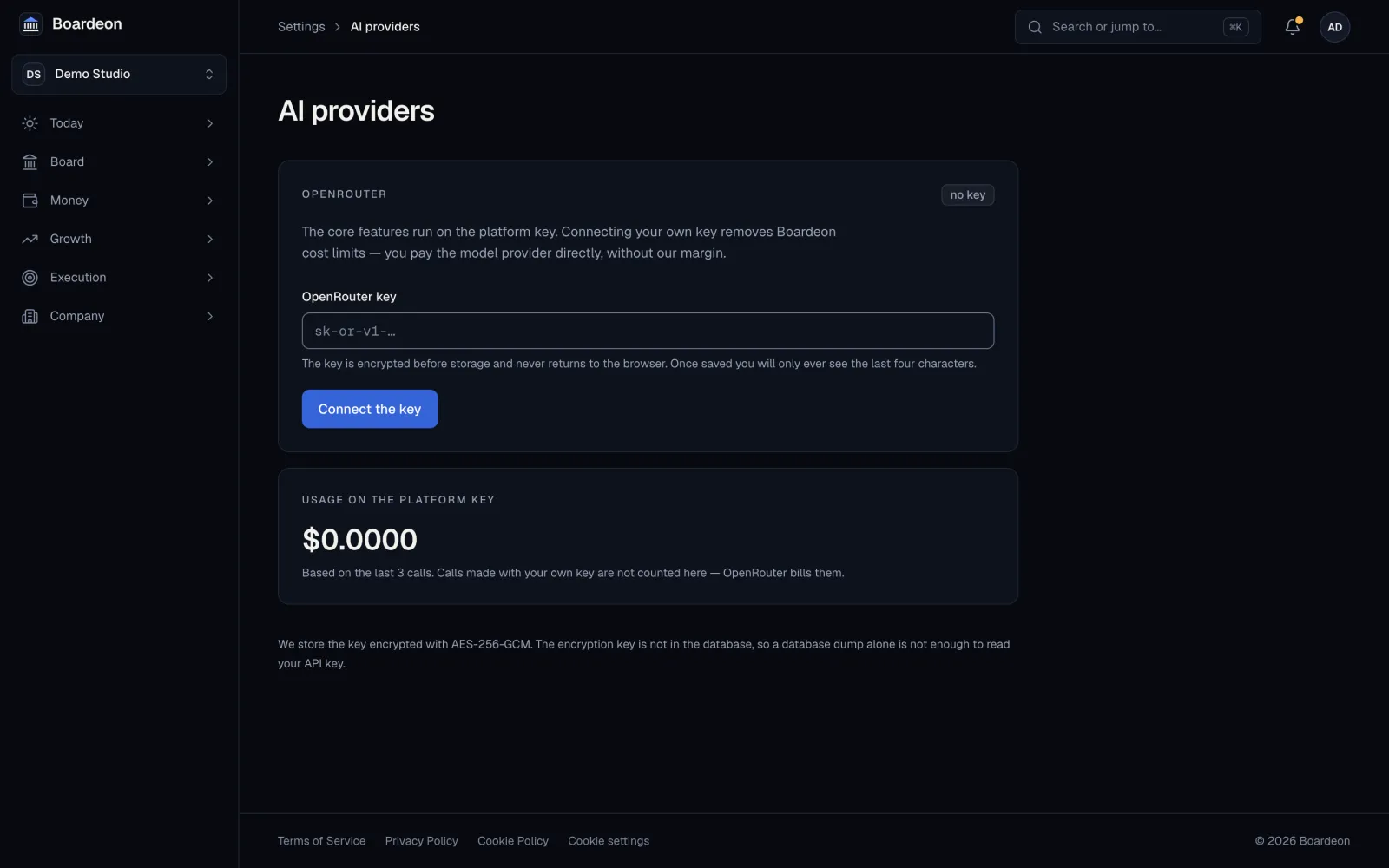
In Settings → AI providers, the core features run on the platform key with a monthly budget in your plan. You can connect your own OpenRouter key instead: it is encrypted with AES-256-GCM before storage, the encryption key is not in the database, and after saving you only ever see the last four characters. Your own key removes Boardeon's cost limits, not your plan's limits; you can disconnect it at any time.
Step 5: Give people the right role
Each organisation has four roles — owner, administrator, member and viewer. Only owners and administrators can connect an AI key or change the plan, and roles also decide who can upload documents. Give viewer access to people who need to read, not change.
Step 6: Keep decisions human and recorded
Use AI Boardroom to analyse a decision from five perspectives, and Decision Room to record what you decided, on what assumptions, with a review date. AI in Boardeon does not act outside the app: it does not send messages to your clients, change other systems or spend money. Read the guide on making hard decisions for the full process.
When is Boardeon not the right tool for AI work?
Do not use Boardeon — or any business AI — for decisions about specific people, and do not enter special categories of personal data such as health information. Boardeon analyses the company, not employees, candidates or clients as individuals, and its rules prohibit using AI responses as the sole basis for hiring, dismissal, pay or evaluation decisions.
Boardeon is also not a general-purpose writing or image tool and not a replacement for legal, tax or compliance advice. If your company builds AI systems or uses AI in high-risk areas under the AI Act, you need specialist advice.
Frequently asked questions
How can a small business use AI safely?
Approve a small set of business tools, write down which data may go into them, keep calculations in deterministic software, require a human to check anything sent out or used for a decision, label AI output, and brief the team on what AI can and cannot do. Review the rules every six months.
What data should never be entered into a public AI chatbot?
Personal data of clients and employees, special categories such as health data, documents under confidentiality agreements, passwords, API keys and bank details, and sensitive strategy or financial information. If you would not e-mail it outside the company, do not paste it into an unapproved AI tool.
Can I trust AI with financial calculations?
Not with producing them. Language models predict text and can generate numbers that look right and are wrong. Use tested, deterministic software for calculations and let AI explain the results. In Boardeon, margins, runway, simulations and valuations are calculated by code; the model only comments.
What does the EU AI Act require from small businesses?
For most small companies that use rather than build AI, the main obligations are AI literacy — making sure staff understand the AI tools they use, in force since 2 February 2025 — transparency where AI interacts with people or generates content, and avoiding prohibited practices. High-risk uses, such as AI in recruitment or credit decisions, carry more obligations.
What should a company AI policy contain?
A one-page policy should list the approved tools, the classes of data that may and may not be entered, when human review is mandatory, how AI output is labelled, the prohibited uses — including decisions about individuals based solely on AI — and whom to contact with questions or incidents.
Does Boardeon use my data to train AI models?
No. Boardeon does not train models on your data, and the model providers it uses do not use data submitted via the API for training. Only the fragments needed for a request are sent to the model, every organisation is isolated at the database level, and the data is hosted in the European Union.
Sources
- Cisco, Organizations Ban Use of GenAI Over Data Privacy Security Risks (2024 Data Privacy Benchmark Study), January 2024: newsroom.cisco.com
- European Commission, AI Act — regulatory framework and application dates: digital-strategy.ec.europa.eu
- Regulation (EU) 2024/1689 (Artificial Intelligence Act), EUR-Lex: eur-lex.europa.eu/eli/reg/2024/1689/oj
- Boardeon's AI policy, security overview and pricing. Related guide: cash control.
Hire an AI board for your company
Your AI board applies this to your company’s data and prepares decisions for you to approve. Every plan starts with a 3-day trial for your first company; the diagnosis takes about a quarter of an hour.
Keep reading
All guides →AI
Boardeon vs ChatGPT for running a company: when a general AI assistant is enough
ChatGPT is a general AI assistant; Boardeon is an AI board built on a model of your company. When each one is enough, where the numbers come from, and prices.
11 min read
Read the guide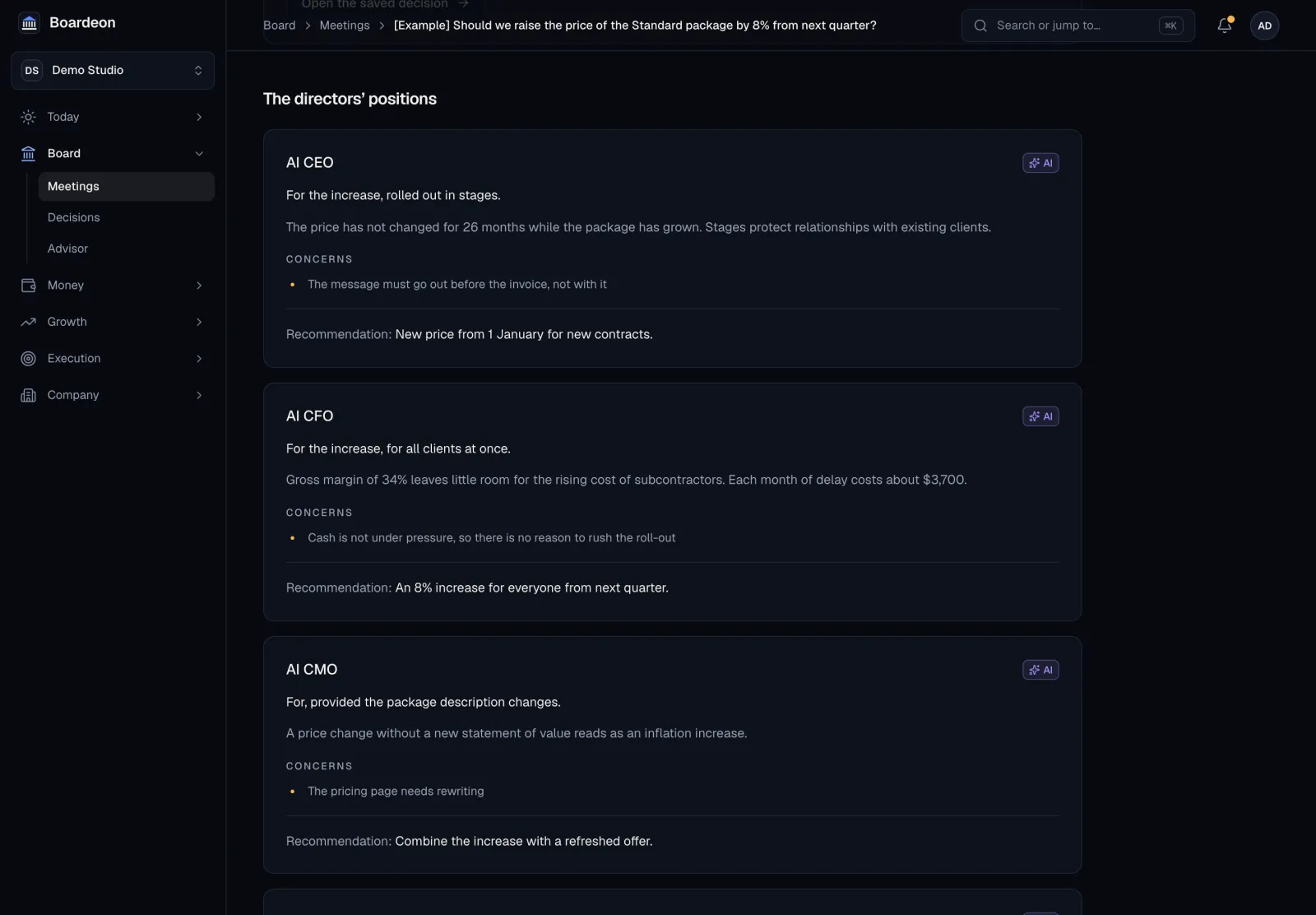
AI
Boardeon vs MyExecs.ai: two AI boards for small and mid-sized companies, compared
Boardeon and MyExecs.ai both give a company a board of AI executives. How they differ on finance, approvals, integrations, languages, data location and price.
12 min read
Read the guide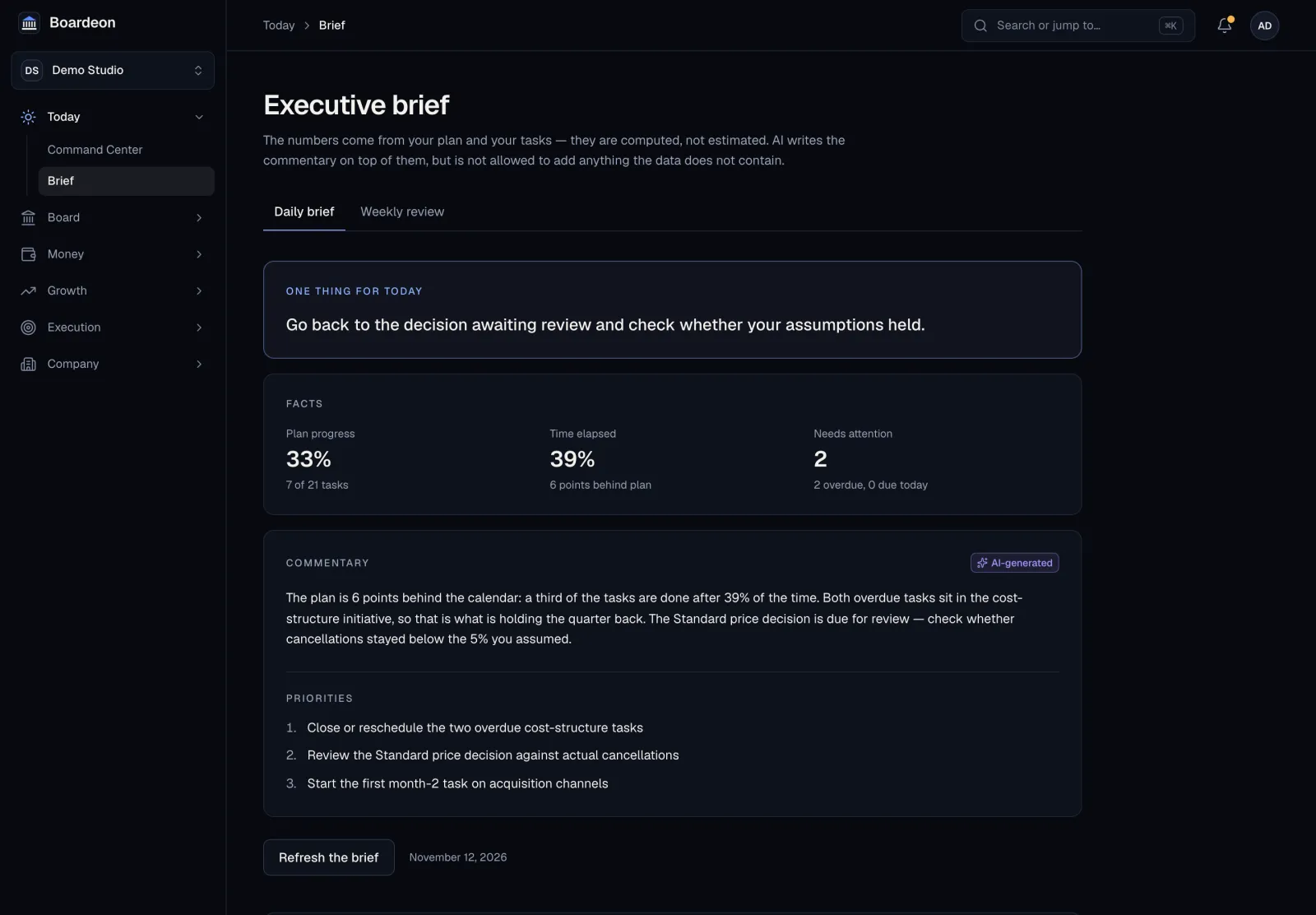
AI
Boardeon vs Hello Alice: a paid AI board with a model of your company, or a free AI advisory board?
Boardeon vs Hello Alice, compared honestly: advisors, health score, daily routine, financial calculations, approvals, integrations, data location and price.
13 min read
Read the guide