Cash flow control for small businesses: runway, burn rate and break-even explained
How owners keep control of cash: burn rate, cash runway, break-even, customer acquisition payback and a 13-week cash view — with formulas, examples and the warning thresholds.
- Published:
Key takeaways
- Profit is an opinion, cash is a fact: a profitable company can still run out of money because of late payments, tax dates, inventory or fast growth.
- The median US small business holds only 27 days of cash buffer, and a quarter hold fewer than 13 days (JPMorgan Chase Institute).
- Cash runway is cash in the bank divided by the monthly net burn; under six months is the point where pressure starts.
- Break-even tells you how much you must sell each month; customer acquisition payback tells you how long each new customer ties up your cash.
- In Boardeon, Finance Center calculates burn, runway, break-even and customer economics with tested code, and the daily brief keeps the plan and the alerts in front of you.
Contents
You are in control of cash when you know, every week, three numbers: how much cash you have, how much you burn or generate each month, and how many months that gives you. Everything else — break-even, customer acquisition cost, payment terms — is there to move those three numbers in the right direction. Most owners look at revenue and profit instead, and are then surprised by a month in which the company is profitable but cannot pay its bills.
This guide explains why profitable companies run out of cash, how to calculate burn rate, runway and break-even, which customer numbers tie up cash, how to build a simple 13-week cash view, what to do when runway is short, and how to check all of it in Boardeon.
Why do profitable businesses run out of cash?
Because profit is recorded when you invoice, and cash arrives when the customer pays — and the bills in between do not wait. The gap between the two is where small companies get into trouble.
The most common reasons are:
- Late payments. You deliver in March, invoice in April, and get paid in June. Salaries for March, April and May are paid from your buffer.
- Tax and payroll dates. VAT or sales tax, payroll taxes and corporate income tax fall due on fixed dates, regardless of when your clients pay.
- Growth. Every new project or order requires you to pay for people and materials before the customer pays you. Fast growth consumes cash even when every project is profitable.
- Inventory and prepayments. Stock sitting in a warehouse and annual software licences paid upfront are profit that has not turned into cash yet.
- Debt repayments. Loan principal reduces cash but does not appear as a cost in the profit and loss statement.
The buffer most small companies hold is thin. The JPMorgan Chase Institute found that "the median small business holds 27 cash buffer days in reserve", and that 25% hold fewer than 13 days (JPMorgan Chase Institute, Cash is King). In the Federal Reserve's 2026 Report on Employer Firms (based on a survey conducted in 2025), 54% cited paying operating expenses and 50% cited uneven cash flows as financial challenges (Federal Reserve Banks, Small Business Credit Survey: 2026 Report on Employer Firms).
What is burn rate, and how do you calculate cash runway?
Burn rate is how much cash the company loses in a month; cash runway is how many months the cash in the bank will last at that pace. For a company that is not yet profitable, runway is the single most important number.
The formulas are simple:
- Net burn = monthly costs − monthly revenue (if the result is negative, the company generates cash and does not burn it).
- Cash runway = cash in the bank ÷ net burn.
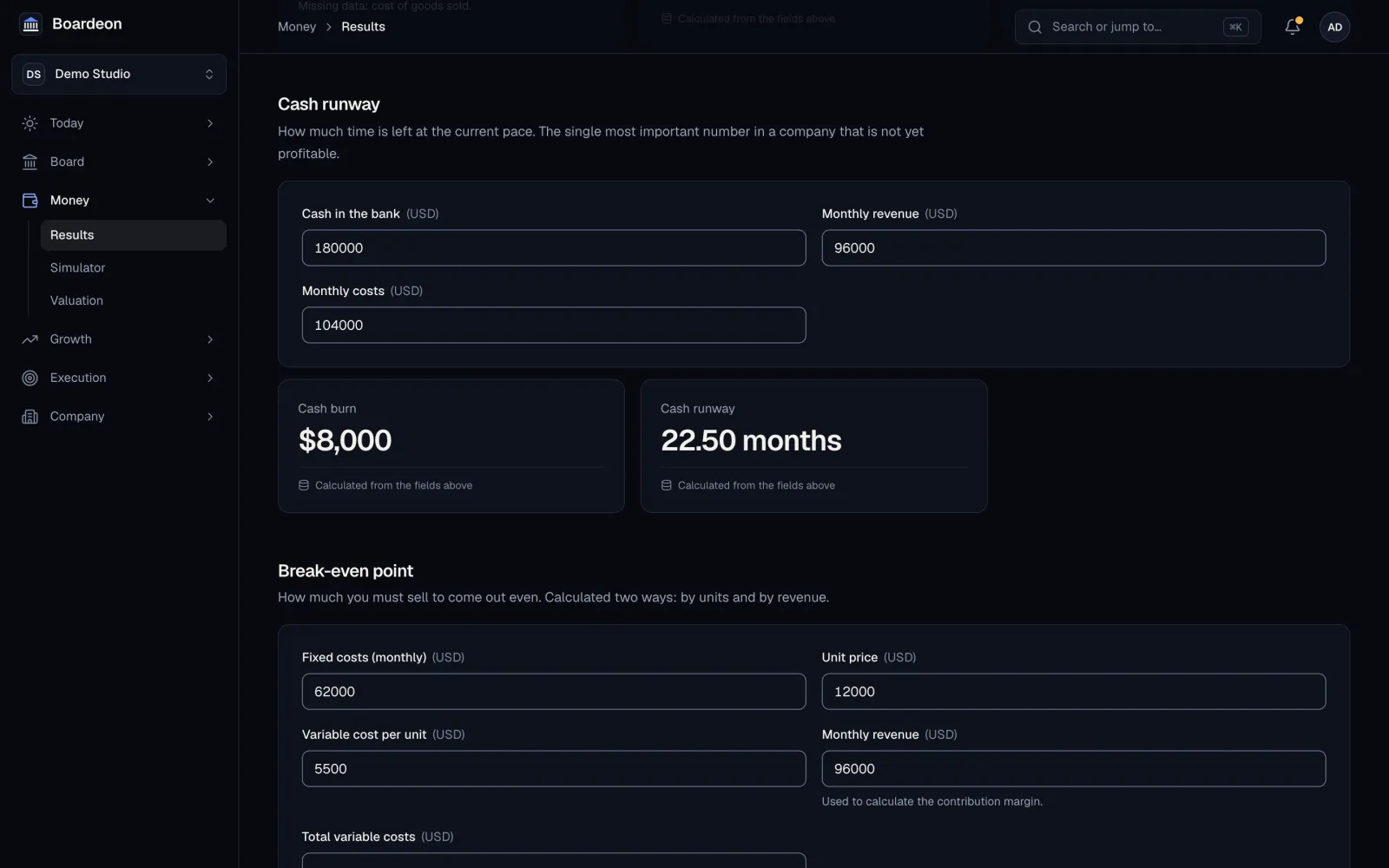
Example: a company with 180,000 in the bank, monthly revenue of 96,000 and monthly costs of 104,000 burns 8,000 a month. Its runway is 180,000 ÷ 8,000 = 22.5 months.
| Runway | What it means | What to do |
|---|---|---|
| Over 18 months | Comfortable | Invest deliberately; review monthly |
| 12–18 months | Healthy, but finite | Plan the path to break-even now |
| 6–12 months | Tight | Act on costs, prices and collections this quarter |
| Under 6 months | Pressure | Weekly cash meetings; act this month |
The six-month line is not arbitrary: raising money, renegotiating a loan or turning a cost structure around all take months, so by the time runway is under six months, your options are already narrowing.
How do you calculate your break-even point?
Your break-even point is the level of sales at which contribution margin exactly covers fixed costs — profit is zero, and every sale above it is profit. You can express it in units or in revenue.
- Contribution per unit = price − variable cost per unit.
- Break-even in units = monthly fixed costs ÷ contribution per unit.
- Break-even revenue = monthly fixed costs ÷ contribution margin ratio.
Example: a design studio sells a standard package for 12,000. Each package costs 5,500 in subcontractors and direct delivery, so the contribution is 6,500 per package (a 54% contribution margin ratio). Fixed costs — permanent salaries, rent, software — are 62,000 a month. Break-even is 62,000 ÷ 6,500 = 9.5 packages a month, or about 114,500 in revenue.
If the price does not cover the variable cost, there is no break-even point: every additional sale increases the loss. That is the moment to read how to price products and services before anything else.
Which customer numbers tie up your cash?
Customer acquisition cost, customer lifetime value and the payback period tell you how much cash each new customer consumes and how long it takes to get it back. They matter most for subscription and recurring-revenue businesses, but every company that spends money to win customers should know them.
- Customer acquisition cost (CAC) = sales and marketing spend ÷ number of new customers.
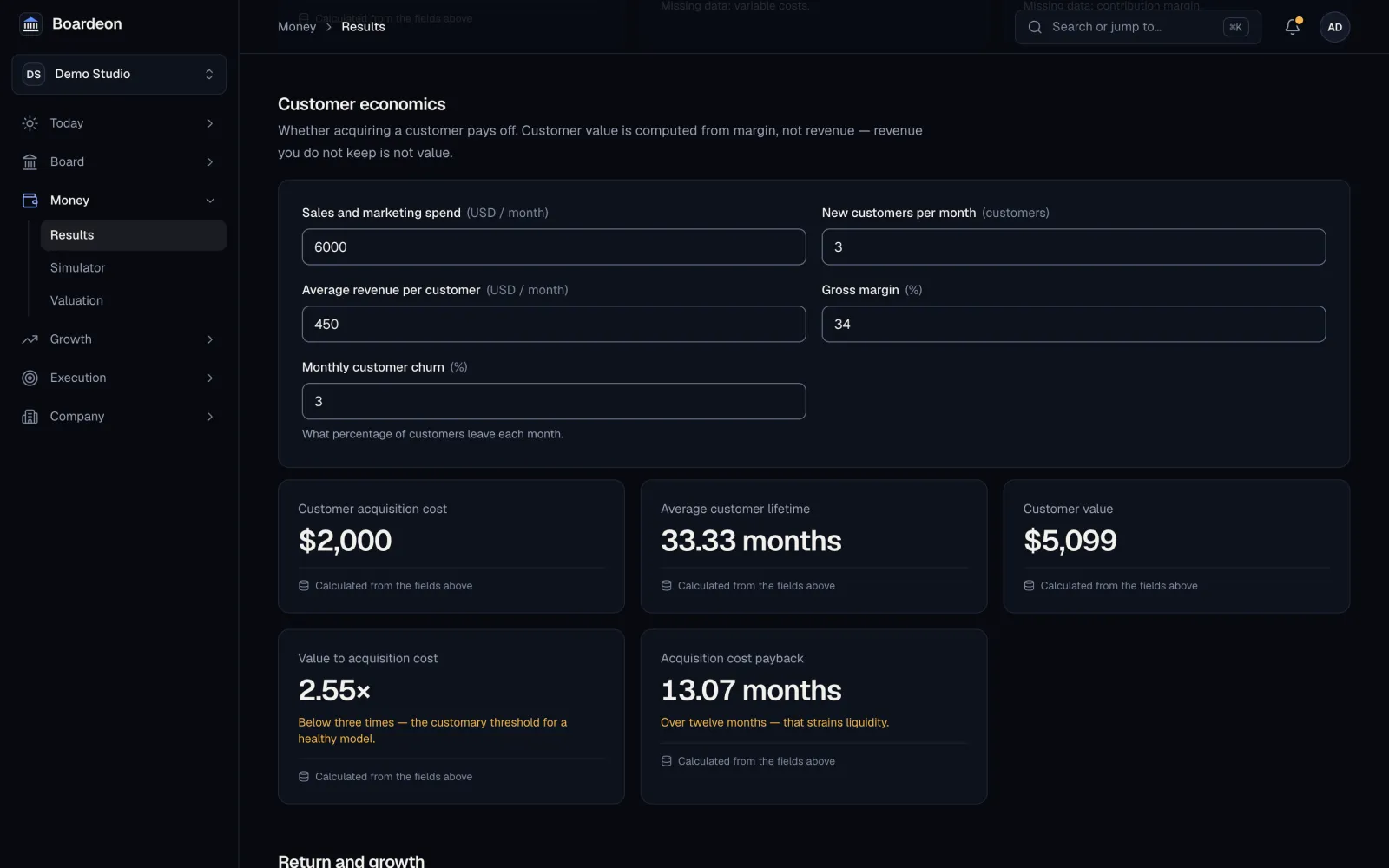
- Average customer lifetime = 1 ÷ monthly churn. With 3% churn, a customer stays about 33 months on average.
- Customer lifetime value (LTV) = monthly revenue per customer × gross margin × lifetime. Compute it from margin, not revenue: revenue you do not keep is not value.
- LTV to CAC ratio — below 3 is the customary warning threshold for a healthy model.
- CAC payback = CAC ÷ (monthly revenue per customer × gross margin). Over 12 months strains liquidity.
Example: spending 6,000 a month to win 3 new care-plan customers gives a CAC of 2,000. At 450 a month per customer, a 34% gross margin and 3% churn, LTV is about 5,100 and the ratio is 2.55 — below 3. Payback takes about 13 months. Each new customer is profitable, but the company finances them for over a year.
How do you build a simple 13-week cash view?
List, week by week for the next 13 weeks, the cash you expect to receive and the cash you will pay out, and track the closing balance against a minimum buffer. Thirteen weeks is one quarter: long enough to see a problem coming, short enough to forecast with reasonable confidence.
Build it with five rows:
- Opening cash — the bank balance at the start of the week.
- Receipts — invoices you realistically expect to be paid that week (use the client's actual payment habits, not the due date).
- Payments — payroll, rent, suppliers, subscriptions, loan instalments.
- Tax payments — VAT or sales tax, payroll taxes and income tax on their real dates.
- Closing cash — opening + receipts − payments − taxes; it becomes next week's opening balance.
Mark every week where the closing balance falls below your minimum buffer — for example, one month of fixed costs. Those weeks are your action list. Update the view every Monday; it takes fifteen minutes once the first version exists.
What should you do when your runway is too short?
Act on the levers that are fastest and most certain first: collections, payment terms and costs; then on prices; then on financing. Growth plans do not fix a short runway in time.
- Collect what you are owed. Chase overdue invoices personally, offer a small discount for immediate payment, and stop new work for clients who do not pay.
- Shorten your terms and lengthen your suppliers'. Ask for deposits on new projects; negotiate longer terms with suppliers you have a good history with.
- Cut or postpone costs that do not affect delivery. Subscriptions, travel, non-essential hires. Cutting fixed costs is immediate and certain, unlike growth.
- Raise prices where the market allows. The pricing guide shows how to calculate how much volume you can afford to lose.
- Arrange financing before you need it. A credit line negotiated with 12 months of runway costs less and comes with fewer conditions than one requested with 3.
Avoid the most tempting mistake: heavy discounting to pull revenue forward. It improves this month's cash and permanently lowers your margin.
How to check your cash position in Boardeon, step by step
Boardeon calculates every number on these screens with tested code, from the data in Company Brain and the values you type in. The screenshots show a fictional demo studio; the values were entered to test a scenario in which monthly costs rise above revenue.
Step 1: Open Finance Center and enter your cash in the bank
Go to Finance Center (Money → Results) and scroll to Cash runway. Monthly revenue and costs are pre-filled from Company Brain; enter your current cash in the bank. Boardeon calculates the cash burn and the runway in months — and if revenue covers costs, it tells you the company is not burning cash instead of showing a meaningless number. Boardeon does not connect to your bank account, so you type the balance yourself.
Step 2: Calculate your break-even point
In the Break-even point group, enter monthly fixed costs, the unit price and the variable cost per unit. Boardeon shows break-even in units, the contribution margin and break-even revenue. If the price does not cover the variable cost, you see the reason instead of a number.
Step 3: Check your customer economics
In Customer economics, enter your monthly sales and marketing spend, new customers per month, average monthly revenue per customer and monthly churn; gross margin comes from Company Brain. Boardeon calculates CAC, average customer lifetime, customer value, the value-to-cost ratio and the payback period, and flags a ratio below three or a payback over twelve months.
Step 4: Test a fix in Business Simulator
Open Business Simulator and try the decision you are considering: Cut fixed costs by 15%, Raise prices by 10%, or a change of your own. The simulator compares the current state with three market scenarios, so you see whether the fix holds even if the market reacts worse than you hope.
Step 5: Keep it in front of you with the daily brief
The daily brief is generated every morning from your plan and tasks — progress against the calendar, overdue tasks, decisions to make and alerts — with one thing for today. AI writes a short commentary on top, but is not allowed to add anything the data does not contain. You can receive it by e-mail, or on Telegram in the Executive plan.

When is Boardeon not the right tool for cash management?
Boardeon does not replace your accounting software or your bank. It does not issue or chase invoices, reconcile bank transactions, file taxes or forecast cash automatically from your bank feed. Use accounting and invoicing software for those jobs, and use Boardeon to see what the numbers mean for your decisions and plan.
If you are already in a liquidity crisis — unable to pay salaries or taxes on time — talk to your accountant and your bank first. Software helps you see a problem early; it does not negotiate with creditors.
Frequently asked questions
How do I calculate cash runway?
Divide the cash in your bank account by your monthly net burn, which is monthly costs minus monthly revenue. With 180,000 in the bank and a net burn of 8,000 a month, runway is 22.5 months. If revenue is higher than costs, the company is not burning cash and runway does not run out.
What is the difference between burn rate and cash flow?
Burn rate is the net amount of cash a company loses per month when costs exceed revenue. Cash flow is the broader movement of money in and out, which can be positive or negative. A company with positive operating cash flow has no burn rate.
How do I calculate my break-even point?
Divide your monthly fixed costs by the contribution per unit, which is the price minus the variable cost per unit. With fixed costs of 62,000, a price of 12,000 and a variable cost of 5,500, you break even at about 9.5 units a month.
What is a good LTV to CAC ratio?
A ratio of at least 3 — customer lifetime value three times the cost of acquiring the customer — is the customary threshold for a healthy model. Calculate lifetime value from gross margin, not revenue, and look at the payback period too: over 12 months strains liquidity even when the ratio looks fine.
How much cash should a small business keep in reserve?
There is no universal rule, but the data show how thin buffers usually are: the median US small business holds 27 days of cash. A common target is enough to cover three months of fixed costs; companies with lumpy revenue or long payment terms need more.
Can Boardeon see my bank account?
No. Boardeon does not connect to bank accounts. You enter your cash balance in Finance Center yourself; revenue and cost figures come from the data you provide in Company Brain. Every calculation is done by deterministic code, not by a language model.
Sources
- Diana Farrell, Chris Wheat, Cash is King: Flows, Balances, and Buffer Days, JPMorgan Chase Institute, September 2016: jpmorganchase.com
- Federal Reserve Banks, Small Business Credit Survey: 2026 Report on Employer Firms (survey conducted in 2025): fedsmallbusiness.org
- The runway, break-even and customer-economics formulas are standard; thresholds (six months of runway, LTV/CAC of three, twelve-month payback) are common rules of thumb, the same ones Boardeon uses in Finance Center.
- Boardeon features as of the date of this guide: platform overview, pricing and the 3-day trial.
Hire an AI board for your company
Your AI board applies this to your company’s data and prepares decisions for you to approve. Every plan starts with a 3-day trial for your first company; the diagnosis takes about a quarter of an hour.
Keep reading
All guides →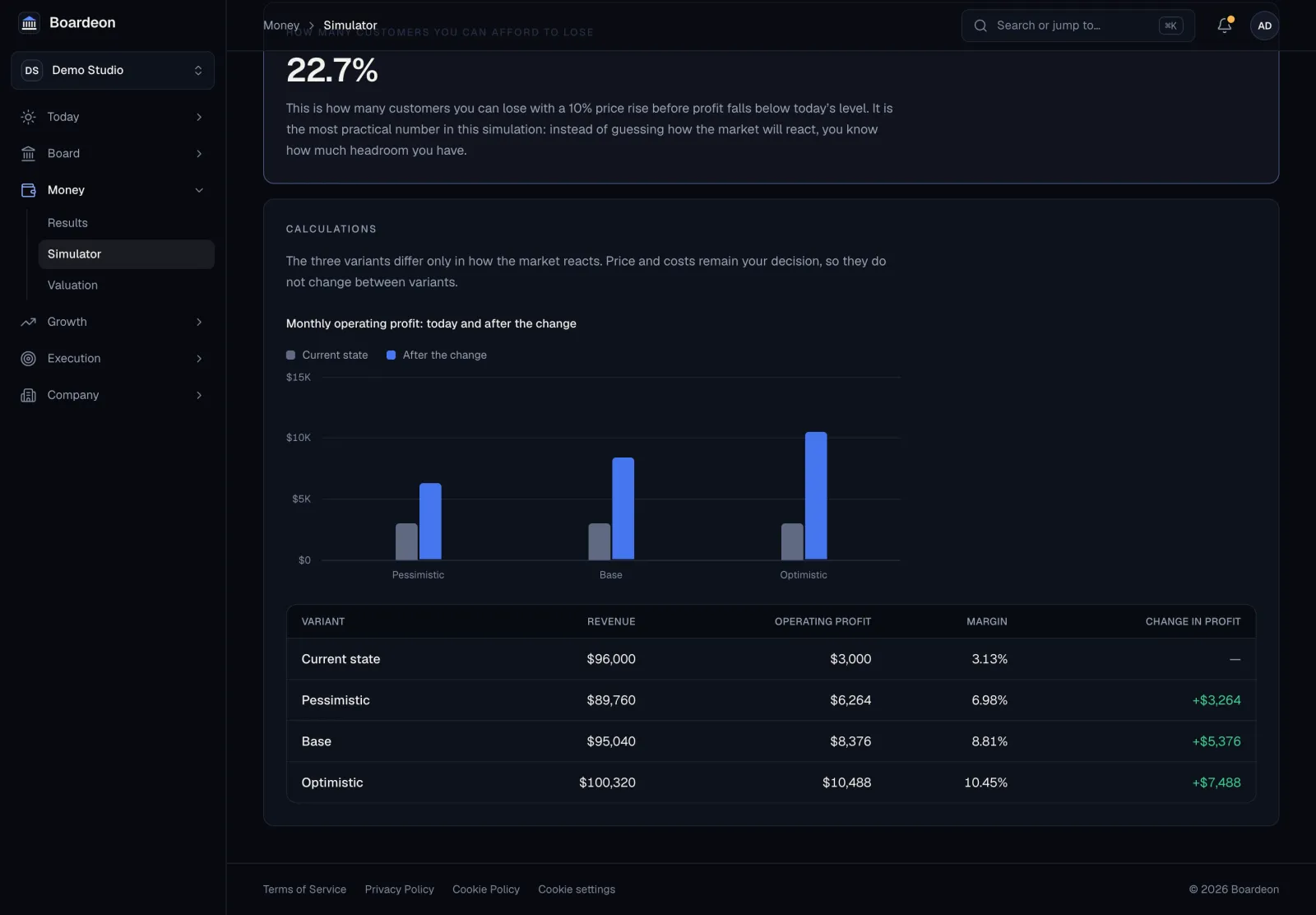
Finance
How to price products and services: margin, markup and the price-increase test
How small companies should set prices: margin vs markup, contribution margin, the price floor, and how many customers you can lose before a price rise stops paying off.
10 min read
Read the guide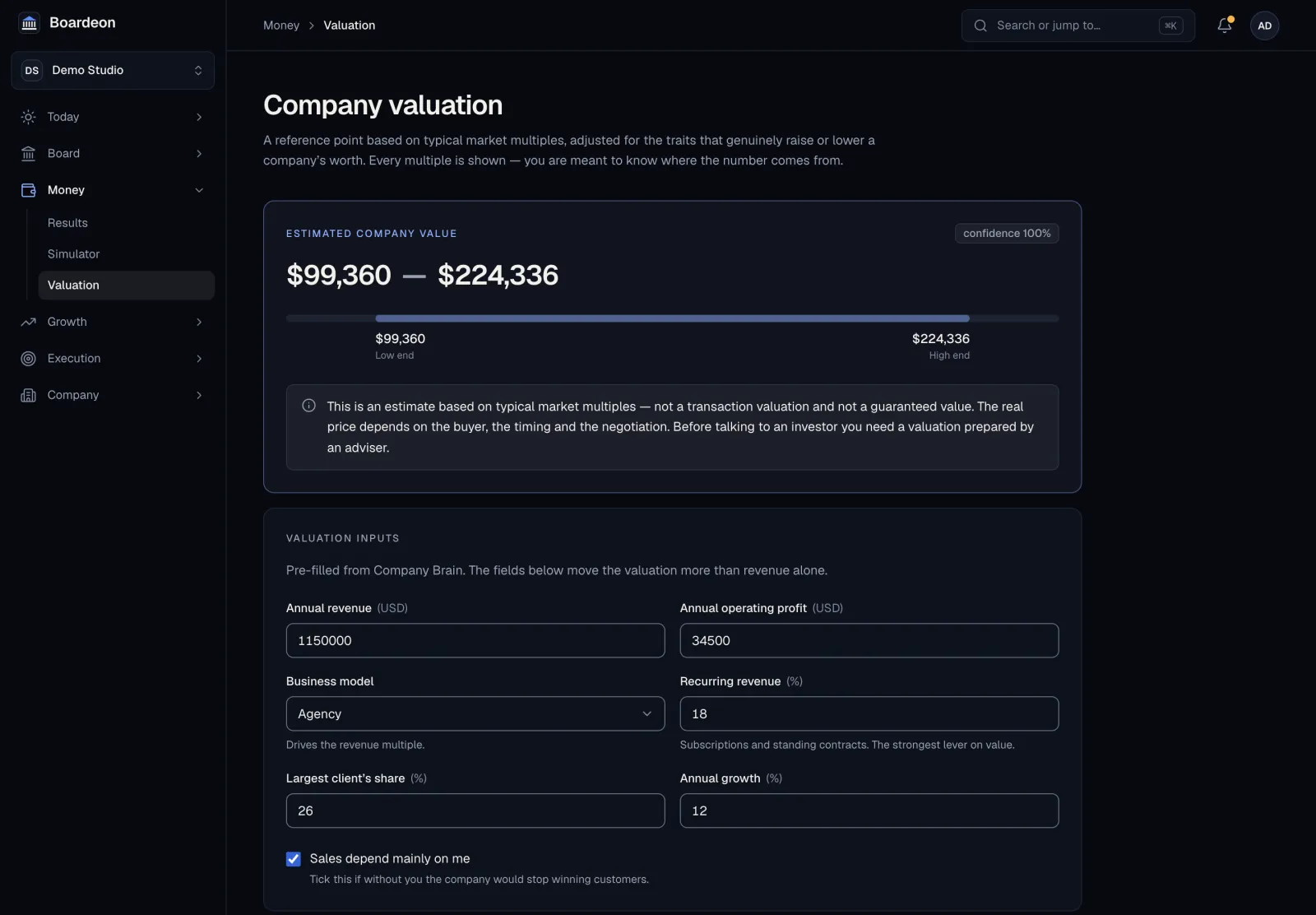
Finance
How to value a small business: revenue and profit multiples, and what moves the price
How small businesses are valued: revenue and profit multiples by model, the traits that raise or cut the price, a worked example and how to increase value.
10 min read
Read the guide
AI
Boardeon vs ChatGPT for running a company: when a general AI assistant is enough
ChatGPT is a general AI assistant; Boardeon is an AI board built on a model of your company. When each one is enough, where the numbers come from, and prices.
11 min read
Read the guide