How to assess the health of your business: an 8-area check-up for owners
A practical way to check your company's health across eight areas — strategy, growth, finance, marketing, sales, operations, digital and AI — and turn the result into a plan.
- Published:
Key takeaways
- A business health check rates a company area by area — strategy, growth, finance, marketing, sales, operations, digital maturity and AI readiness — instead of judging it by revenue alone.
- Every score needs two things to be useful: the reasoning behind it and a confidence level that shows how much of the picture is based on real data.
- Missing data should lower confidence, not the score; otherwise you are measuring how complete the form is, not how healthy the company is.
- The weakest areas, not the most interesting ones, decide what goes into the next 90 days.
- In Boardeon the check-up is an eight-step diagnosis (Company Brain) that produces a deterministic Business Score from 0 to 100 with the reasoning for every area.
Contents
A healthy business is one whose key areas can carry it through the next twelve months without depending on luck or on the owner working harder. You check that by looking at the company area by area — strategy, growth, finance, marketing, sales, operations, digital maturity and readiness for AI — and asking two questions about each: how good is it, and how sure are we? Revenue alone hides more than it shows: a company can grow and still run out of cash, or look profitable while depending on two clients.
This guide gives you a method you can apply with a spreadsheet, the signals worth checking in each area, and a step-by-step walkthrough of the same check-up in Boardeon, where it takes about a quarter of an hour.
What does "business health" actually mean?
Business health is the ability of a company to keep earning, keep delivering and keep improving without a single point of failure. It is a broader idea than profitability. A profitable company with one client worth half its revenue is fragile; a company growing 40% a year with no cash buffer is fragile in a different way.
That is why a useful health check is never one number on its own. It is a set of areas, each with its own evidence. The overall score is a summary for the owner's Monday morning; the areas underneath are where the work is.
There is a sobering reason to do this regularly. According to the U.S. Bureau of Labor Statistics, of the private-sector establishments that opened in 2013, 79.6% were still operating after one year, 50.6% after five years and 34.7% after ten (BLS, Business Employment Dynamics). Most companies do not fail suddenly — they drift, area by area, until one weakness becomes the one that matters.
Which areas should a business health check cover?
Eight areas cover the questions an owner, a lender or a buyer would ask: strategy, growth, finance, marketing, sales, operations, digital maturity and AI readiness. Each one answers a different question, and each one has signals you can check without hiring a consultant.
| Area | The question it answers | Signals worth checking |
|---|---|---|
| Strategy | Do we know where we are going and against whom? | A written description of the business model, a handful of priorities, named competitors, defined markets |
| Growth | Is there room and capacity to grow? | Revenue scale, team capacity, number of sales channels, customer segments, product range |
| Finance | Does the model make money, and do we know our costs? | Gross margin, operating margin, monthly result, knowledge of the cost structure |
| Marketing | Can the right customers find us? | Marketing channels in use, a defined target customer, a website |
| Sales | Can we turn interest into revenue repeatably? | Number of sales channels, segmentation, revenue per employee |
| Operations | Can we deliver without the owner doing everything? | Known operational problems, team structure, defined services |
| Digital maturity | Do we have the basic infrastructure to work at scale? | Own domain and website, tools and systems in use, digital reach channels |
| AI readiness | Are we ready to automate the repetitive work? | Level of AI adoption, technical backbone, recognised repetitive problems |
How do you score each area without fooling yourself?
Score each area from the evidence you can point to, weight the signals that matter most, and record the reasoning next to the number. A score you cannot explain in one sentence is a feeling, not a measurement.
Three rules make the difference between a check-up and a self-assessment quiz:
- Use thresholds, not opinions. "Gross margin of 34%" is a fact; "our margins are fine" is not. Decide in advance what counts as weak and strong for your business model, and map the number onto that range.
- Weight the signals. In finance, gross margin and operating margin say more than whether you have listed your cost categories. Give the important signals more weight and be explicit about it.
- Write the reason down. Next to every score, one line: "Operating margin 3% — no buffer for a weak month." This is what you will need in three months, when you want to know whether the area improved or you simply forgot why you scored it that way.
Missing data lowers confidence, not the score
When you do not know a number, the honest response is to say "unknown", not to score it as zero. If you have not measured customer churn, your sales area is not necessarily bad — you simply know less about it.
This is the most common mistake in DIY scorecards. Penalising empty fields produces a score that measures how complete the form is. Keep two numbers instead: the score from the evidence you have, and a confidence level that shows how much of the picture that evidence covers. A score of 70 with 40% confidence means "probably decent, but go and find out"; a score of 70 with 95% confidence means "decent".
Benchmarks depend on the business model
A gross margin that is excellent for a retailer can be alarming for a software company. Compare yourself against what is typical for your model, not against an average of all companies. An agency, a subscription business and an online shop have different healthy ranges for margin, revenue per employee and customer concentration.
What do the numbers tell you, area by area?
The numbers point to the mechanism behind a weak area — and the mechanism, not the score, tells you what to do. Here is how to read the most common patterns.
Finance. Gross margin is the first number to check, because everything else is paid from it. A low gross margin usually comes from pricing below value or from delivery costs that grew without anyone noticing; the guide on pricing and margin shows how to test both. A positive but thin operating margin — a few percent — means the company works, but has no buffer: one weak month goes straight into a loss. If that is your situation, read how to keep control of cash next.
Growth and sales. Few sales channels and few customer segments mean concentration risk. If most new customers come from referrals and one other channel, growth depends on things you do not control. Revenue per employee is the quickest test of whether work is repeatable: when it is low, the team is usually doing by hand what could be standardised.
Marketing. One defined target customer is not a weakness in itself — focus is good — but if you cannot describe who buys and why, marketing spend gets split by habit rather than by results. The guide on SEO and marketing for small businesses covers positioning and a phrase plan.
Operations. A company of one is, by definition, fully dependent on its founder. That is not a judgement of quality; it is a real operational risk, and it is the single most common reason a good small company turns out to be hard to sell (see how to value a small business).
Digital maturity and AI readiness. These are about infrastructure, not fashion. A company that runs on a website, a CRM, accounting software and a few shared tools can automate repetitive work; a company that runs on e-mail and memory cannot, whatever AI tool it buys. The guide on using AI safely covers where to start.
What does a health check look like on a real example?
Take a nine-person branding and web studio with a gross margin of 34%, an operating margin of 3% and two clients that bring in 31% of revenue. It is the fictional demo company used in the screenshots below, and its profile is typical of an owner-led service business that has grown on referrals.
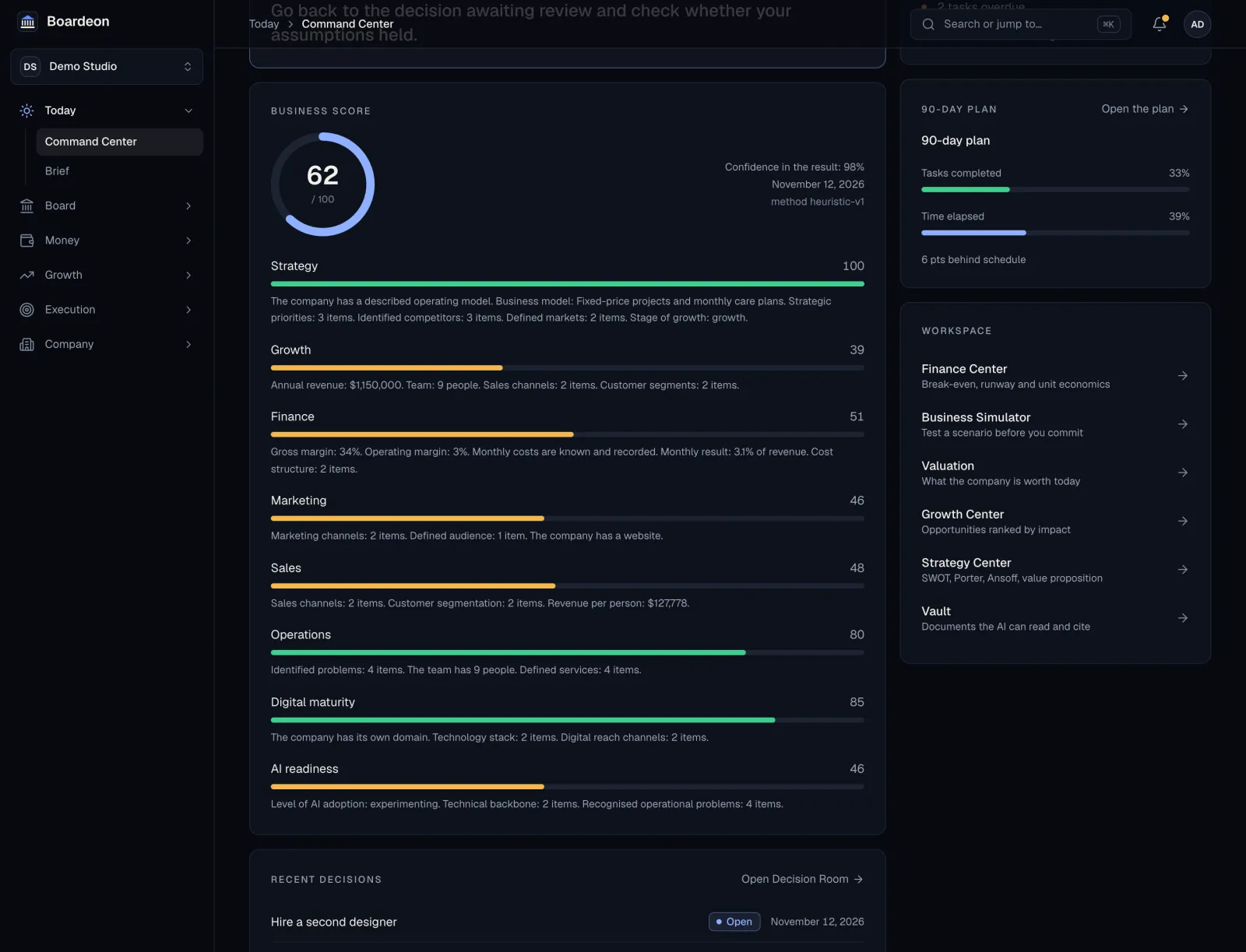
Its check-up gives an overall score of 62 out of 100. On its own, that number says "average". The areas underneath say much more:
| Area | Score | What the evidence says |
|---|---|---|
| Strategy | 100 | Business model described, three priorities, named competitors and markets |
| Digital maturity | 85 | Own domain and website, a few tools in place |
| Operations | 80 | Problems are known and written down, services are defined |
| Finance | 51 | Gross margin 34%, operating margin 3%, monthly result about 3% of revenue |
| Sales | 48 | Two sales channels, two customer segments |
| Marketing | 46 | Two marketing channels, one defined audience |
| AI readiness | 46 | Experimenting with AI, a thin technical backbone |
| Growth | 39 | Revenue scale, team capacity and channel mix limit growth |
The pattern is common: the owner knows exactly where the company is going (strategy scores well), but the engine that pays for the journey — margin, sales channels, marketing — is the weak part. A plan that starts with a new website or a rebrand would be working on the wrong problem. The first quarter should go to the cost structure and pricing, then to finding out which channel actually brings customers.
Notice also what the check-up does not say. It does not say the studio is in trouble — it is profitable, and its operations are solid. It says the company has no buffer, and that its growth depends on a narrow base. That is a very different message from "62 out of 100", and it is the message the owner needs.
How often should you check the health of your business?
Do a full check-up once a quarter and a lighter review every week. The quarterly check-up re-scores all eight areas and resets your priorities; the weekly review looks only at the numbers that move: tasks done, cash, overdue decisions.
Quarterly is the natural rhythm because it matches the planning horizon that works for most small companies — long enough to change something real, short enough that the plan still matches reality. The guide on the 90-day plan explains why a quarter beats a year for owner-led companies.
Re-run the check-up immediately when something structural changes: you lose or win a large client, change your pricing, hire or lose a key person, or enter a new market. A health score that is three months old after a major change is a historical document.
How to run the check-up in Boardeon, step by step
Boardeon turns the method above into a guided diagnosis. The numbers are calculated by tested code, not by a language model, so the same data always gives the same score. The screenshots below show a fictional demo company — a nine-person branding and web studio.
Step 1: Describe the company in Company Brain
Open Company Brain and go through the eight steps of the diagnosis: the company, business model, financial snapshot, customers and markets, sales and marketing, team, goals and problems, technology and AI. Each step saves separately, so you can stop and come back later. Industry and market decide which benchmarks your results are compared against.
Step 2: Fill in the financial snapshot honestly
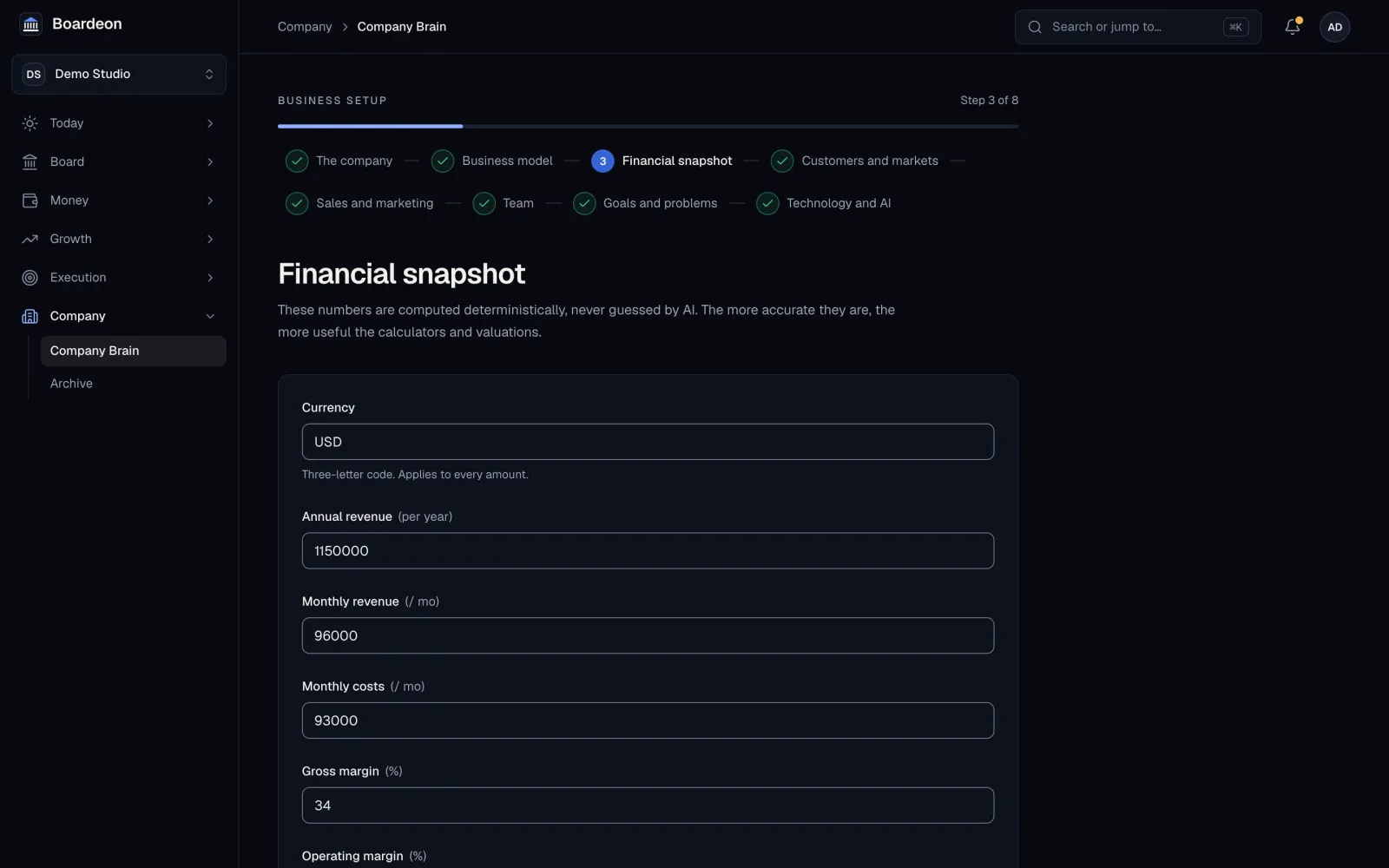
In the financial step, enter monthly revenue, monthly costs, gross margin and operating margin in your own currency. If you do not know a value, leave it empty: an empty field means missing data, not zero, and it lowers the confidence of the result instead of dragging the score down.
Step 3: Read your Business Score area by area
When you save the last step, Boardeon calculates your Business Score: an overall result from 0 to 100 and a score for each of the eight areas. Under every bar you see the reasoning in plain language — "Gross margin: 34%. Operating margin: 3%." — and next to the overall score, the confidence in the result.
Step 4: Check the growth opportunities found in your numbers
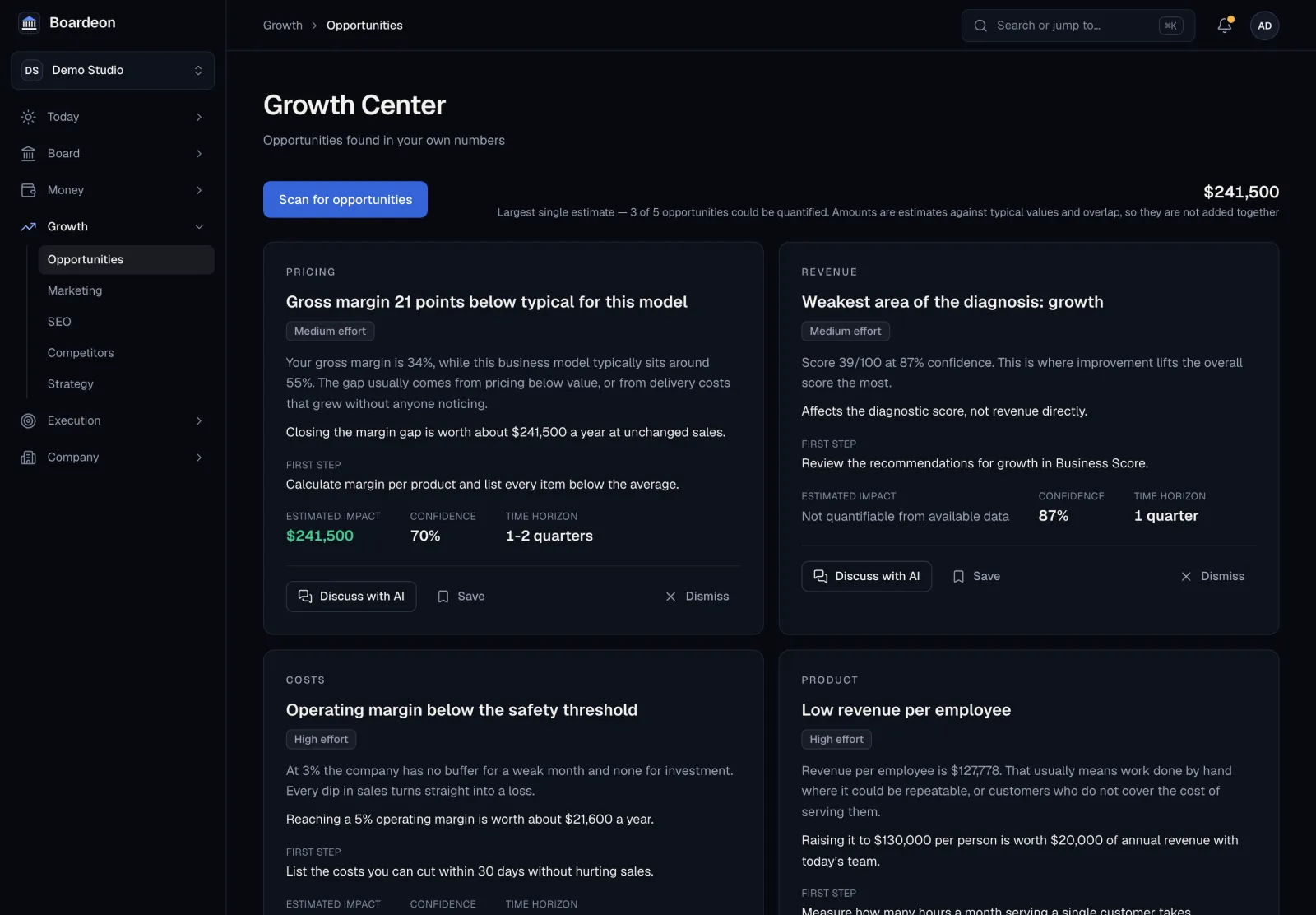
Open Growth Center and run Scan for opportunities. The scanner compares your data with what is typical for your business model and, where the data allows, puts a price on the gap — for example, how much closing a gross-margin gap would be worth at unchanged sales. Amounts are estimates against typical values and overlap, so Boardeon does not add them together.
Step 5: Turn the weakest areas into a 90-day plan
From the 90-day plan screen, build a plan from the diagnosis. Boardeon picks initiatives for the weakest-scoring areas and spreads them over three months — foundation, optimisation, scaling — with at most three initiatives a month, because a plan with fifteen items does not get done.
Step 6: Watch the score on the Command Center
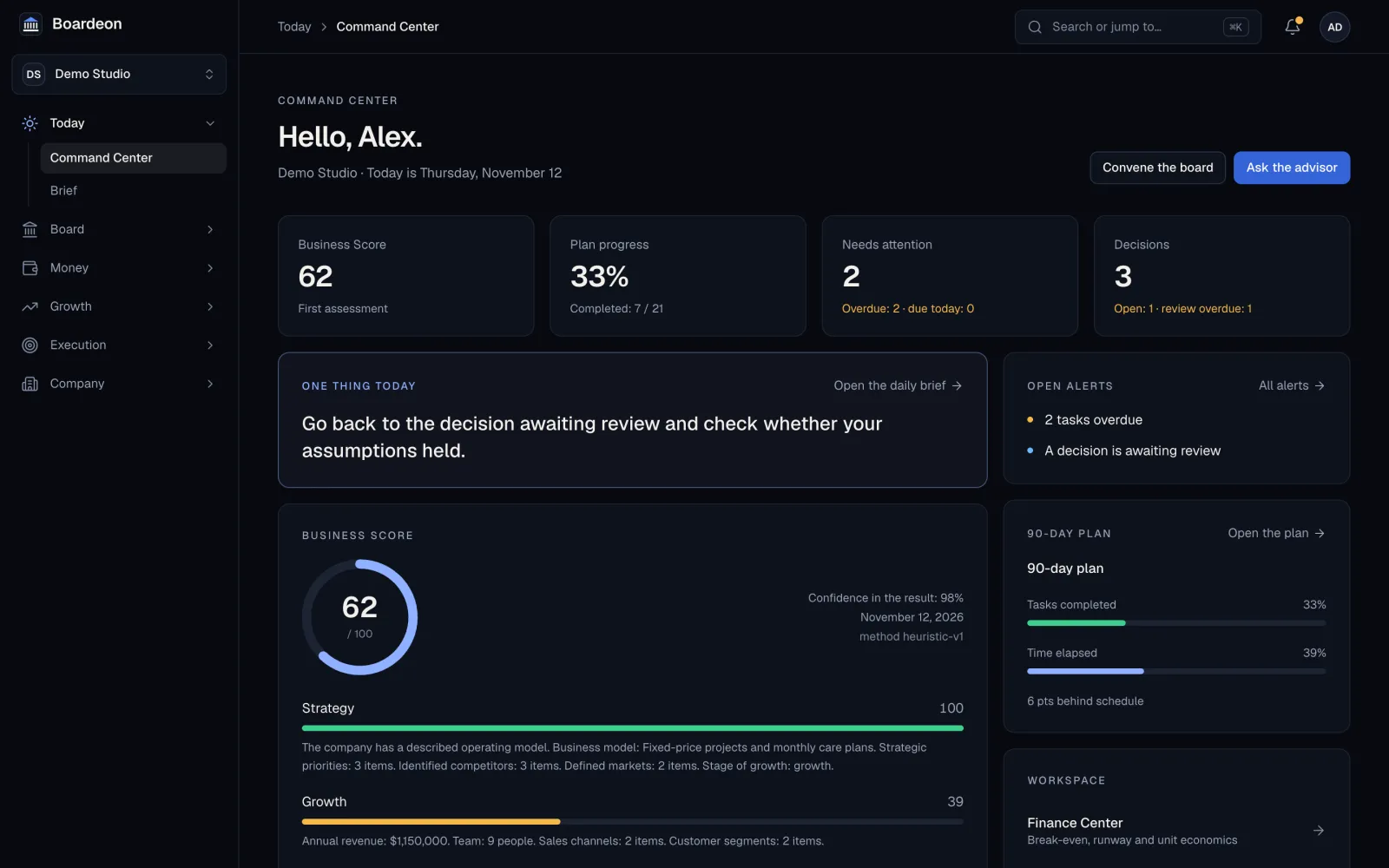
The Command Center shows the score next to plan progress, overdue tasks and open decisions, and the daily brief tells you the one thing worth doing today. When you update Company Brain after the diagnosis, the score is recalculated, so the Command Center and the advisor never show two different numbers.
When is Boardeon not the right tool for this?
If you need an audited assessment for a bank, an investor or a court, you need an accountant or an adviser, not software. Business Score is a transparent heuristic designed to show an owner where to look; it is not a credit rating, an audit opinion or a valuation for a transaction.
It is also not worth it for a company that has not started trading yet: with no revenue, margins or customers, most signals are empty and the confidence of the result will be low. In that case a simple business model canvas and a cash forecast will serve you better for now.
Frequently asked questions
How do I know if my small business is healthy?
Check eight areas — strategy, growth, finance, marketing, sales, operations, digital maturity and AI readiness — against evidence, not impressions. A healthy business has a positive gross and operating margin with some buffer, more than one reliable source of customers, no single client or person it cannot lose, and a written set of priorities that the team actually works on.
What is a business health score?
A business health score is a single number, usually from 0 to 100, that summarises how well a company performs across several areas. It is useful only when it comes with the score for each area, the reasoning behind each score and a confidence level showing how much of it rests on real data.
How is the Boardeon Business Score calculated?
Business Score is calculated by deterministic code from the data in Company Brain, using weighted signals in eight areas, such as gross margin, operating margin, revenue per employee or the number of sales channels. Missing data lowers the confidence of the result, not the score itself. A language model may comment on the result, but never sets it.
How often should I assess the health of my company?
Do a full check-up every quarter and a short weekly review of the numbers that move — tasks, cash and decisions. Re-run the full check-up straight away after any structural change, such as losing a major client, changing prices or hiring a key person.
What should I fix first after a business diagnostic?
Fix the weakest area that the rest of the company depends on — usually finance, because every other improvement is paid for from the margin. Limit yourself to two or three initiatives in the first month and give each one a metric, so you can tell in 90 days whether it worked.
Is a business health check the same as a valuation?
No. A health check tells you how well the company works today and where it is fragile; a valuation estimates what a buyer might pay for it. They are connected — weak areas such as dependence on the owner or on one client also lower a valuation — but they answer different questions.
Sources
- U.S. Bureau of Labor Statistics, Business Employment Dynamics: Establishment age and survival data — survival rates of private-sector establishments opened in 2013: bls.gov/bdm/bdmage.htm
- Boardeon product documentation: how Business Score, Company Brain and the 90-day plan work, as of the date of this guide — see Boardeon's platform overview and pricing.
Hire an AI board for your company
Your AI board applies this to your company’s data and prepares decisions for you to approve. Every plan starts with a 3-day trial for your first company; the diagnosis takes about a quarter of an hour.
Keep reading
All guides →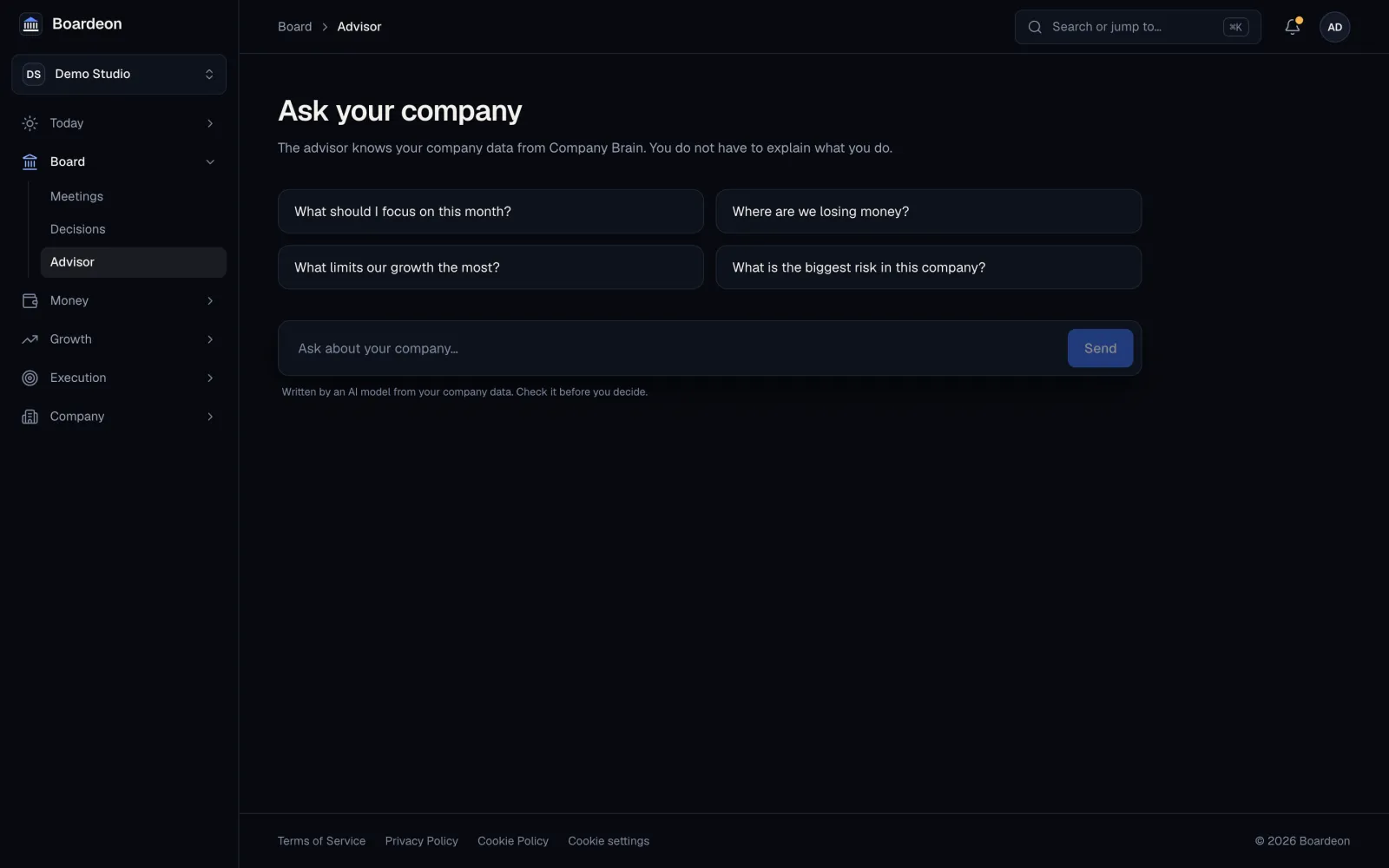
AI
Boardeon vs ChatGPT for running a company: when a general AI assistant is enough
ChatGPT is a general AI assistant; Boardeon is an AI board built on a model of your company. When each one is enough, where the numbers come from, and prices.
11 min read
Read the guide
AI
Boardeon vs MyExecs.ai: two AI boards for small and mid-sized companies, compared
Boardeon and MyExecs.ai both give a company a board of AI executives. How they differ on finance, approvals, integrations, languages, data location and price.
12 min read
Read the guide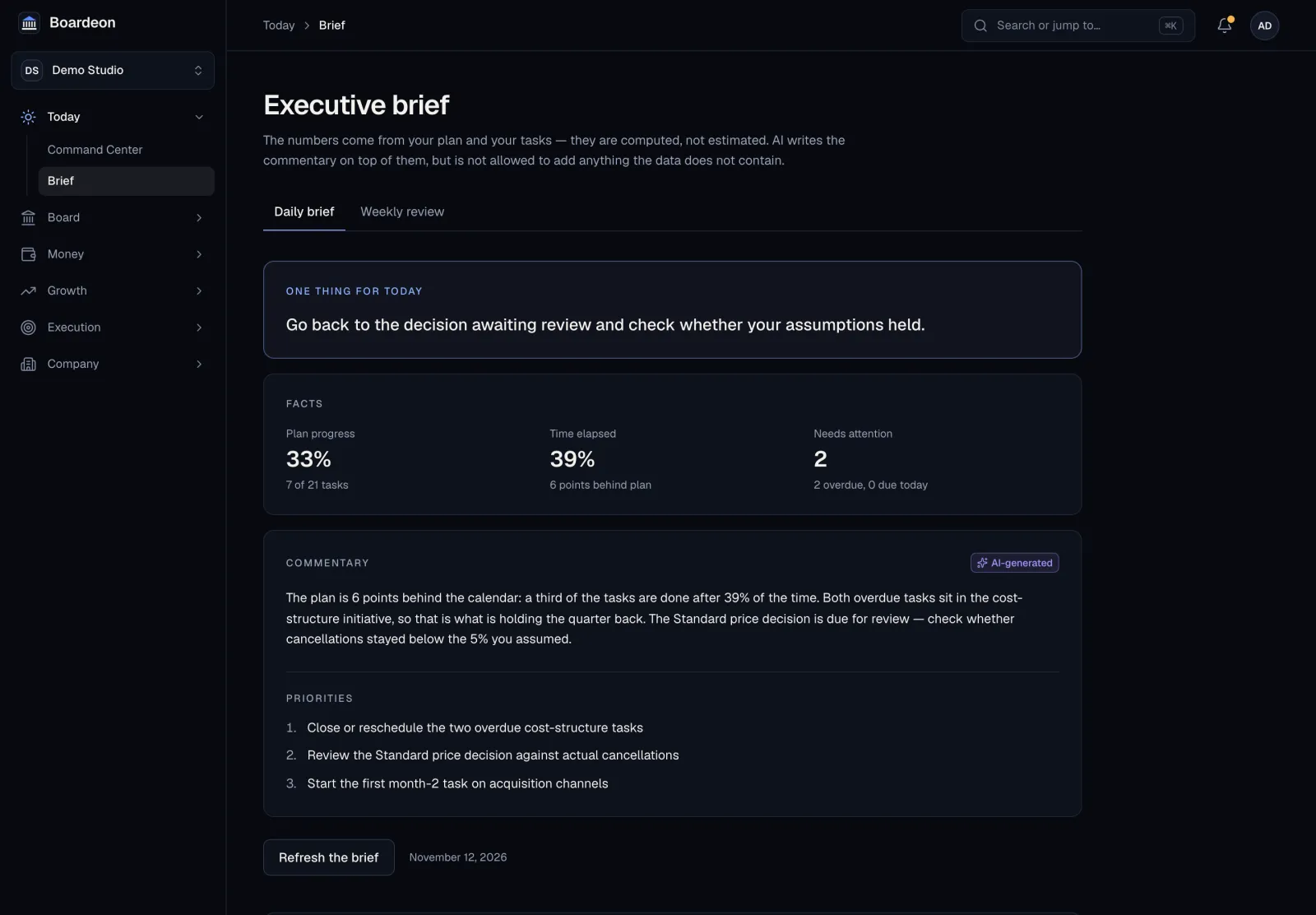
AI
Boardeon vs Hello Alice: a paid AI board with a model of your company, or a free AI advisory board?
Boardeon vs Hello Alice, compared honestly: advisors, health score, daily routine, financial calculations, approvals, integrations, data location and price.
13 min read
Read the guide