SEO and marketing for small businesses: positioning, customer avatar and a keyword plan
A marketing and SEO plan for small companies: one-page positioning, a customer avatar, two channels, a keyword plan by intent and content AI assistants can cite.
- Published:
Key takeaways
- Most small-business marketing fails before it starts: without a written positioning and a defined customer, budget is split by habit rather than by results.
- Positioning fits on one page — category, target customer, differentiator, proof and the alternatives the customer compares you with.
- A keyword plan groups phrases by topic and search intent, and says for each one why it matters and what to write.
- Content that ranks in Google and gets cited by AI assistants is the same content: it answers the question first, uses concrete numbers with sources and is easy to quote.
- In Boardeon, Marketing Center fills positioning and the customer avatar from your company data, Competitors profiles your rivals, and SEO Intelligence proposes phrases with intent, priority and a content idea.
Contents
Effective marketing for a small business starts with two written answers — who exactly you serve and why they should choose you over the alternatives — and only then picks channels and keywords. SEO is one of those channels: it works when you publish pages that answer the questions your customers actually ask, for the phrases that match what you sell. Done in that order, a small company can compete with much larger ones, because it can be more specific than they are.
This guide walks through positioning, the customer avatar, choosing channels, building a keyword plan by search intent, writing content that ranks in Google and gets cited by AI assistants, measuring results, and doing all of it in Boardeon.
Why do small businesses waste so much of their marketing budget?
Because they spend before they decide who they are for, so every channel and every message ends up aimed at everyone. A message aimed at everyone reaches no one in particular.
The symptoms are familiar:
- Many channels, none done well. A little advertising, an occasional post, a newsletter that goes out when someone remembers.
- No idea which channel works. Asked where new customers come from, the owner says "referrals, mostly" — and nobody has counted.
- Content without intent. Blog posts about company news instead of answers to the questions customers type into a search engine.
- Competing on price by default. Without a clear difference, the customer compares the only thing left.
The fix is not more activity. It is a short sequence of decisions: positioning, customer, channels, then content.
How do you define positioning on one page?
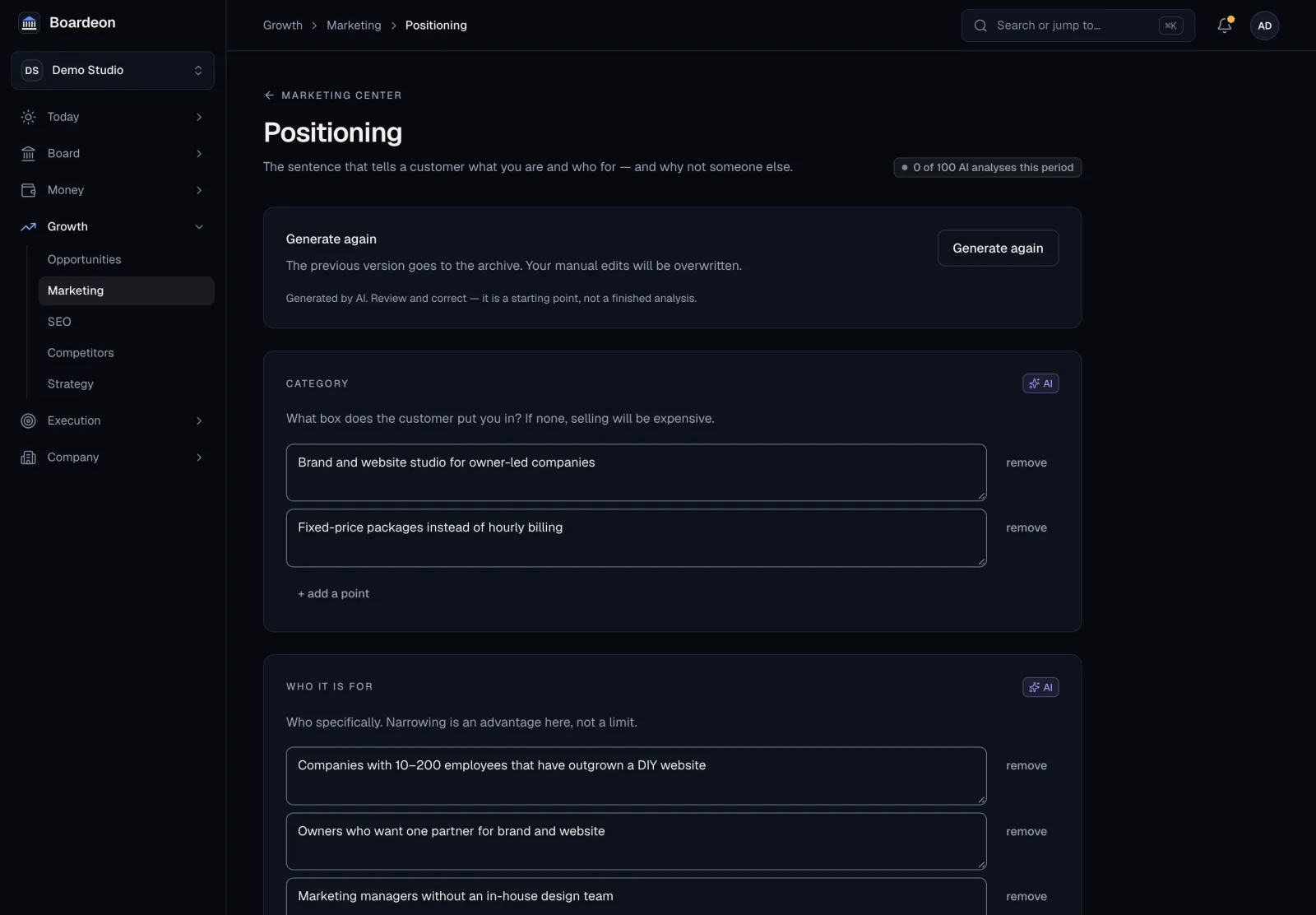
Positioning is the place your company occupies in the customer's mind relative to the alternatives, and you can define it with five parts: category, target customer, differentiator, proof and alternatives. If you cannot fill all five in a few lines each, your marketing will not be able to say it either.
| Part | Question | Example — a small branding and web studio |
|---|---|---|
| Category | What are we, in the customer's words? | Brand and website studio for owner-led companies |
| Target | Who exactly is it for? | Companies of 10–200 people that have outgrown a DIY website |
| Differentiator | What do we do that the alternatives do not? | Fixed price and scope agreed before work starts; brand and website by one team |
| Proof | Why should anyone believe it? | Package scope written down line by line; portfolio in the client's industry |
| Alternatives | What does the customer compare us with? | Freelancers, large agencies, website builders |
The alternatives row is the one most companies skip and the one that matters most. Customers never choose in a vacuum; they choose between you, a cheaper option, a more prestigious option and doing nothing. Your differentiator must be different from those, not from an imaginary average competitor.
What is a customer avatar, and what should it include?
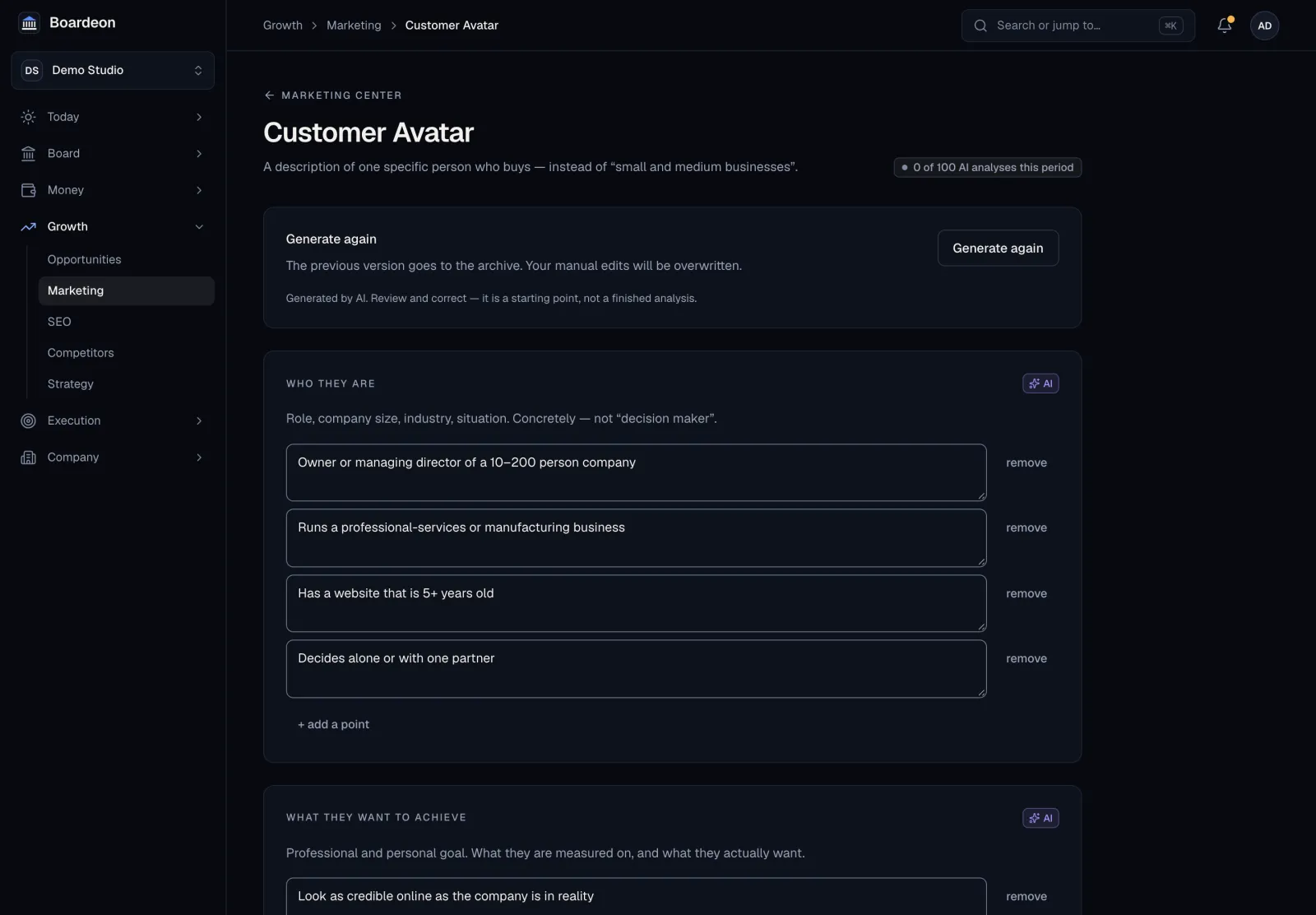
A customer avatar is a written description of the specific person who buys from you — their role, goals, pains, objections, where they spend attention and what triggers a purchase. It turns "small and medium businesses" into someone your team can picture when writing a page or an e-mail.
Six sections are enough:
- Who — role, company size, industry, how decisions are made.
- Goals — what they want to achieve, in their words.
- Pains — what is not working today and what they have tried.
- Objections — the reasons they hesitate: price, risk, timing, past bad experiences.
- Where — where they look for information and whom they trust.
- Triggers — the events that make them start looking: a merger, a hiring push, a lost deal.
Triggers and objections are the most valuable parts for SEO: triggers tell you when people search, objections tell you what they need to read before they buy.
How do you choose marketing channels?
Choose two channels that your customers already use and that you can run consistently, measure which one brings customers, and only then add a third. Consistency beats coverage: a newsletter sent every two weeks for a year outperforms five channels used sporadically.
A practical test for each channel: can we keep it going every week for 90 days with the people we have? If not, it is not a channel, it is an experiment. Then count: for every new customer this quarter, write down where they first heard of you. The share of each channel in new customers is the metric that decides where the next budget goes — a natural initiative for your 90-day plan.
How do you build a keyword plan for a small business?
Group the phrases your customers search for into topic clusters, label each phrase with its search intent, give it a priority, and write down why it matters and what page or article it needs. A short, deliberate list beats a long export from a keyword tool.
Search intent is the reason behind the query, and it decides what kind of page can rank:
| Intent | What the searcher wants | Example | The page you need |
|---|---|---|---|
| Informational | To understand or learn | how much does a brand identity cost | A guide that answers the question in full |
| Commercial | To compare options | brand identity design for small business | A service page or a comparison |
| Transactional | To buy or sign up | website maintenance plan | An offer page with price and next step |
| Navigational | To find a specific brand | [your company name] reviews | Your homepage, reviews and profiles |
For each cluster, aim for one strong commercial page and a few informational articles that link to it. A plan of six to ten phrases for a quarter is realistic for a small company; more is usually a list nobody acts on.
How do you write content that ranks and gets cited by AI assistants?
Write for the person asking the question: answer it in the first sentences, then give the detail, the numbers and the sources. That is what Google asks for, and it is also what makes a page easy for an AI assistant to quote.
Google's guidance is to create "helpful, reliable, people-first content" rather than content made primarily to rank (Google Search Central). For AI features, Google states that "there are no additional requirements to appear in AI Overviews or AI Mode, nor other special optimizations necessary" (Google Search Central, AI features and your website) — the same pages that deserve to rank are the ones that get used.
Research on generative engines points the same way. In the study that coined the term generative engine optimization, adding citations, quotations and statistics improved a source's visibility in AI-generated answers by roughly 30–40%, while keyword stuffing performed poorly (Aggarwal et al., GEO: Generative Engine Optimization, KDD 2024).
In practice:
- Answer first. Put a direct answer in the first one or two sentences under each heading.
- Use questions as headings. They match how people search and how assistants are asked.
- Make paragraphs stand alone. A paragraph quoted out of context should still make sense — name the subject instead of writing "it".
- Use concrete numbers with sources, and tables for comparisons.
- Format for scanning. Readers scan pages in an F-shaped pattern, and good formatting — clear headings, short paragraphs, lists — reduces the cost of that scanning (Nielsen Norman Group).
- Show who wrote it and when it was updated.
How do you measure SEO results?
Use the Performance report in Google Search Console: it shows the queries your pages appear for, their impressions, clicks, click-through rate and average position. Check it monthly; SEO moves in months, not days.
The report "shows important metrics about how your site performs in Google Search results" (Google Search Console Help). Watch impressions first — they rise before clicks do — then clicks for the phrases in your plan, then the conversions those visits lead to. If a page gets impressions but few clicks, rewrite its title and description; if it gets clicks but no enquiries, fix the offer and the call to action.
How to build your marketing and SEO plan in Boardeon, step by step
Boardeon fills marketing frameworks and phrase lists from your Company Brain and your documents, so nothing starts from a blank page, and every point stays editable. The screenshots show a fictional demo company with example content.
Step 1: Fill in positioning in Marketing Center
Open Marketing Center (Growth → Marketing) and choose Positioning. Click Fill in with AI: Boardeon fills the framework — category, target, differentiator, proof, alternatives — from Company Brain and your documents. Then correct every point; it is your analysis, not the model's.
Step 2: Describe your customer with the customer avatar
In the same Marketing Center, open Customer avatar and fill it the same way: who, goals, pains, objections, where they look for information and what triggers a purchase. Marketing Center also contains offer, marketing funnel, content strategy and campaign plan frameworks.
Step 3: Profile your competitors
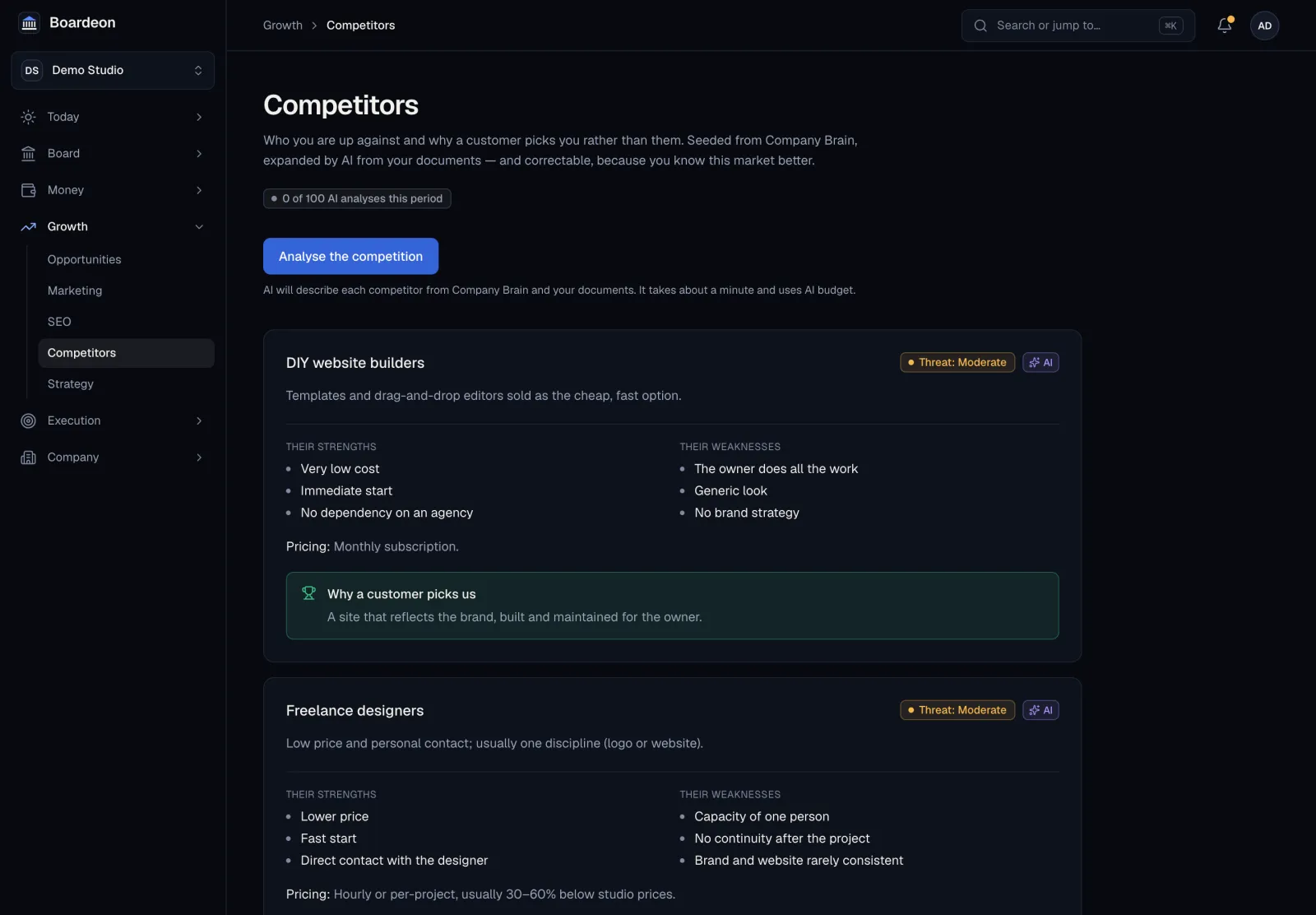
Open Competitors. The list starts from the competitors in Company Brain; Analyse the competition asks AI to describe each one from your data and documents: how they position themselves, their strengths and weaknesses, their pricing, why a customer picks you and the level of threat. You can correct everything.
Step 4: Propose phrases in SEO Intelligence
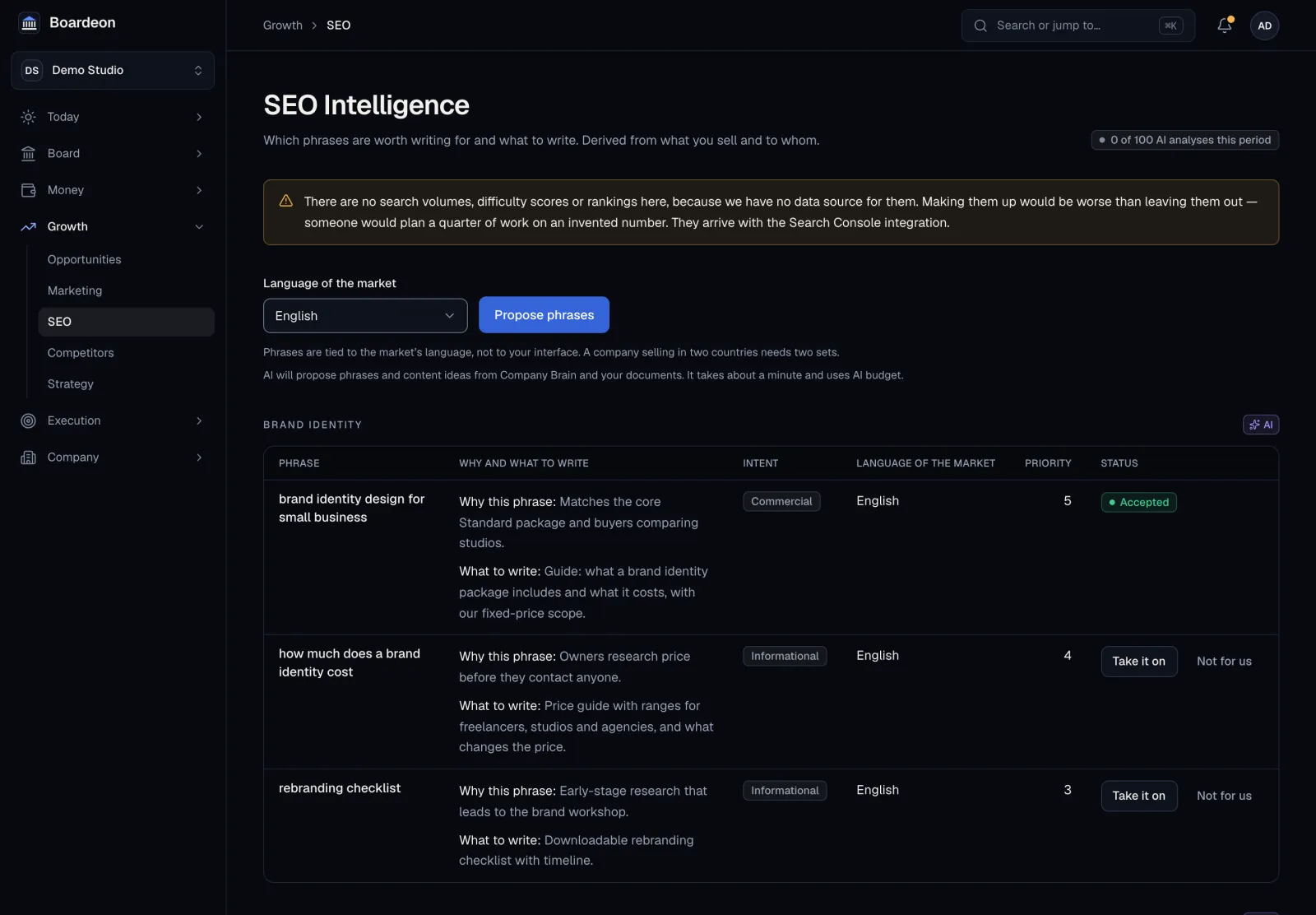
Open SEO Intelligence (Growth → SEO), choose the language of the market — phrases are tied to the market, not to your interface, so a company selling in two countries needs two sets — and click Propose phrases. Boardeon groups the phrases in topic clusters and gives each one an intent, a priority from 1 to 5, why the phrase matters and what to write.
Step 5: Accept the phrases you will work on
Mark each phrase Take it on or Not for us. The accepted ones become your content plan; add the most important pages to your 90-day plan with a deadline and an owner. Analyses use your plan's monthly allowance: 20 a month in Entrepreneur, 100 in Executive (see pricing).
Step 6: Check results in Google Search Console
Publish, then check Search Console every month for the phrases you accepted: impressions, clicks and position. Boardeon does not yet read Search Console data, so this step happens in Google's tool.
When is Boardeon not the right tool for marketing and SEO?
Boardeon is a planning and decision tool, not a marketing execution suite. It does not provide search volumes, keyword difficulty or rank tracking, does not run or optimise ad campaigns, and does not publish content to your website or social media. For those, use Search Console, a keyword research tool and your ad and publishing platforms.
If you already have a marketing team with a mature process and tools, Boardeon's frameworks add less; their value is highest for owners who have never written down their positioning or their customer.
Frequently asked questions
How should a small business start with SEO?
Start by writing down your positioning and your target customer, then list six to ten phrases those customers search for, grouped by topic and labelled by intent. Create one strong page for each commercial phrase and a few articles answering informational questions, and connect Google Search Console to measure results.
How do I write a positioning statement?
Define five things: the category you belong to in the customer's words, who exactly you serve, what you do differently from the alternatives, the proof that makes it believable, and the alternatives the customer compares you with. Keep each to a few lines; if you cannot, the positioning is not clear yet.
What is a customer avatar?
A customer avatar is a written profile of the specific person who buys from you: their role, goals, pains, objections, where they look for information and the events that trigger a purchase. It helps your team write marketing and sales material aimed at one real person rather than at everyone.
How do I choose keywords for a small business website?
Choose phrases that match what you sell and the questions your customers ask, label each with its search intent — informational, commercial, transactional or navigational — and prioritise the commercial ones closest to a purchase. Check real demand in Search Console or a keyword research tool before investing in a page.
How can a small business appear in AI Overviews or ChatGPT answers?
There is no special trick: Google says no additional optimisation is needed for AI Overviews. Publish helpful pages that answer questions directly, use concrete numbers with sources, make paragraphs quotable on their own, keep pages indexable, and make sure your brand is described consistently across the web.
Does Boardeon show search volumes for keywords?
No. Boardeon does not show search volumes, difficulty scores or rankings because it has no data source for them, and inventing them would mislead you. It proposes phrases with intent, priority and a content idea; use Search Console or a keyword research tool for the numbers.
Sources
- Google Search Central, Creating helpful, reliable, people-first content: developers.google.com
- Google Search Central, AI features and your website: developers.google.com
- Google Search Console Help, Performance report (Search results): support.google.com
- Pranjal Aggarwal et al., GEO: Generative Engine Optimization, KDD 2024: arxiv.org/abs/2311.09735
- Kara Pernice, F-Shaped Pattern of Reading on the Web: Misunderstood, But Still Relevant, Nielsen Norman Group: nngroup.com
- Related guides: how to price products and services and the business health check.
Hire an AI board for your company
Your AI board applies this to your company’s data and prepares decisions for you to approve. Every plan starts with a 3-day trial for your first company; the diagnosis takes about a quarter of an hour.
Keep reading
All guides →
AI
Boardeon vs ChatGPT for running a company: when a general AI assistant is enough
ChatGPT is a general AI assistant; Boardeon is an AI board built on a model of your company. When each one is enough, where the numbers come from, and prices.
11 min read
Read the guide
AI
Boardeon vs MyExecs.ai: two AI boards for small and mid-sized companies, compared
Boardeon and MyExecs.ai both give a company a board of AI executives. How they differ on finance, approvals, integrations, languages, data location and price.
12 min read
Read the guide
AI
Boardeon vs Hello Alice: a paid AI board with a model of your company, or a free AI advisory board?
Boardeon vs Hello Alice, compared honestly: advisors, health score, daily routine, financial calculations, approvals, integrations, data location and price.
13 min read
Read the guide