How to value a small business: revenue and profit multiples, and what moves the price
How small businesses are valued: revenue and profit multiples by model, the traits that raise or cut the price, a worked example and how to increase value.
- Published:
Key takeaways
- Small businesses are usually valued with a multiple of profit or revenue, adjusted for the traits that make the company more or less risky for a buyer.
- Which multiple matters depends on the model: subscription and online businesses are valued mostly on revenue, agencies and service firms mostly on profit.
- Dependence on the owner, a single client above 25% of revenue (more so above 40%) and mostly one-off revenue are the traits that cut the price most; recurring revenue, growth and a high margin raise it.
- A valuation is a range, not a number — the gap between methods is information about whether the company is valued for its scale or its profitability.
- Boardeon's Company Valuation shows every multiple, every adjustment and the actions that would raise the value; it is a reference point, not a transaction valuation.
Contents
A small business is usually worth a multiple of its annual profit or revenue — the multiple depending on the business model — adjusted up or down for the traits that make it more or less risky for a buyer. Two companies with the same profit can be worth very different amounts: the one that runs without its owner, has many clients and earns recurring revenue will sell for far more than the one that depends on the founder and two large contracts. The useful answer is therefore never a single number but a range, with the reasons behind it.
This guide explains the main valuation methods for small businesses, which multiple applies to which model, the traits that move the price, a worked example, the actions that raise your company's value, and how to get a transparent estimate in Boardeon in about fifteen minutes.
What is a small business actually worth?
A business is worth what a willing buyer pays a willing seller, so any valuation before a sale is an estimate of the range in which that price is likely to fall. The estimate is still worth having, long before you think of selling: it tells you which parts of the company create value and which destroy it.
For context, in the United States the median small business sold in the third quarter of 2026 changed hands for $350,000, across 2,132 transactions reported by BizBuySell (BizBuySell Insight Report). Medians hide enormous variation by industry, size and quality, which is exactly why the method matters more than the market average.
Owners value their companies for many reasons besides a sale: bringing in a partner, buying out a co-founder, raising capital, planning succession, or simply measuring whether the work of the last year made the company more valuable.
Which valuation methods are used for small businesses?
Most small-business valuations use a multiple of profit or of revenue; larger or very predictable businesses may also use a discounted cash flow, and asset-heavy ones an asset-based value. Each method answers a slightly different question.
| Method | How it works | When it fits |
|---|---|---|
| Profit multiple (EBITDA or operating profit) | Annual profit × a multiple | Profitable companies, especially services and agencies |
| Seller's discretionary earnings (SDE) | Profit plus the owner's salary and perks × a multiple | Very small, owner-operated businesses, common among US brokers |
| Revenue multiple | Annual revenue × a multiple | Subscription and online businesses that reinvest profit, or fast-growing companies |
| Discounted cash flow (DCF) | Future cash flows discounted to today | Stable, predictable businesses with reliable forecasts |
| Asset-based | Value of assets minus liabilities | Holding companies, asset-heavy or loss-making businesses |
Because a buyer is paying for future profit, profit-based methods are the default for small companies. Revenue multiples matter where current profit understates value — a subscription company deliberately reinvesting in growth, for example.
Which multiple applies to my business?
The multiple depends on how predictable and scalable your revenue is: subscription models earn the highest revenue multiples, project-based services the lowest, and profit multiples rise with the size of the company. Boardeon uses the following reference ranges — typical points for small and mid-sized companies, not the price of any particular transaction:
| Business model | Revenue multiple used by Boardeon | Weight of the revenue method |
|---|---|---|
| SaaS / subscription | 2.0–6.0× | 75% |
| Online retail | 0.6–2.0× | 60% |
| Product | 0.8–2.5× | 50% |
| Mixed / other | 0.5–1.5× | 50% |
| Agency | 0.5–1.2× | 30% |
| Services | 0.4–1.0× | 25% |
For the profit method, the multiple grows with the company: from 2–3.5× annual operating profit for the smallest companies to 5–9× for the largest. Larger companies are less dependent on individuals, easier to finance and cheaper to integrate, so buyers pay more per unit of profit.
The weights explain a common source of confusion. A SaaS company is valued mostly on revenue, because the buyer pays for the customer base and its predictability; an agency is valued mostly on profit, because what matters is what actually remains. Combining both methods with weights keeps the range narrow enough to be useful.
Why do two companies with the same profit sell for different prices?
Because buyers pay for future profit and discount every risk that threatens it — and the biggest risks in small companies are dependence on the owner, on a few clients and on revenue that has to be won again every year. These traits move the price more than a few percent of extra revenue.
The adjustments Boardeon applies show the size of these effects:
| Trait | Adjustment | Why a buyer cares |
|---|---|---|
| Sales depend mainly on the owner | −25% | The buyer acquires a company that stops selling without you |
| Team of one or two people | −20% | Most of the operating capability leaves with the owner |
| One client is 40% of revenue or more | −30% | Losing one contract overturns the company |
| One client is 25–40% of revenue | −15% | Noticeable concentration raises the risk |
| Recurring revenue of 70% or more | +25% | Predictability is worth paying for |
| Recurring revenue below 25% | −15% | The company starts each year from zero |
| Growth of 30% a year or more | +20% | The buyer is paying for the future |
| Falling revenue | −25% | Lowers value regardless of current profit |
| Gross margin of 70% or more | +15% | Revenue growth turns into profit quickly |
The adjustments are added together and capped at ±60%, because three qualitative traits should not wipe out 90% of a company's value. Owner dependence is the single most common reason a good small services company turns out to be hard to sell.
How do you calculate a valuation range? A worked example
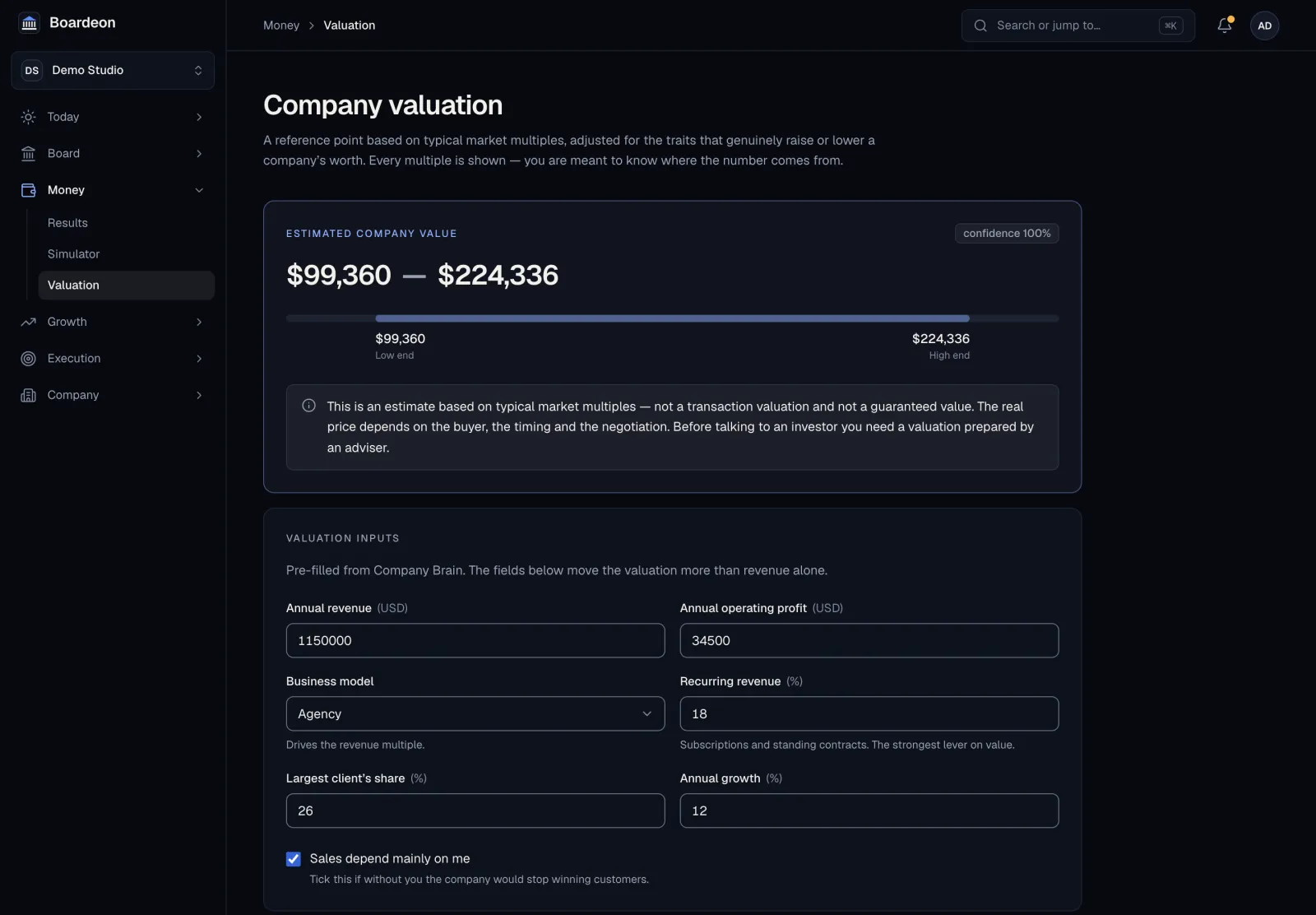
Calculate a range with each method, weight the methods by business model, then apply the adjustments. Take the fictional demo company from the screenshots: a branding and web agency with annual revenue of $1,150,000 and annual operating profit of $34,500.
- Revenue method (agency, 0.5–1.2×): $575,000 to $1,380,000, weight 30%.
- Profit method (smallest size band, 2–3.5×): $69,000 to $120,750, weight 70%.
- Weighted range before adjustments: low = 0.3 × 575,000 + 0.7 × 69,000 = $220,800; high = 0.3 × 1,380,000 + 0.7 × 120,750 = $498,525.
- Adjustments: sales depend on the owner (−25%), the largest client is 26% of revenue (−15%), recurring revenue is 18% (−15%) — a total of −55%.
- Result: $220,800 × 0.45 to $498,525 × 0.45 = $99,360 to $224,336.
The lesson is uncomfortable but useful: more than half of this company's potential value is lost to three traits that the owner can change. None of them requires selling more.
How can you increase the value of your company?
Remove the risks a buyer would discount, and improve the economics that a multiple amplifies. The actions are the same whether you plan to sell in two years or never — they also make the company easier to run.
- Hand part of the sales relationships to someone else and document the sales process. It is the most effective way to reduce owner dependence.
- Convert some one-off work into standing contracts or a subscription. Recurring revenue is the strongest single lever on value.
- Reduce the largest client's share by winning two or three comparable clients.
- Raise the gross margin. Under multiple-based valuation, margin works harder than sales growth; the pricing guide shows how to test a price change.
- Build a team that can run the company without your daily presence.
- Put the paperwork in order: contracts, processes and financial statements. Chaos lowers the price in negotiations.
These are also natural initiatives for a 90-day plan: each has a clear metric, and each shows up in the next valuation.
How to estimate your company's value in Boardeon, step by step
Boardeon calculates the valuation with deterministic code and shows every multiple, weight and adjustment, so you can see where the number comes from. Company Valuation is part of the Executive plan.
Step 1: Open Company valuation
Go to Valuation (Money → Valuation). Annual revenue, operating profit and the business model are pre-filled from Company Brain. The model is a starting point: change it if Boardeon guessed it wrong.
Step 2: Fill in the fields that move the value
Add recurring revenue (the share of subscriptions and standing contracts), the largest client's share, annual growth, and tick Sales depend mainly on me if, without you, the company would stop winning customers. The confidence of the result shows how many of the inputs that matter you have provided.
Step 3: Read the range and the methods
The top of the screen shows the estimated range. Below it, Valuation methods shows the revenue multiple and the operating-profit multiple separately, with each method's weight in the result and the total adjustment for company traits. A wide gap between the methods tells you whether the company is valued more for scale or for profit.
Step 4: Read what moves the valuation — and how to raise it
What moves the valuation lists every trait that changed the result, with its percentage impact and an explanation. How to raise the company's value turns those traits into concrete actions — for the demo company, delegating sales relationships, converting one-off work into contracts and reducing the largest client's share.

Step 5: Turn the improvements into initiatives
Pick one or two improvements and add them to your next 90-day plan, or put the bigger ones — hiring a sales lead, launching a subscription — in front of AI Boardroom. Test the economics first in Business Simulator.
Step 6: Re-check the valuation every quarter
Update Company Brain when revenue, profit or your client mix change, and come back to the valuation at the end of each quarter. The trend matters more than any single estimate.
When is Boardeon not the right tool for a valuation?
Before a sale, an investment round, a partner buy-out, an inheritance or any tax or legal matter, you need a valuation prepared by a qualified adviser. Boardeon's estimate is a reference point based on typical market multiples — not a transaction valuation and not a guaranteed value. The real price depends on the buyer, the timing, the terms of the deal and the negotiation.
The reference multiples are also general: they do not reflect a specific country, industry niche or the state of the market in a given quarter. Use Boardeon to understand and improve the drivers of value; use an adviser to put a price on them.
Frequently asked questions
How much is my small business worth?
Most small businesses are worth a multiple of their annual profit — typically low single digits for small companies — or, for subscription and online models, a multiple of revenue. The exact figure depends on the business model, size, growth, margin and risks such as dependence on the owner or on a few clients. A valuation should be expressed as a range.
What multiple is used to value a small business?
Profitable small companies are usually valued at a multiple of annual operating profit or EBITDA; very small owner-operated businesses in the US often use seller's discretionary earnings. Boardeon's reference ranges run from 2–3.5× operating profit for the smallest companies to 5–9× for the largest, and from 0.4–1.0× revenue for services to 2–6× for subscription businesses.
Should I value my business on revenue or on profit?
Use profit for agencies, service firms and most traditional businesses, where buyers pay for what actually remains. Use revenue for subscription and online businesses, where buyers pay for the customer base and predictability and current profit is often reinvested. Combining both, weighted by business model, gives a more useful range.
What lowers the value of a small business?
The biggest negatives are sales that depend on the owner, one client accounting for a large share of revenue, revenue that is mostly one-off, a very small team and falling revenue. Each of them makes future profit less certain for a buyer, so each reduces the price.
How can I increase the value of my business before selling?
Reduce owner dependence by delegating sales and documenting processes, increase the share of recurring revenue, diversify your client base, raise your gross margin and get your contracts and financial statements in order. Start at least one to two years before a planned sale; buyers look at the trend, not just the latest year.
Is Boardeon's valuation accepted by banks or investors?
No. It is an estimate based on typical market multiples, designed to show an owner what drives the value of the company. For a sale, an investment, a loan or any legal or tax purpose, you need a valuation prepared by a qualified adviser.
Sources
- BizBuySell (CoStar Group), Insight Report, Q3 2026 — median sale price of small businesses sold in the US and number of transactions: bizbuysell.com/insight-report
- Valuation multiples, weights and adjustments: Boardeon's valuation model as of the date of this guide — reference points, not market data for a specific transaction. Related guides: business health check and the 90-day plan.
Hire an AI board for your company
Your AI board applies this to your company’s data and prepares decisions for you to approve. Every plan starts with a 3-day trial for your first company; the diagnosis takes about a quarter of an hour.
Keep reading
All guides →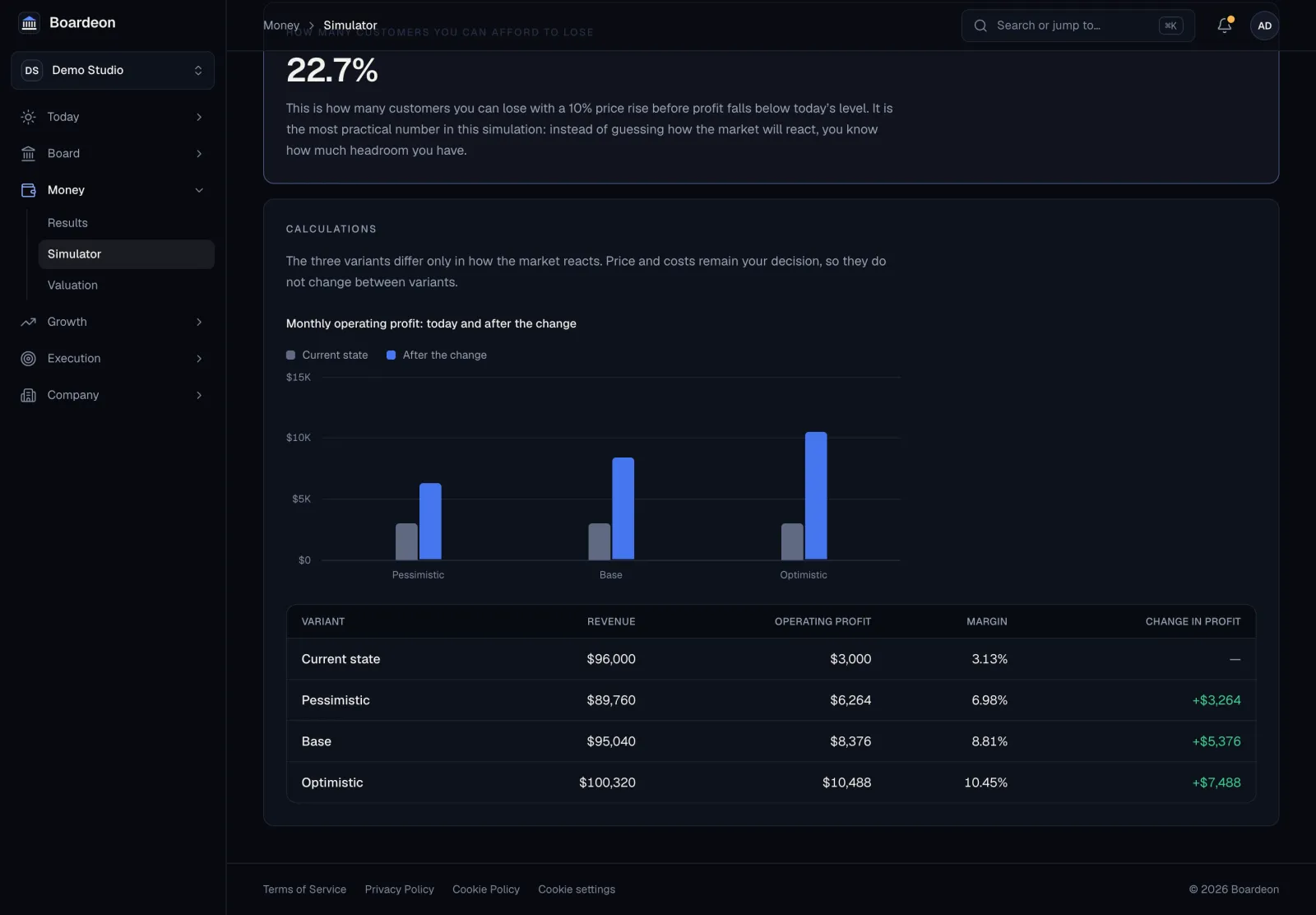
Finance
How to price products and services: margin, markup and the price-increase test
How small companies should set prices: margin vs markup, contribution margin, the price floor, and how many customers you can lose before a price rise stops paying off.
10 min read
Read the guide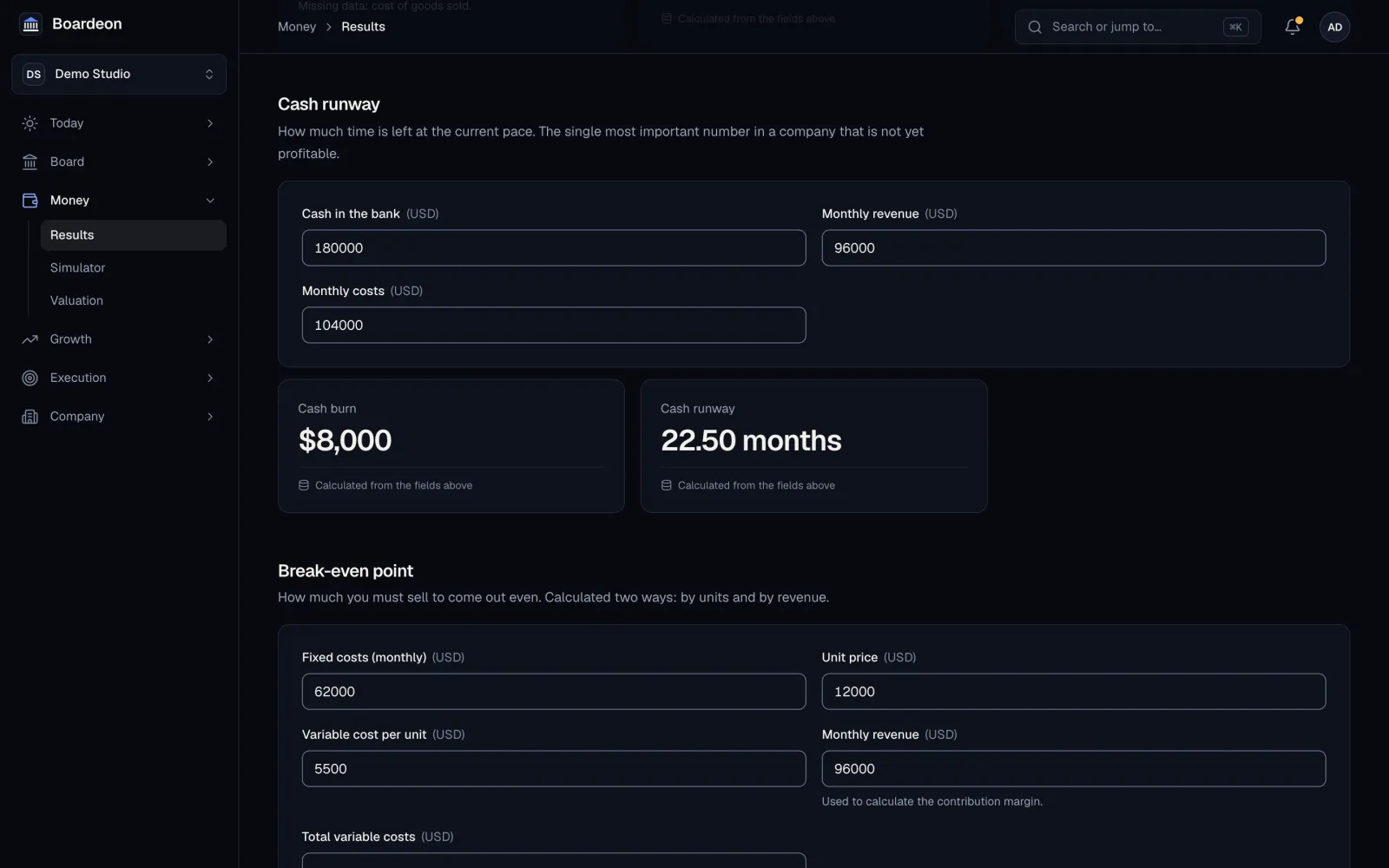
Finance
Cash flow control for small businesses: runway, burn rate and break-even explained
How owners keep control of cash: burn rate, cash runway, break-even, customer acquisition payback and a 13-week cash view — with formulas, examples and the warning thresholds.
10 min read
Read the guide
AI
Boardeon vs ChatGPT for running a company: when a general AI assistant is enough
ChatGPT is a general AI assistant; Boardeon is an AI board built on a model of your company. When each one is enough, where the numbers come from, and prices.
11 min read
Read the guide